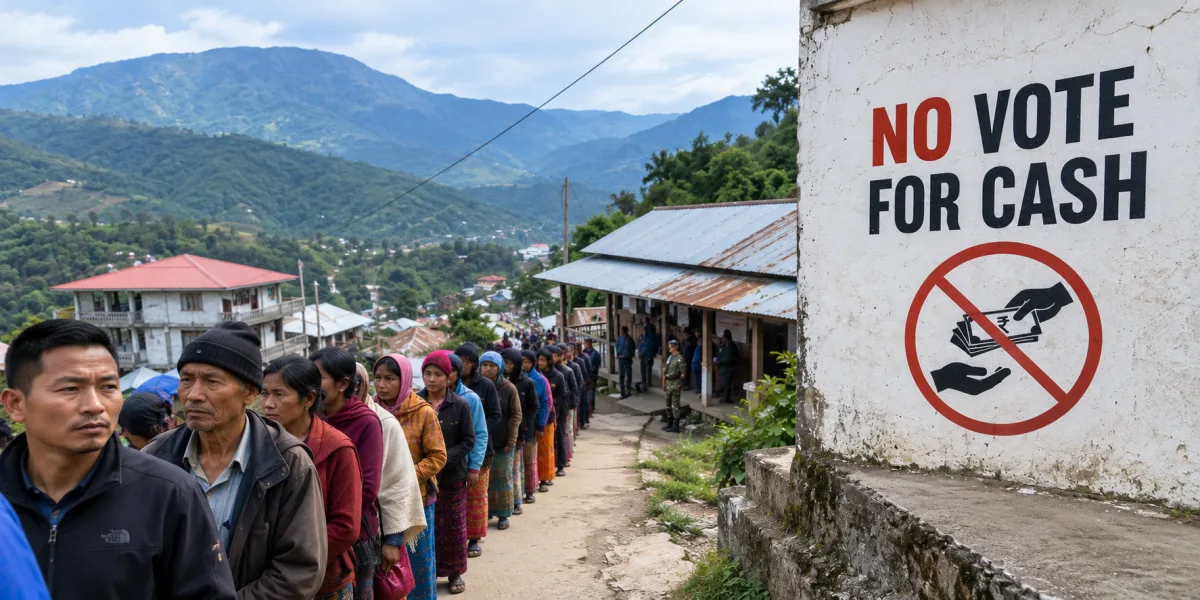
 Photo Courtesy: Representative Image
"NEWire.in editorial examines the collapse of electoral integrity in Manipur's hill constituencies ahead of the 2027 Assembly elections, documenting the gap between Rs 170 crore in seizures and zero prosecutions."
In the 2022 Manipur Assembly elections, enforcement agencies intercepted Rs 170.24 crore in cash, narcotics, liquor, and precious metals. The legal ceiling for what any candidate could spend in a constituency was Rs 28 lakh. Do the arithmetic: the seized contraband alone was worth more than six hundred times what a single candidate was legally permitted to spend. And this was only what the agencies caught.
The Election Commission of India recorded this as enforcement success. Flying Squads were deployed. Expenditure Observers landed in Imphal. The Election Seizure Management System logged every intercepted packet. Yet available public records indicate that no candidate has been publicly found to have exceeded the Rs 28 lakh limit, and no election petition alleging money power appears to have succeeded. The machinery documented the crime and filed no bill.
This is the arithmetic of impossibility that will shadow the 2027 Assembly elections, the first since the ethnic violence of May 2023 killed more than 260 people and displaced 60,000. Manipur's hill constituencies, where the violence carved de facto partition lines between valley and tribal areas, are preparing to vote again. The question is not merely who will win. It is whether democracy in those constituencies still functions as democratic deliberation, or whether it has been converted into something else entirely: a marketplace where votes are bought, chiefs broker access, and resources flow through militia camps to polling booths.
The Association for Democratic Reforms analysed the affidavits of 265 candidates who contested in 2022. Their average declared assets stood at Rs 2.55 crore. Fifty-four per cent were crorepatis. The wealthiest candidate declared Rs 7.28 crore; the legal spending cap was Rs 28 lakh. In seventeen instances, a crorepati winner defeated a non-crorepati runner-up.
These figures do not prove that anyone broke the law. Wealth is not expenditure. But they establish a structural condition that no institution has publicly addressed. A candidate with Rs 7 crore in assets and a candidate with Rs 15 lakh in assets are subject to the same spending ceiling. The discrepancy between declared wealth and legal limits is so vast that the ceiling has become a fiction maintained on paper while another economy operates beneath it.
The Election Commission knows this. Its own seizure data confirms it. According to Election Commission of India seizure data, total seizures in Manipur rose by 2,553 per cent between 2017 and 2022, from Rs 6.42 crore to Rs 170.24 crore. Narcotics dominated the 2022 haul at Rs 143.78 crore, more than 84 per cent of all seizure value. Cash seizures were a fraction, at Rs 6.14 crore. The rest included precious metals, liquor, and freebies. The Commission has not released constituency-wise breakdowns. It has not published candidate expenditure scrutiny reports. The gap between what was intercepted and what was accounted for remains unexplained.
This opacity matters because it severs the connection between documentation and accountability. An enforcement apparatus that seizes Rs 170 crore but cannot link it to specific candidates or constituencies is not failing at detection. It is failing at the next stage: the translation of evidence into consequence. The seizure data becomes a performance of vigilance rather than vigilance itself.
Behind the seizure statistics lies an institutional architecture that has concentrated electoral power in the hands of those who can monetise it. Four pillars support this structure, and each has been documented.
The first is the collapse of local self-governance. Autonomous District Council elections in Manipur's six hill districts have not been held since 2015. Their term expired in 2020. For five years, the councils functioned without electoral mandate. In June 2025, the Governor appointed Deputy Commissioners as Administrators following a recent High Court directive. The result is a democratic vacuum where development funds that should flow through elected local bodies now move through MLA channels. The Assembly election becomes the primary patronage event. Tribal voters do not elect their district councils; they depend on Assembly candidates to bring them roads, water, and employment. This centralisation of patronage at the MLA level is not an accident of administrative delay. It is a systematic failure to hold elections despite judicial compulsion, and it fundamentally alters the incentives of every candidate who contests.
The second pillar is the intersection of security payments with electoral cycles. Under the Suspension of Operations agreements signed in 2008, Kuki militant cadres in designated camps receive monthly stipends of Rs 5,000 and camp maintenance assistance. These are statutory obligations. But the Congress alleged in March 2022 that the BJP-led state government released Rs 16.6 crore to SoO groups during the Model Code of Conduct period (in force from 8 January 2022), with payments of Rs 15.7 crore on 1 February and Rs 92.6 lakh on 1 March. The Congress termed these "bribes" to influence hill-district elections. The BJP denied the charge and counter-alleged that Naga militant groups engaged in booth capturing and voter intimidation.
The third pillar is the capture of Village Authorities by wealth-based chiefly authority. Under the Manipur Village Authorities (in Hill Areas) Act of 1956, hereditary chiefs remain ex-officio chairmen of Village Authorities. Academic field research in Churachandpur district documents that chiefs "generally command in the polling booths as well." A new trend has emerged: those who can afford to procure land and gather twenty households can become de facto chiefs. As one researcher noted, the path now runs from "rich man" to "chief". Village Authorities, intended as channels for development funds, have become sites where electoral access is negotiated. The chief who controls fund flows also controls voting behaviour. The institution designed to empower villagers has been captured by those who can purchase authority.
The fourth pillar is the border political economy. Manipur shares a 398-kilometre border with Myanmar. Journalist Greeshma Kuthar, reporting from the ground, observed that "power in Manipur is profitable, the border is highly monetised. Timber entering from Myanmar, drugs, contraband of every kind, everyone gains from this business." A report by the Vivekananda International Foundation has argued that a "narco-insurgency" nexus exists, where insurgent groups require consistent funding and link with drug traffickers in the Golden Triangle (the border region of Myanmar, Laos, and Thailand). The Rs 143.78 crore in narcotics seizures during the 2022 election cycle dwarfs every other category. Whether these seizures were election-related enforcement or routine border interdiction has not been established. But the overlap between peak trafficking activity and the election calendar raises questions that no official inquiry has publicly addressed.
This architecture is not abstract. It shapes the daily choices of voters in hill constituencies.
Consider the displaced voter. Since May 2023, thousands have lived in relief camps, receiving a state-allocated Rs 80 per person per day. A person displaced from Churachandpur to Imphal, or from the valley to a hill town, faces the 2027 election as an outsider in their own state. They cannot return home. They cannot campaign freely across ethnic lines. The de facto partition of Manipur means that candidates may not be able to canvass in territories controlled by other communities. An election conducted in segregated zones is not merely difficult to monitor. It is difficult to conceptualise as a free and fair exercise.
Consider the woman in the church. The same field research found that in the Evangelical Baptist Church Convention of the Paite tribe, no woman has held the position of director or general secretary, and that church women's departments treat electoral politics as "unclean" compared to spiritual work. This is not merely a theological preference. It is a governance deficit. Tribal women have no reservation in ADCs or village councils. Only one woman has ever been elected from a hill constituency. When half the population is told that politics is sacred territory, the electorate is halved before the first vote is cast.
Consider the chief's polling booth. Academic research confirms that villagers "cannot become villagers without the Village Chief and vice versa." The welfare of the village depends on the joint endeavours of chief and villagers. But when chief-making itself has become a function of wealth, the polling booth becomes a site of economic transaction rather than democratic deliberation. The voter does not choose between policy platforms. The voter negotiates with an authority that controls both development funds and social standing.
And consider the candidate with Rs 7.28 crore in declared assets, legally permitted to spend Rs 28 lakh, competing in a constituency where the average asset base is Rs 2.55 crore. The candidate does not need to distribute cash to every voter. The candidate needs to control the channels through which voters receive everything else: roads, water, employment, security, and social recognition. Money power in Manipur's tribal constituencies operates less through direct purchase than through the capture of institutional pipelines.
The 2027 election will not resemble 2022. The ethnic violence of May 2023 has consolidated identity-based voting in ways that the pre-2023 data cannot fully predict. This changes the electoral economy. Where ethnic identity becomes the primary ballot structure, individual candidate spending may matter less than communal mobilisation. The Kuki People's Alliance won two seats in 2022 as an explicitly ethnic vehicle. The Naga People's Front has long held Naga-dominated constituencies on identity lines.
What has not changed is the institutional architecture. The ADCs remain under Administrator rule. Village Authorities remain captured. The border economy remains unregulated. The ECI's expenditure monitoring remains a seizure apparatus without transparent accountability. The post-2023 electoral economy is undocumented. The pre-2023 institutional failures are not.
The Election Commission of India, exercising its plenary powers under Article 324, must publish constituency-wise seizure data and candidate expenditure scrutiny reports for the 2022 elections immediately, and mandate the same transparency for 2027. It must investigate and publicly report whether any candidate exceeded the Rs 28 lakh ceiling, or explain why the discrepancy between declared assets and legal limits has never been addressed. Deploying Expenditure Observers is not sufficient when the public cannot see what those observers found.
The Government of Manipur must schedule and conduct ADC elections before the 2027 Assembly polls, complying with the High Court's recent directive in letter and spirit. Restoring elected local governance is not an administrative formality. It is a constitutional and statutory obligation under Article 371C and the Manipur (Hill Areas) District Councils Act, 1971, that would reduce the concentration of patronage in MLA hands. The state must also establish a transparent mechanism for SoO stipend disbursement that is automatically suspended during Model Code of Conduct periods, removing any appearance of electoral misuse of public funds.
The Union Government must direct the Ministry of Home Affairs to publish a white paper on the intersection of border drug trafficking and election financing in Northeast India, with specific attention to Manipur's 2022 narcotics seizures. Central grants-in-aid, MGNREGS funds, and Finance Commission awards to hill districts should flow through restored ADC structures rather than MLA channels alone.
Political parties must publish audited election expenditure statements for Manipur 2022 that reconcile declared spending with documented asset bases, or explain the discrepancy. The fact that every major party fielded candidates with criminal cases, ADR analysis found between 8 and 24 per cent carrying serious charges while claiming to respect the law.
Tribal civil society, building on the Youth Collective Manipur's 2022 election monitoring model, should establish systematic election monitoring networks with specific attention to women's polling booth autonomy. Church bodies should examine whether the theological barrier that treats electoral politics as "unclean" can be transcended through non-partisan voter education. The absence of church-led electoral reform in the documentary record is a gap that communities themselves must fill.
The 2027 Assembly election in Manipur will be remembered for what it tests, not merely for who wins. It will test whether a state that has seen killing of more than 260 of its own citizens and displaced 60,000 can still hold an election that qualifies as democratic deliberation. It will test whether institutions that documented Rs 170 crore in intercepted contraband can translate documentation into accountability. It will test whether the promise of tribal self-governance under Article 371C can be restored after a decade of suspension, or whether the democratic vacuum has become permanent.
The arithmetic remains impossible. Rs 2.55 crore in average candidate assets against a Rs 28 lakh ceiling. Rs 170.24 crore in seizures against zero public prosecutions. A decade without ADC elections against a High Court directive. These are not isolated failures. They are the component parts of one system, a layered architecture that has converted tribal constituencies from spaces of democratic deliberation into markets of monetised patronage.
Manipur does not need another election that is merely counted. It needs an election that is genuinely contested, where voters choose between policies rather than negotiating with chiefs, and where the Rs 28 lakh ceiling means something more than a number on a form. The 2027 election will reveal whether constitutional democracy in the hills can still be rebuilt.
— The Editorial Team, NEWire.in

Comments