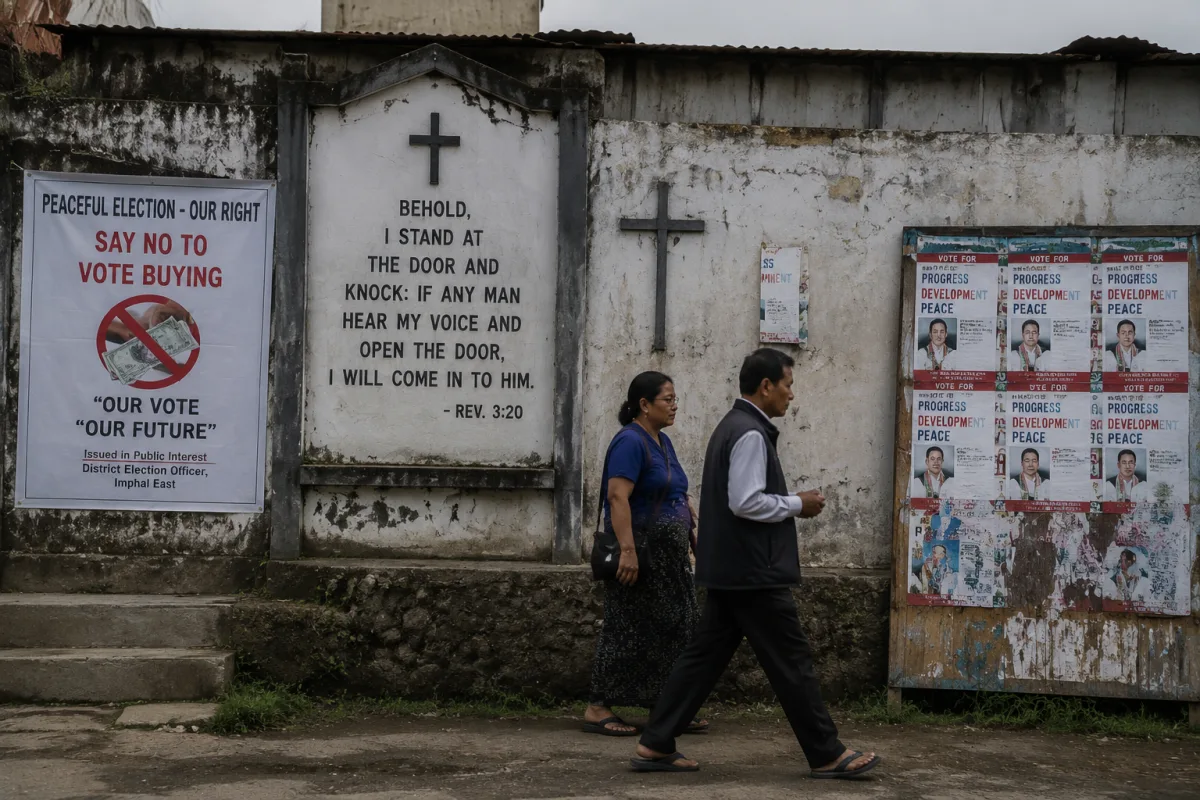
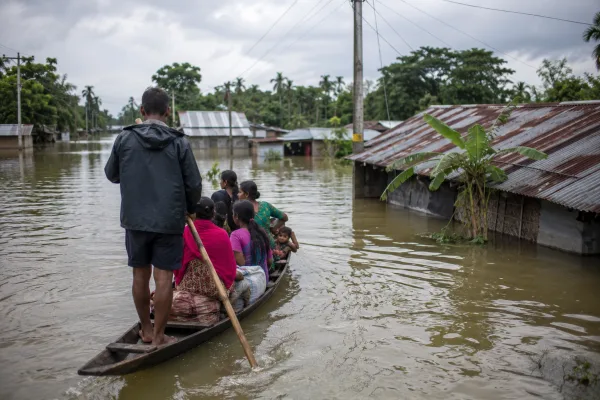
 Photo Courtesy: Representative Image
"NEWire.in Editorial Board examines the silence of Manipur's major Christian institutions on documented vote-buying in the 2022 assembly elections, linking electoral corruption to rural debt and demanding church-led voter education before the next polls."
A candidate arrives at a rural household in Manipur's hill districts with an envelope of cash. The nearest bank is a day's journey away. The moneylender has already visited twice. For this family, the offer is not a bribe. It is survival. And on the Sunday before Election Day, the church they attend will say nothing about it.
This is the documented reality of Manipur's 2022 assembly elections. Official documents record that the Election Commission of India seized Rs 167.83 crore in illicit cash and designated six constituencies as expenditure-sensitive. Election monitoring field reports document that vote-buying was rampant. Independent election observation and media reporting establish that in constituencies where candidates possessed money and muscle power, voter turnout was higher. Academic research and field surveys on rural household debt in Northeast India demonstrate that the absence of banking infrastructure makes cash offers rational survival strategies, not mere moral lapses. The choice before many voters was not between integrity and corruption. It was between debt and deeper debt.
The Bible does not mention vote-selling by name. Modern electoral democracy did not exist in its historical context. Yet published evidence supports its unambiguous condemnation of bribery. Exodus 23:8 warns that a bribe blinds the discerning and twists the words of the innocent. Deuteronomy 16:19 commands that judges shall not accept bribes, "for a bribe blinds the eyes of the wise and subverts the cause of the righteous." Proverbs calls the bribe-taker wicked. Acts records Peter's rebuke of Simon for attempting to purchase spiritual influence with money. Within Christian theological framework, selling a vote constitutes bribery, theft, greed, and injustice. Indian law agrees. Section 171B of the Indian Penal Code, 1860 (since replaced by the Bharatiya Nyaya Sanhita, 2023) criminalises both giving and accepting gratification to influence an electoral vote, punishable with imprisonment of up to one year, or fine, or both.
According to the 2011 Census of India, Christians constitute 92 per cent of the hill-district population and 41.3 per cent of the state. These communities look to their churches for moral leadership. Despite the documented scale of vote-buying, no public statement condemning the practice by the All Manipur Christian Organization, the Manipur Baptist Convention, or the Catholic Diocese of Imphal has come to the attention of this Board or entered the public record. The Editorial Board's review of public records and its requests for comment from these bodies received no response addressing vote-buying in the 2022 elections. No equivalent of the Nagaland Baptist Church Council's Clean Election Campaign, which has operated since 2012 with booklets, pledges, and public advocacy, appears to exist in Manipur. The contrast is instructive. In Nagaland, a teacher named Sensonaro stood in a polling queue advocating clean elections and her own community forced her to leave. She described Nagaland's democracy as "community democracy" where village councils dictate votes, making individual moral choice structurally difficult. Witness testimony confirms that even where the church speaks, clean voting remains arduous. Yet at least the church speaks. In Manipur, the pulpits have been silent.
The post-May 2023 ethnic violence offers a partial explanation. Multiple independent sources, including field documentation by human rights monitors and independent media reports, indicate that attackers burned over two hundred churches and that Meitei Christians faced forced re-conversions. Survival understandably consumed institutional attention. But hill churches, where the majority of Christians live, suffered less direct damage than valley congregations. The verified chronology shows that the Nagaland Baptist Church Council launched its third Clean Election Campaign in March 2022, even as candidates bought votes in Manipur. The violence does not fully account for why hill church bodies have not replicated a proven regional model. Current records suggest that even in Nagaland, where Christians dominate the state's political and administrative leadership, "Christian values are forgotten the moment people go out of Churches," as the Council's General Secretary acknowledged in 2022. That admission raises an uncomfortable question for Manipur: whether church silence is enabled by the same patronage system that distributes cash during elections, and whether institutional independence has been compromised.
The consequence is not abstract. When churches abandon electoral integrity, corrupt politicians gain moral impunity. The Comptroller and Auditor General's Audit Report on State Finances for the year ended March 2023 (tabled in 2024) documented Rs 13,984 crore in unaccounted funds in Manipur. The Editorial Board considers this unaccounted expenditure symptomatic of the same patronage system that sustains electoral cash distribution. According to analysis by the Association for Democratic Reforms and Manipur Election Watch, 91 of 173 Phase I candidates in the 2022 elections were crorepatis, and 37 (21%) had declared criminal cases against them, with 16% facing serious charges. Unaccounted public funds mean missing roads, clinics, and schools. They mean the voter who accepted cash for a ballot has traded not merely a vote, but a future.
The All Manipur Christian Organization and major hill denominations should launch explicit voter education and anti-vote-buying campaigns before the next elections, modelled on the Nagaland experience and Mizoram. Church leaders should issue pastoral letters addressing vote-selling as bribery sin and provide confession and reconciliation frameworks for voters who feel coerced.
The candidate with the envelope will return at the next election. The moneylender will not wait. What must change is whether the church, standing between them, finds its voice.
— The Editorial Team, NEWire.in

Comments