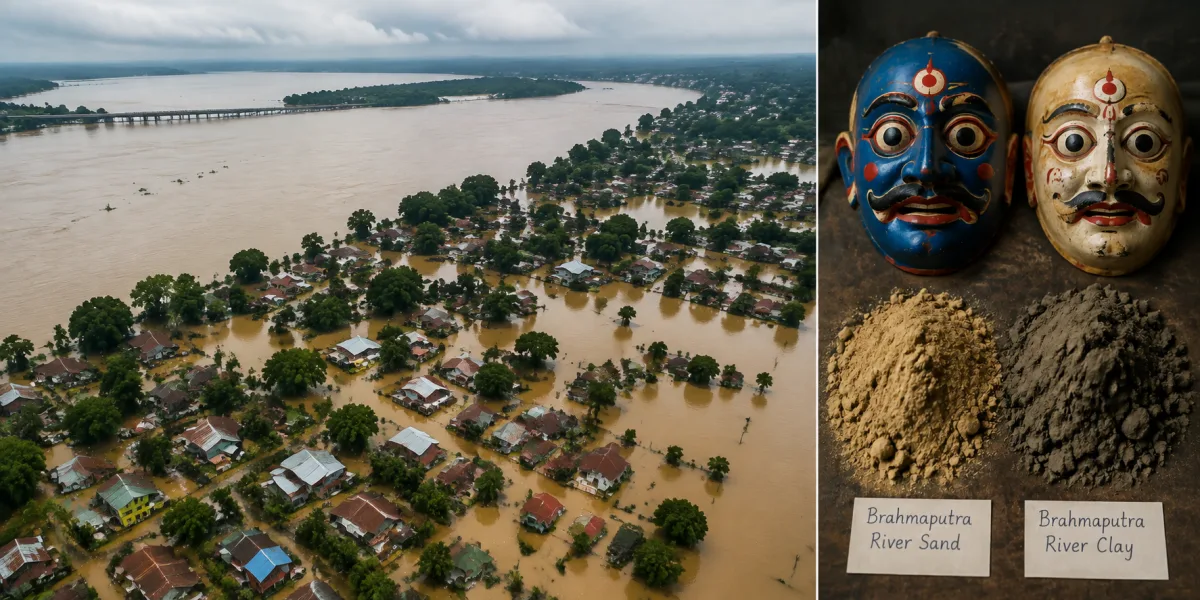
 Photo Courtesy: Representative Image
"NEWire.in editorial argues Assam's annual floods are a governance crisis, not a natural disaster, citing 46 years of ignored expert recommendations and damning CAG findings on unspent disaster funds and unauthorized expenditure."
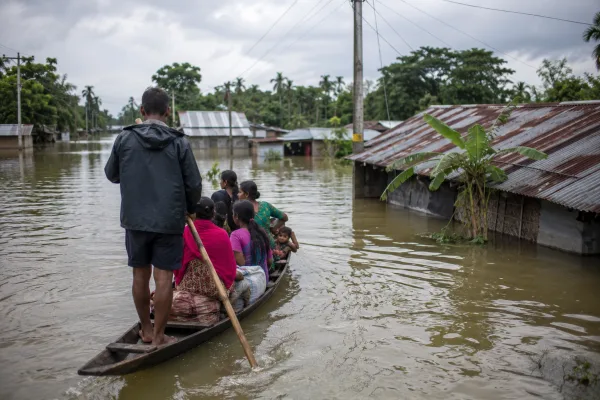
Mitali Gogoi woke to water climbing her walls. It was July 2026, in Sivasagar, a district that residents say was "not familiar with floods." Within hours, her house was submerged. There was no time to move belongings. By morning, her family was collecting drinking water from flooded roads in plastic bottles. She was one of 6.5 lakh people affected when the Brahmaputra and its tributaries breached their banks yet again. The death toll reached at least sixty-eight. Among the dead were people who had never before needed to think about embankments.
This is the geography of institutional failure. Sivasagar was not supposed to flood. Yet the Chief Minister acknowledged this July that "the character of the calamity has changed." The institutions charged with anticipating that change have had forty-six years of warning and have chosen not to listen.
Why has Assam remained trapped in annual devastation for seven decades despite statutory mandates, expert commissions, and thousands of crores in public expenditure? The answer is not in the river's natural force. It is in the institutions that have chosen, for forty-six years, to ignore their own experts.
In 1980, the National Flood Commission submitted 207 recommendations to the Government of India. The Commission examined the Brahmaputra's braided channels, its sediment load, its history of catastrophic flooding. Its conclusion was precise: indiscriminate embankments would stop silt distribution, raise riverbeds, cause drainage congestion, and ultimately worsen the very floods they were meant to control. The Commission recommended instead that Assam learn to live with its rivers through raised settlements, flood-resilient agriculture, floodplain zoning, and integrated basin management. That was forty-six years ago. Not one of those recommendations has been implemented at scale. The 1975 Model Flood Plain Zoning Bill, circulated to all states, remains unadopted by Assam fifty-one years later.
Instead, the state has built 4,473.82 kilometres of embankments. Over 60 per cent of this network, approximately 3,000 kilometres, now requires repair or reconstruction. Between 2021 and 2024, the Water Resources Department spent more than Rs 1,500 crore on 105 embankment projects. In 2024-25 alone, the government constructed 220 kilometres of new embankments while the majority of the existing system decayed. The Water Resources Minister claims the "overall flood situation is improving." The annual death tolls suggest otherwise: 124 dead in 2020, 181 in 2022, 121 in 2024, at least sixty-eight in 2026. The embankments are not controlling the floods. They are controlling the political narrative, a narrative sustained by Rs 1,500 crore in spending and 220 kilometres of new construction while the existing system rots.
The Brahmaputra Board tells its own story of statutory failure. Established by an Act of Parliament in 1980, the Board was mandated to prepare and implement master plans for flood and erosion management across the Brahmaputra and Barak valleys. Forty-six years later, no implemented master plan has been located in the public domain. The Board's own reports document nineteen embankment breaches in Majuli alone over three decades. An institution created by law to solve the problem has become a monument to the problem.
The financial record is equally damning. The Comptroller and Auditor General found that the Assam government incurred Rs 509.59 crore in expenditure during 2024-25 without any budget provision, supplementary grant, or re-appropriation order, a direct violation of Article 204 of the Constitution. The CAG also identified Rs 1,112 crore lying unutilized in the State Disaster Response Fund as of March 2025, even as flood victims waited for adequate compensation. Another 6,929 Utilisation Certificates remained pending, involving Rs 23,240.56 crore. The state's 2024 Flood Memorandum identified a gap of Rs 1,110.57 crore between actual infrastructure damage and what SDRF-NDRF norms would admit. The Centre approved Rs 313.69 crore. The arithmetic of institutional neglect is not abstract. It is measured in Rs 1,112 crore of unspent disaster money, Rs 509.59 crore of unauthorized spending, and a Rs 1,110 crore gap between what the floods destroyed and what the state is permitted to claim.
Among the invisible are the erosion-displaced. Riverbank erosion is not classified as a "natural disaster" under the Disaster Management Act, 2005. This statutory exclusion leaves nearly 500,000 historically displaced persons, those who lost 2,500 villages and eighteen towns between 1997 and 2008 alone, without rehabilitation, resettlement, or SDRF relief. A thirty-nine-year-old resident of Kayakuchi Pathar Gaon in Barpeta, living on a char (riverine island), explained the logic of normalized deprivation: "We have not been fortunate enough to enjoy the pleasure of electrification, access to proper toilets, or LPG as a primary cooking source because floods and erosion force us to relocate every year, and therefore investing in such permanent facilities becomes futile." Government schemes assume permanent habitation. The char dwellers know better.
The constitutional framework permits this evasion. Entry 17 of the State List grants Assam full authority over water, drainage, embankments, and floodplain zoning. Entry 56 of the Union List gives the Centre control over inter-state rivers. The Chief Minister states that "almost 100% of financial assistance for flood relief and erosion comes from the Central government." The Centre notes that embankments, drainage, and wetland protection fall squarely within state jurisdiction. Both are correct. Neither acts. The Constitution is not the obstacle. The obstacle is that both levels of government hide behind constitutional division to avoid accountability, constitutional evasion dressed as federalism.
The North East Water Management Authority bill, conceptualized in 2019 and touted as the "first such endeavour to find a permanent solution," has remained pending at the Prime Minister's Office for six years. A bill touted as the "first such endeavour to find a permanent solution" cannot remain in bureaucratic limbo for six years without explanation.
In Guwahati, the institutional failure is visible in concrete and garbage. The Bharalu river, which should drain the city, functions as a dumping ground. Deepor Beel, a Ramsar wetland and elephant corridor, receives untreated sewage from the city and leachate from the West Boragaon garbage dump. A railway line cuts through the elephant corridor despite National Green Tribunal objections. One citizen observed that flyovers are built before dump yards are shifted. The city floods not because the rain is extraordinary, but because the institutions that should absorb it have been sold, filled, or choked.
The Chief Minister acknowledged in July 2026 that "the character of the calamity has changed." The institutional response has not. There is no climate-resilient agriculture programme at scale. No raised housing initiative for char areas. No managed retreat. Only embankments, relief camps, and ex gratia announcements.
In Majuli, the river delivers a different kind of loss. Hem Chandra Goswami, a national award-winning mask maker at Samaguri Satra (Vaishnavite monastery), watches the Brahmaputra carry sand instead of clay. "The Brahmaputra which used to get the clay suitable for mask making now carries only lodha-matti or sand which can't be used for mask making," he said. The satras have dwindled from sixty-five to twenty-two. Ahatguri mouza (revenue unit) has been almost totally wiped out. This is not merely environmental degradation. It is civilizational loss, delivered by a river that institutions have tried to wall rather than understand.
The natural calamity narrative does not survive contact with the documentary record. The 1950 Assam-Tibet earthquake altered the Brahmaputra's morphology, and climate change is intensifying monsoon bursts. But these are intensifying factors, not explanations. The same geography existed for millennia without annual humanitarian crises of this scale. Human interventions, embankments that trap silt, wetlands that are paved, rivers that are choked have manufactured the vulnerability that nature then exploits.
The Editorial recommends six specific actions. Parliament must review the Brahmaputra Board's performance under the 1980 Act and require the Board to produce an implemented master plan within twenty-four months, or face statutory restructuring. Parliament must amend the Disaster Management Act, 2005 to recognize riverbank erosion as a natural disaster, extending SDRF and NDRF support to the nearly 500,000 permanently displaced. The Government of Assam must immediately adopt legislation based on the 1975 Model Flood Plain Zoning Bill, restricting construction in flood-prone areas and establishing enforceable wetland protection buffers. The Prime Minister's Office must either clear the NEWMA bill or provide a documented public explanation for its six-year delay. The Assam government must establish a transparent mechanism to utilize SDRF funds for disaster preparedness and mitigation, and must publicly account for the Rs 1,112 crore in unutilized funds and the Rs 509.59 crore in unauthorized expenditure identified by the CAG. Finally, the Centre and State must jointly commission an independent, published assessment of the 4,500-kilometre embankment network's net hydrological and economic benefit against the alternatives the National Flood Commission recommended in 1980.
These are not radical proposals. They are the recommendations that experts have made for nearly half a century.
A resettled resident of Molual Kalita in Majuli described the asset-erosion cycle that official statistics never capture: "Everything got washed away during the flood and for 15 days we lived in the relief camps. Finally we moved to this village with no land or house... All our savings have been used during floods and we have started all over again." He lost five bighas of land and all his cattle. He now sharecrops. His displacement is permanent, but it is not classified as a disaster. Over 3.13 lakh people entered relief camps in July 2026. The invisible thousands, those staying with relatives, those eroded out of existence, those starting over on borrowed land, do not appear in the camp arithmetic.
The question is not why the Brahmaputra floods. It is why, after forty-six years, the institutions charged with protecting Assam's citizens have not learned to do anything except build embankments, distribute relief, and wait for next year.



Comments