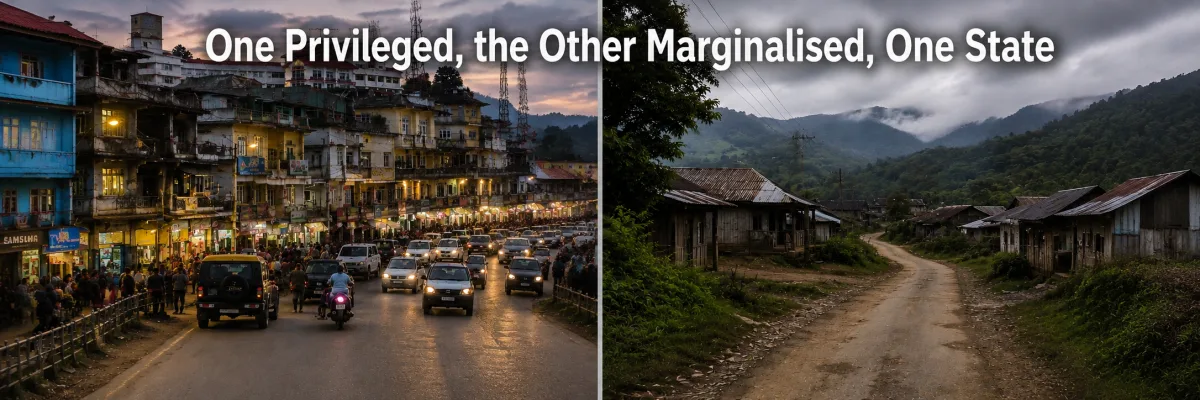
 Photo Courtesy: Representative Image
"NEWire.in editorial on FNTA's demand of legislative powers. Without which, the FNTA is toothless, not a true autonomous authority. The NTC is explicitly and vehemently opposing exactly this"
A voter in Tuensang carries roughly half the weight of a voter in Mokokchung. The 2011 Census recorded roughly 195,000 people in each district. Mokokchung elects ten members to the Nagaland Legislative Assembly. Tuensang elects four. This arithmetic has remained frozen since 1973, and it is the silent foundation beneath every argument now unfolding in Kohima and Delhi.
On February 5, 2026, the Government of India, the Government of Nagaland, and the Eastern Nagaland Peoples' Organisation signed a Memorandum of Agreement that promised to address this frozen inequality. The Frontier Nagaland Territorial Authority would cover six eastern districts. It would exercise legislative and executive powers over forty-six subjects, field a forty-nine-member body, and receive direct funding from the Centre. Legislative powers were the mechanism. They were also the sticking point.
The Nagaland Advocate General opined on February 26 that state legislation cannot confer legislative powers upon a body the state itself creates. Article 371(A), which protects Naga customary law and land ownership, is explicitly preserved by the MoA and is not in question. The state lacks competence, he advised, to delegate its own legislative authority under the Seventh Schedule. The Ministry of Home Affairs deferred the Bill on March 26 and sought the Solicitor General's opinion. That was four months ago. As of July 31, 2026, no opinion has been disclosed. No public explanation for the delay has been offered. A constitutional question that affects roughly forty-five per cent of Nagaland's indigenous population has been left to gather dust.
The state government reversed course on July 6, announcing an emergency Cabinet decision to convene a Special Session of the Legislative Assembly to enact legislation including legislative powers for the FNTA, subject to Centre approval. The Eastern Nagaland Legislators' Union participated in that meeting. Deputy Chief Minister Yanthungo Patton travelled to Delhi. The Centre reportedly promised a decision within two weeks. No Special Session has been convened. No date has been announced. A commitment made in public has dissolved into private negotiation.
Into this vacuum, the Nagaland Tribes Council has stepped with fierce opposition. Its president, Pankathung Lotha, and general secretary, Onnen Walling, have warned that legislative powers would create a "mini state" and split Nagas into "Burma Nagas, FNTA Nagas, and remaining Nagaland Nagas." The council has called the proposal "nothing short of political stupidity." The NTC represents tribes outside the six eastern districts. Its constitutional concerns deserve scrutiny. So does its political base. The tribes it speaks for have historically held disproportionate government posts, more legislative seats per capita, and greater administrative influence than the communities the FNTA would serve. Constitutional caution and the preservation of historical privilege are not always distinguishable.
The human cost of this paralysis is documented and severe. Census data from 2001 record Konyak literacy at 47.67 per cent against Ao's 83.06 per cent. A Konyak child born in that era was twice as likely to be illiterate. That child is now an adult. The gap has not closed. Employment data from 2012 show Kohima with 23,397 government staff and Mokokchung with 11,922. Longleng and Kiphire together held fewer than 4,100. The Department of Under Developed Areas was created more than two decades ago to address these deficits. It has not closed them.
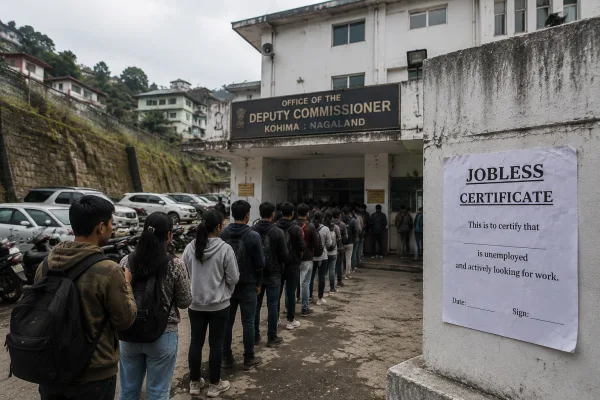
The reservation policy reserves thirty-seven per cent of posts for backward tribes, frozen since 1977 and extended indefinitely in 1989. Unfilled posts have persisted for over fifteen years. Thousands have marched in rain carrying placards that read "48 years is enough." A Konyak youth with a Class XII qualification finds the quota meant for her community sitting empty while major-tribe candidates demand graduate degrees for the same positions. She is told to wait for the 2027 Census. She has been told to wait since before her parents were born. The FNTA's legislative powers over education, health, and employment were designed to end this waiting. The waiting continues.
The constitutional question is genuine. Whether a state legislature may delegate its own List II powers to a sub-state body under Article 246 is a matter that deserves a definitive legal answer. But constitutional questions do not answer themselves. They require institutions to act. The MHA has had four months to produce or disclose the Solicitor General's opinion. The state government has had twenty-five days to name a date for the Special Session it announced. Neither has done so. What presents itself as constitutional caution has become institutional paralysis, and the citizens of eastern Nagaland are paying the price.
The Ministry of Home Affairs must disclose the Solicitor General's opinion immediately, or explain why a matter of this urgency has been buried in bureaucratic silence for one-third of a year. If state legislation is constitutionally barred, the Centre must clarify its plan B within thirty days. The Government of Nagaland must either convene the promised Special Session or offer a public explanation for its failure to do so. The draft Bill and the list of forty-six subjects must be published. The NTC must engage with the substantive provisions of the MoA rather than relying on blanket obstruction. Constitutional debate requires specific legal critique, not slogans about fragmentation.
And a voter in Tuensang continues to count for half a voter in Mokokchung, waiting for the institutions that signed a promise in February to finally honour it.
— The Editorial Team, NEWire.in

Comments