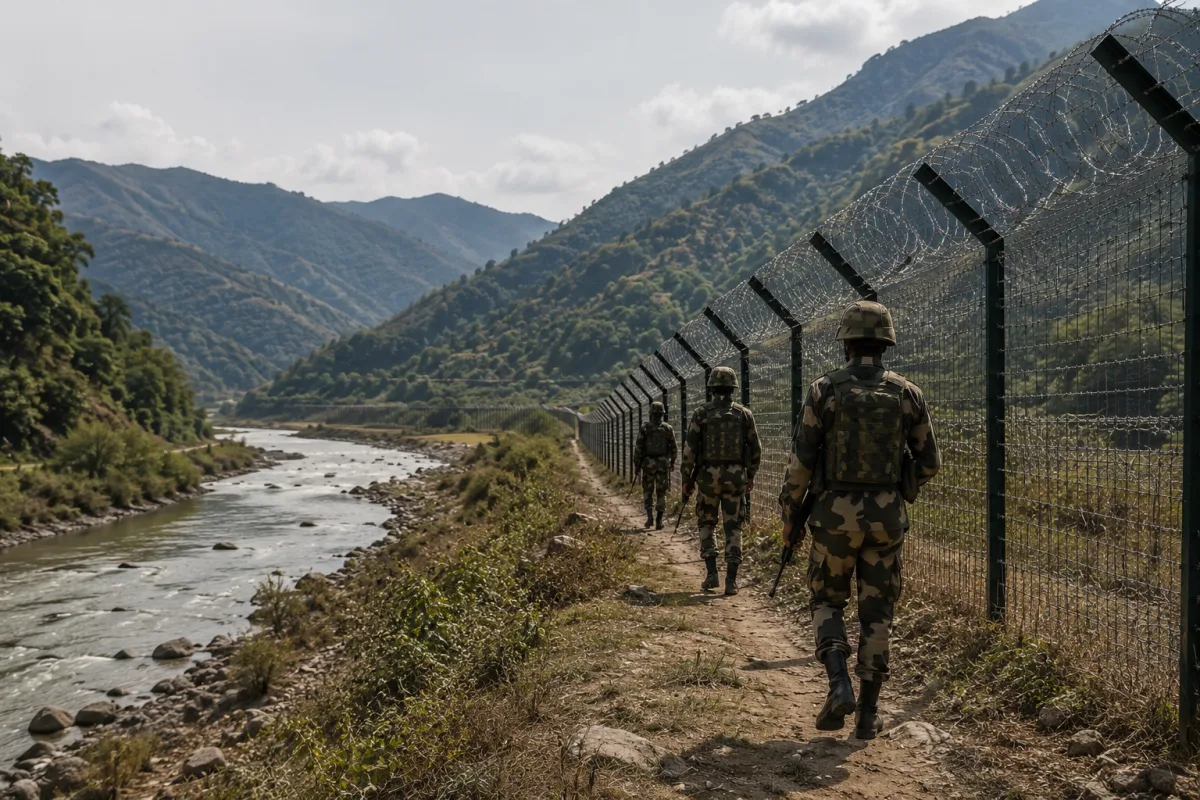
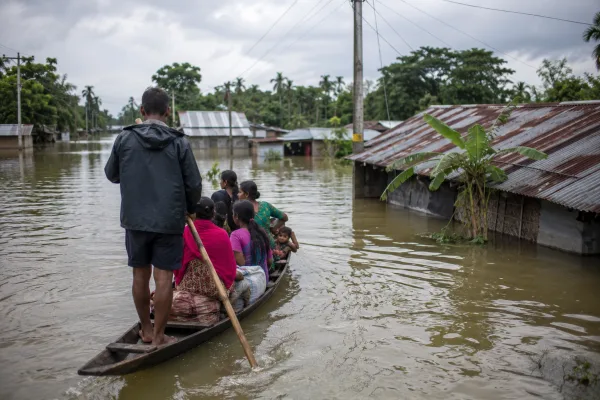
 Photo Courtesy: Representative Image
"NEWire.in's editorial argues that indigenous tribal communities deserve institutional protection, not just hospitality. Six recommendations. One warning. Read the full editorial."
The storm tore the plastic roofing from the bamboo shelter at the Trade Centre Camp in Kanan Veng, Lawngtlai district, and the Chin family inside woke to rain on their blankets. The bamboo poles creaked. The 50 GSM plastic sheeting that served as their ceiling flapped in the wind. They had crossed the Tiau River from Myanmar three years earlier, fleeing military airstrikes and the burning of churches in Chin State. Three kilometres away, a Mizo family living in a district where more than a third of the population survives below the poverty line sent their child to a government school that now enrolls refugee children with tuition waivers and free uniforms, while the host family still struggles to buy books. The Centre has provided ₹10 crore for more than 40,000 refugees across Mizoram. That is roughly ₹2,500 per person.
This is not a story about refugee cruelty. It is a story about indigenous burden. Mizoram, a state of 1.2 million people, now hosts approximately 40,000 Chin and Myanmar nationals who fled the February 2021 military coup and the atrocities that followed. That is nearly four refugees for every hundred citizens. No domestic law governs their status. No systematic census counts them. And no funding formula ensures that the indigenous tribal communities absorbing this demographic shock receive proportional support from the Centre. The Mizo family in Lawngtlai did not ask to become a border state. They are asking why they must subsidise a national security crisis with their own limited land, water, schools and firewood.
A small, poor state cannot give indefinitely before generosity becomes self-destruction. That is the reality that India's ad hoc refugee management has forced upon Mizoram. It is the same reality that Manipur answered with bullets and burning houses. And it is the reality that the Union government continues to ignore by treating refugee influx as a border security problem rather than a governance emergency.
What happened in Manipur did not begin with violence. It began with silence.
In September 2022, the Manipur government suspended the Free Movement Regime that had allowed cross-border passage along the Myanmar frontier. In February 2023, eviction drives began in Churachandpur, Kangpokpi and Tengnoupal, declaring forest dwellers encroachers on their own ancestral land. Three churches were razed in Imphal's Tribal Colony for alleged illegal construction. In April 2023, the Manipur High Court directed the state to consider Scheduled Tribe status for the Meitei community. On 3 May 2023, ethnic violence erupted between Meitei and Kuki-Zo communities. The official toll stands at 258 dead, 60,000 displaced, and 4,786 houses burnt to the ground.
The Coordinating Committee on Manipur Integrity and the United Naga Council perceived the influx as an existential challenge. The state cabinet demanded a National Register of Citizens with 1951 as the base year. The Manipur government established a State Population Commission in February 2023 and implemented the Inner Line Permit system with a 1961 cut-off date for native status. These were institutional responses to demographic anxiety. They were also accelerants. When institutions treat migration as an existential threat without data, they legitimise the violence that follows.
Mizoram is not Manipur. The ethnic geography differs. The political leadership differs. But the structural conditions are eerily similar. Both states share a porous border with Myanmar. Both have absorbed thousands of refugees since the 2021 coup. Both lack systematic migration data. Both face indigenous communities who fear that their land, their jobs and their political weight are being eroded by populations the Centre will not acknowledge, count or fund. And both operate under the same legal fiction: that in India, there are no refugees, only illegal migrants.
The legal fiction has real costs.
Under the Foreigners Act of 1946, every Myanmar national in India is classified as an illegal migrant. The Supreme Court observed in May 2025, while hearing the pending Rohingya deportation case, that if refugees are foreigners under this Act, the Centre may deal with them as the law permits. That observation stripped displaced persons of legal protection while also stripping host states of structured central support. The Act empowers the government to prohibit, regulate or restrict entry. It does not empower Mizoram to feed, house or educate 40,000 people on a state budget already stretched to breaking.
The fiscal disparity is staggering. Official records show that the Centre allocated ₹10 crore for Chin refugees in Mizoram. The Bru resettlement agreement for 6,935 families displaced from Mizoram to Tripura involved a central package of approximately ₹656 crore. That is roughly ₹1.77 lakh per Bru family against ₹2,500 per Chin refugee. The Bru settlement was procedurally necessary and morally right. But the comparison exposes a governing principle that the Northeast cannot afford: the Centre funds displacement resolution generously when it chooses to, and abandons border states to informal hospitality when it does not.
The Citizenship Amendment Act compounds the inequity. The 2019 Act provides accelerated citizenship for Christians fleeing religious persecution in Pakistan, Bangladesh and Afghanistan. A Pakistani Christian who crossed the border before 31 December 2014 has a legal pathway. A Chin Christian who fled church burnings and military airstrikes in Myanmar does not. This is legislative inconsistency dressed as national security. The CAA's September 2025 extension of the cut-off date to 31 December 2024 did not include Myanmar in its notified operational rules. The exclusion is not accidental. It is structural.
India is not a signatory to the 1951 UN Refugee Convention. The government argues that non-refoulement, the principle that refugees cannot be returned to persecution does not bind it. Petitioners before the Supreme Court counter that the principle has attained the status of customary international law. Whatever the court decides in the pending Rohingya deportation case, the legal vacuum already hurts indigenous communities most. They are the ones sharing classrooms, land and firewood with populations that the law refuses to recognise.
The indigenous communities are noticing.
In 2024, the Central Young Mizo Association passed a resolution calling for Chin refugees to be placed in compact areas. The Aizawl district administration issued an order restricting Chin land purchases and business licences. These are not the gestures of a society turning cruel. They document a hospitality model reaching its structural limit. The Mizo family in Lawngtlai does not hate the Chin family in the bamboo shelter. They compete with them for land that the Sixth Schedule reserves for tribal use, for jobs that do not exist, for classrooms that cannot expand, and for firewood that grows scarcer each winter.
Field observation reveals the pressure in granular detail. Lawngtlai district hosts a disproportionate share of the refugee population. More than a third of its indigenous residents live below the poverty line. Multiple independent sources indicate that host families have subsidised refugee care through private land, shared water and informal employment. The Mizoram government initially maintained an open-door policy, mandating school enrollment under the Right to Education Act and permitting biometric enrollment by Assam Rifles. That enrollment now covers 93.04 per cent of the documented refugee population. But enrollment is not status. Biometrics are not law. And hospitality is not a governance policy.
The Mizoram Home Minister has acknowledged what local civil society already knows. Refugees, he said, are always a burden in one way or the other. The state government prohibited birth and death certificates for illegal immigrants and refugees in February 2024. That measure may be legally defensible under the Foreigners Act. It does not solve the indigenous burden. It merely shifts the cost from documented state responsibility to undocumented community sacrifice.
The Bru precedent proves that even generous displacement resolution creates decades of tension.
In 1997, more than 40,000 Bru fled ethnic violence in Mizoram for relief camps in Tripura. They lived in temporary shelters for twenty-three years. In January 2020, a quadripartite agreement signed by the Centre, Mizoram, Tripura and Bru representatives promised permanent settlement: houses, land plots, fixed deposits of ₹4 lakh, monthly cash assistance of ₹5,000, and free rations through direct benefit transfer. By April 2026, all 6,935 eligible families had shifted. Union Home Minister Amit Shah visited Bruhapara in Dhalai district in December 2024 to review the progress.
Yet locals in Kanchanpur protested. Vehicles were torched. Bru families anxious about the lack of jhum land blocked highways over pending promises. The resettlement ended procedurally complete but socially incomplete. Independent audits found that even well-funded, centrally supervised permanent settlement creates new inter-community tensions and livelihood gaps. It took twenty-seven years to resolve a displacement crisis that began in one of India's smallest states.
If 40,000 Chin refugees remain in Mizoram indefinitely without legal status, without central funding and without a demographic plan, the state is not managing a temporary emergency. It is incubating a permanent crisis that will outlast every current government and corrode the ethnic fabric that holds the border together.
The Constitution was designed to prevent exactly this kind of unplanned demographic shock.
Article 21 guarantees the right to life to all persons, not merely citizens. But the Foreigners Act severely limits its practical protection for refugees. The Sixth Schedule reserves land and governance authority for indigenous tribal communities in Mizoram through autonomous district councils. Refugee influx directly pressures these protections by increasing competition for resources that the Constitution explicitly shields for tribal use. And Article 19 guarantees freedom of movement and residence only to citizens, a distinction the Supreme Court affirmed in May 2025 when it observed that refugees do not possess the right to settle.
Federalism demands more than policy divergence. It demands fiscal partnership. The Centre cannot claim exclusive authority over foreign borders, scrap the Free Movement Regime, impose biometric passes valid for seven days and ten kilometres, and begin fencing the 1,643-kilometre frontier while leaving the humanitarian cost to a state with 1.2 million people. The Mizoram government has gradually aligned with New Delhi on border security since the Zoram People's Movement took office in December 2023. That alignment is constitutionally legitimate. But legitimacy without funding is merely offloading.
The Naga Students' Federation has appealed to the United Nations Secretary-General against the border fencing, calling it a ploy that violates the Naga birthright to a contiguous homeland. The Zo Reunification Organisation led mass rallies in Aizawl in January 2025, burning copies of government orders. Mizo youth leaders have warned that if the Centre fences the border and ditches the Free Movement Regime, they will have no alternative but to take up arms. These protests are not merely about refugees. They are about whether the Republic respects the ethnic geography it inherited from the British.
The remedy is not sentiment. It is law.
The Union government must introduce a comprehensive domestic refugee law that establishes formal status determination, distinguishes refugees fleeing persecution from illegal economic migrants, mandates central fiscal responsibility with per-capita funding benchmarks, and protects indigenous tribal land rights through zoning and employment restrictions. The current reliance on the Foreigners Act is constitutionally and administratively inadequate.
The Ministry of Home Affairs must revise central assistance to Mizoram to reflect the actual cost of hosting 40,000 refugees. A transparent funding formula based on refugee population, host-state poverty levels and infrastructure capacity must replace the current ad hoc charity.
The Union government must conduct a systematic census of all Myanmar nationals in Mizoram, distinguishing camp residents from those in rented housing, host families and unauthorised settlements. Policy without data is negligence.
The government should establish an independent Northeast Migration Monitoring Commission comprising state representatives, indigenous tribal councils and security agencies to verify demographic data and issue early warnings before migration pressures reach ethnic breaking points. Manipur's violence was preceded by clear signals that institutional monitoring could have flagged.
The Union must address the CAA's exclusion of Myanmar Christians either by extending coverage or creating a separate humanitarian visa category for refugees fleeing documented religious persecution.
And the Mizoram government must enforce existing legal protections for indigenous tribal employment, land use and business licensing in high-refugee districts. The YMA's call for compact refugee areas should be evaluated as a zoning measure, not dismissed as xenophobia.
Assam Rifles has achieved 93.04 per cent biometric enrollment. That is administrative competence. But biometric data collection without legal status determination is surveillance masquerading as governance. The data must serve a law, not merely a border fence.
The storm that tore the roofing from the Chin family's shelter in Kanan Veng also exposed something else: the illusion that goodwill can substitute for governance. The Mizo family three kilometres away did not stop being generous. They stopped being able to afford it.
India's northeastern indigenous communities have shown extraordinary compassion for people fleeing military violence, church burnings and displacement. But compassion without law leaves both the refugee and the host unprotected. It leaves the refugee vulnerable to deportation, political manipulation and aid fragmentation. On-the-ground reporting indicates that humanitarian aid in Chin camps had dried up entirely for camps affiliated with one political faction while flowing to another. It leaves the indigenous community vulnerable to demographic anxiety, resource competition and the kind of ethnic mobilisation that turned Manipur from a border state into a battlefield.
Mizoram still has time to choose a different path. But the choice is not between hospitality and cruelty. It is between governed borders and broken communities. The Tiau River has always been more than a line on a map. For the Zo people on both sides, it is a family tie. For the Indian state, it is a national boundary. For the indigenous communities living beside it, it is becoming a test of whether the Republic will protect those who protect its frontiers.
Generosity is not a governance policy. And Manipur has already shown where generosity without governance ends.
— The Editorial Team, NEWire.in

Comments