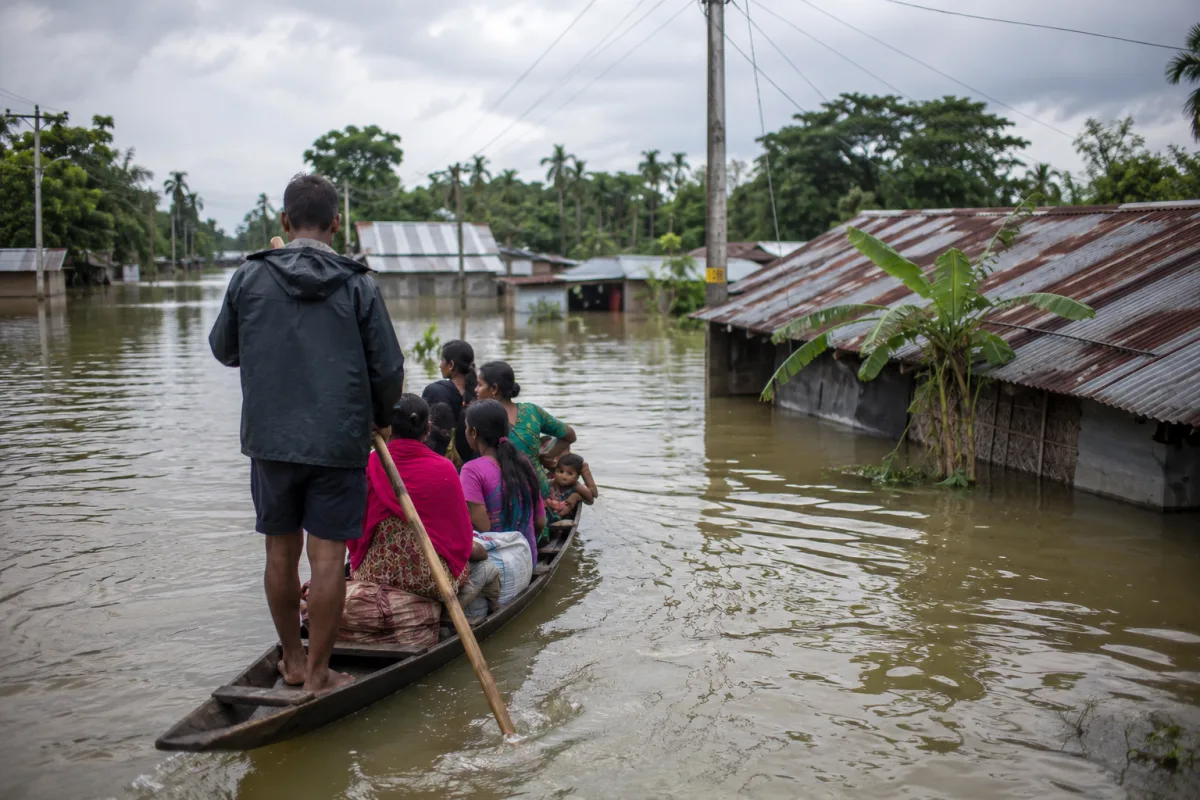
 Photo Courtesy: Representative Image
"Assam floods every year. Why doesn't the solution, and who is to blame? An investigation into 75 years of institutional failure, unutilised funds, and a 'flood economy' that profits from disaster."
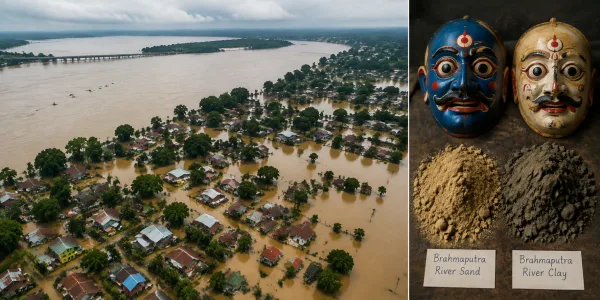
Satellite images show the river nearly tripled in width in some stretches. In Nazira, Upper Assam, families shelter on rooftops while boats move through submerged neighbourhoods. Fifty thousand people in Nazira and another thirty thousand in Sivasagar, the government has not been able to reach them with relief. More than sixty thousand households remain without electricity. Roads and bridges are gone.
Eighty-two people are dead. Forty are still missing. One lakh ninety-three thousand remain affected. Fifteen thousand four hundred and thirty hectares of cropland lie submerged. This is not an anomaly. This is Assam, every year, for seventy-five years.
The question is not whether Assam floods. The question is why the devastation is the same every year and why governments at every level have failed to stop it.
Assam sits in the floodplain of the Brahmaputra, one of the world's largest rivers. Flooding is natural to its geography. But devastation is not natural. Devastation is made by flawed policy choices, institutional negligence, political expediency, and a "flood economy" that profits from disaster rather than preventing it.
The solution has been known for seventy-five years. In 1951, the Garg Committee explicitly warned that embankments on silt-heavy rivers would "probably cause more harm than good" and "upset the land building process." The warning was ignored. Over the following decades, thousands of kilometres of embankments were constructed along the Brahmaputra, the Barak, and their tributaries. Every government since independence has perpetuated the same strategy. The result: embankments that trap sediment, raise the riverbed, and make breaches more destructive. In 2022, over four hundred breaches occurred. In July 2024, the Chief Minister claimed that "in 2004 there were 400 embankment breaches while today we have only 4." The 2026 floods have decisively contradicted that claim.
The problem is not a secret. It is documented. And it has been documented for three-quarters of a century.
The Bhogdoi embankment in Jorhat, residents say, has not undergone major repairs for more than five decades. Five decades. A single piece of infrastructure, critical to protecting lives and livelihoods, left to decay by the Water Resources Department. "It's not just water that we battle," a retired irrigation department engineer told The Statesman in 2025. "It's indifference."
That word indifference captures something that statistics cannot. The government's own CAG audit found Rs 1,112 crore unutilised under the State Disaster Response Fund. Between 2019 and 2024, Assam sought Rs 8,394 crore from the National Disaster Response Fund and received only Rs 205 crore, approximately 2.4 per cent of what was requested. The Jal Shakti Department, opposition MP Gaurav Gogoi has alleged, "is being used like an ATM", a mechanism for political distribution rather than flood prevention. Meanwhile, embankments continue to be built with temporary earthen materials by "the same contractors," as The Statesman reported, feeding what many describe as a "flood economy" that thrives on disaster rather than prevention.
The financial failure is staggering. The institutional failure is more so.
In Barkhetri, Nalbari District, residents of Doulashal village watch the Brahmaputra inch closer to the embankment every day. "Fear and uncertainty have gripped residents," the Sentinel Assam reported. Large portions of land are being washed away. Several public institutions, agricultural land, and the homesteads of hundreds of families have already been lost to the river, local residents told the Sentinel Assam. A local official offered the standard response: "The embankment must be safeguarded at any cost... Since permanent erosion-control works are difficult during the monsoon, temporary protective measures will be undertaken immediately. A comprehensive and permanent solution will be implemented during the dry season."
The dry season. Every year, the same promise. Every monsoon, the same breach. Every flood, the same displacement. For generations, as a Guwahati resident wrote to The Telegraph, "schoolchildren in Assam have written essays on 'The Floods of Assam.' Yet successive governments have done little beyond making promises."
The monsoon does not just bring rain. It brings fear, displacement, and the grim certainty that once the waters recede, families will be left to rebuild, once again, with little more than hope.
This is not a natural disaster. This is a manufactured crisis, the direct and predictable consequence of a seventy-five-year policy failure that every government has perpetuated because it serves political convenience and contractor interests better than it serves the people of Assam. The 1951 Garg Committee's warning was not obscure. It was not contested. It was ignored. The solution has never been unknown. What has been absent is the political will to act on it.
The Constitution's Article 21 protects the right to life. Yet every year, the state presides over a system that it knows will fail. When the government knows that its chosen approach fails every year, and continues that approach regardless, it is not merely making a policy error. It is failing in its constitutional duty to protect life.
The Centre's refusal to declare Assam floods a "national calamity" compounds the failure. A state that loses 2.6 million people on average every year to floods is not experiencing a seasonal inconvenience. It is experiencing an annual calamity. The refusal to recognise it as such is not bureaucratic caution. It is a form of neglect.
What should be done? The evidence is clear. The recommendations are not radical. They are remedial.
First, the Government of Assam must commission an independent review of the embankment strategy, with public release of findings within six months. The Garg Committee warned in 1951. Seventy-five years of evidence have confirmed that warning. Continuing the same approach is not policy; it is ritual.
Second, comprehensive embankment maintenance records must be published for all major embankments since 2000. The Bhogdoi embankment went fifty years without repairs. That is not an oversight. It is a choice. The public has a right to know which embankments are being maintained, and which are being neglected.
Third, the "flood economy" must be stopped. Contractor records must be audited. Bidding must be competitive. Performance guarantees must be enforced. The cycle of temporary repairs by the same contractors must end.
Fourth, the Government of India must increase NDRF allocation to Assam and must classify Assam's floods as a national calamity. Approving only 2.4 per cent of requested funds while a state loses 2.6 million people annually is not fiscal prudence. It is institutional abandonment.
Fifth, the Government of Assam must deploy the Rs 1,112 crore un-utilised under SDRF for flood resilience immediately, transparently, and effectively. Money that remains in government accounts while families lose everything is not savings. It is negligence.
Sixth, a permanent flood resilience commission must be established with multi-sectoral membership and binding authority. Seventy-five years without a permanent solution is not a problem of resources. It is a problem of institutional structure.
Seventh, affected families must be compensated fully and transparently. No further delays. The eighty-two dead, the forty missing, the one lakh ninety-three thousand still affected, they are not statistics. They are citizens. They are entitled to justice.
The editorial should make people uncomfortable, not with the editorial, but with the failure it documents. A reader in Assam should recognise the description of their world. A reader outside Assam should understand why this matters to the nation. Every rupee left unspent on flood prevention is a life put at risk. Every monsoon that passes without permanent solutions is another year of displacement and loss for millions of families.
The solution has been known for seventy-five years. The 1951 Garg Committee knew it. Hydrologists have known it. Residents of Barkhetri, Jorhat, and Nazira know it. The question is not what to do. The question is whether the people of Assam will continue to wait for a will that has not yet arrived.
The water will recede. The bodies will be counted. The relief camps will close. The promises will be made, once again, for the dry season. And the people of Assam will rebuild, once again, with little more than hope.
Hope is not a flood management strategy. Hope is what you have when institutions have failed you. It is time to stop hoping. It is time to demand what the evidence has always required: a strategy that works, institutions that act, and a government that fulfils its constitutional duty to protect the lives it has been entrusted to serve.
- The Editorial Team

Comments