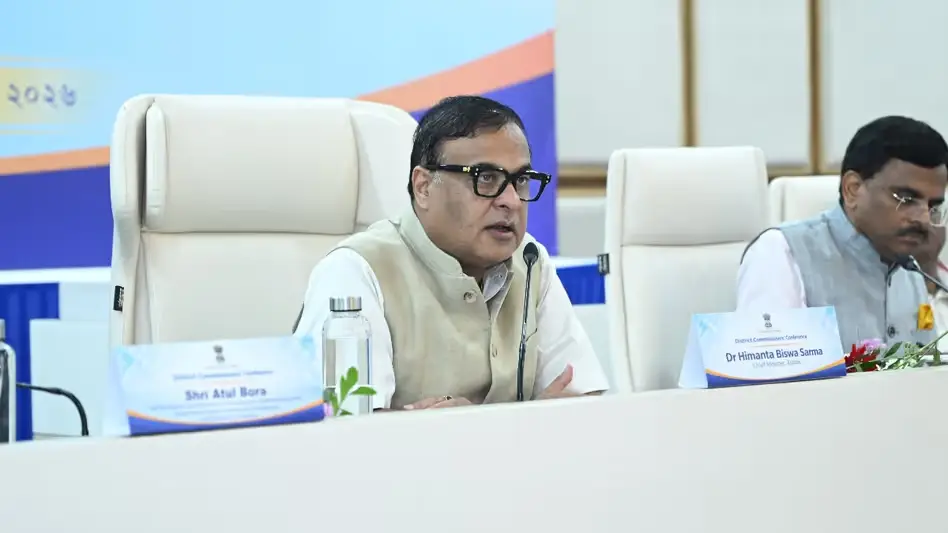
 Photo Courtesy: India Today Group
Guwahati: Assam Chief Minister Himanta Biswa Sarma ordered district commissioners to scrap colonial administrative habits. He wants them to adopt the discipline and professionalism seen in the private sector. The mandate came at the close of a two-day conference in Jorhat. Over 27 hours, officials chewed through the agendas of 15 different departments. The session wrapped up just after midnight on Monday.
Sarma leaned heavily on technology and artificial intelligence as tools for modern governance. He wants these systems baked into daily operations. Every district head must now meet with relevant departments to push state orders down to field workers without stalling. The goal is speed. Implementation must match the pace of ongoing government reforms.
The Chief Minister kept busy during the summit. He cleared more than 85 files and drafted over 34 notes and letters to dignitaries. He expects these high-level discussions to trigger real, measurable changes at the local level. District administrators carry the burden of turning these talks into actual results. "Assam's districts must compete to excel," Sarma said, challenging each commissioner to turn their territory into the finest in the country.
Updated at 16th September 2026 at 1:48am
Sarma set a firm target for public health and industry outside of the administrative overhaul. He announced that the state will open government-run drug rehabilitation centers in every district to bypass unreliable private facilities. The Chief Minister cited mounting complaints and reports of drug use inside private centers as the catalyst for the move. He also referenced the BRICS Guwahati Declaration on drugs, promising a unified push against narcotics to secure a safer future for the state.
Economic growth remains a key priority for the district heads. Sarma ordered commissioners to scout for suitable land in their jurisdictions to build industrial land banks. He noted that while investment interest in Assam is high, the lack of available land is currently a bottleneck for new factories. Aside from industry and addiction, officials also spent time during the summit mapping out improvements for the middle school education system and the broader health sector.
Updated at 16th September 2026 at 9:47am
Sarma set his sights on a Rs 50,000 crore investment injection under the Viksit Assam 2047 vision. He signaled a massive infrastructure push including new stadiums, updated school facilities, and the construction of Anganwadi centers. The state currently trails behind industrial powerhouses, holding less than 10,000 bighas for industrial use compared to the seven lakh bighas set aside by states like Gujarat and Maharashtra.
To keep the public engaged, the government will run the Seva Sankalpa Abhiyan from September 17 to October 17. The month-long drive targets Viksit Bharat and Viksit Assam themes through community competitions and honors for frontline workers like ASHA and Anganwadi staff. Officials will also host Seva Setu camps at the block level, providing a direct channel for citizens to lodge grievances and file applications.
The administrative agenda includes specific health and social targets beyond the rehab mandate. Officials are fast-tracking the conversion of 4,000 health sub-centers into hospitals and pushing ahead with the TB Mukt Bharat Abhiyan and the buildout of new medical colleges. On the education front, leaders locked in strategies to curb dropout rates at the secondary level, while flood-hit embankments and preparations for the upcoming Khel Maharan took priority.





Comments