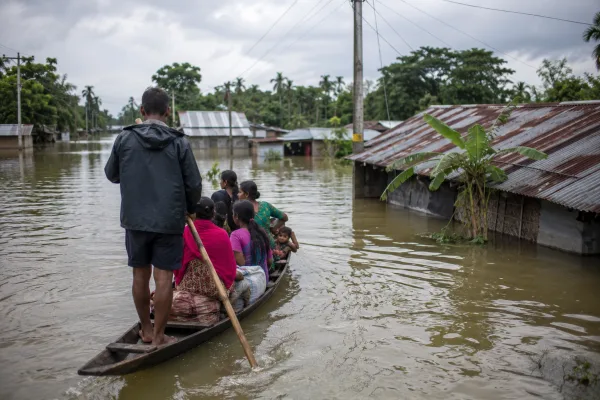
 Photo Courtesy: Representative Image
"Six Zeliangrong men abducted on 13 May took 28 days to find. On 10 October a Zeliangrong farmer was beheaded in Kangpokpi. Manipur's failure is constitutional, not merely criminal."
A state that cannot recover a severed head in its own territory has failed the first duty of the republic. Manipur's crisis is no longer only criminal. It is constitutional.
Two bodies lie in the morgue of the Jawaharlal Nehru Institute of Medical Sciences in Imphal, and one of them is incomplete. Ajinbou R., fifty-two years old, was beheaded at Makui Ashang village in Kangpokpi district on 10 October. A video purporting to show his severed head held aloft by camouflaged men has circulated across the state. The Joint Tribes Council has halted the post-mortems and given the Centre and the state government forty-eight hours, counting from 11 October, to recover the head before anything else is done. "We will not allow the state machinery to mutilate the remains further while the head is treated as a trophy by terrorists," the council said. The deadline expires even as this editorial goes to press. The head has not been found.
This standoff did not come from nowhere. On 13 May, hours after unidentified gunmen ambushed and killed three Thadou church leaders in Kangpokpi, eighteen Naga villagers were pulled from five vehicles at Leilon Vaiphei, a Kuki village, between half past ten and eleven in the morning. Women and an infant were among them. Kachiaklungliu watched her husband, the Reverend Dr. Manu Thiumai, dragged away in front of her. Within the hour, one of the six men who were kept sent his family a WhatsApp message. It was their last proof of life. Twelve captives, mostly women and children, were freed in a hostage exchange brokered by security forces on 15 May. The six men, two of them pastors, were not.
Here is the interval that indicts. The first information report was filed at Sekmai police station on 14 May, the day after the abduction, invoking sections of the Bharatiya Nyaya Sanhita covering kidnapping, secret confinement and gang membership. The families filed a complaint with the police on 21 May, fearing their men were being tortured. Yet it took twenty-eight days, a second hostage release of fourteen Kukis by Naga groups on 9 June, and a search by some 450 police, CRPF and Assam Rifles personnel with sniffer dogs and forensic teams to find the six bodies, recovered near the very village where they had been taken. Six men were abducted in daylight, along a corridor where central and state forces are deployed in strength. The state needed nearly a month to find what was taken in front of everyone.
The investigation, to be fair to it, has produced something. The National Investigation Agency re-registered the case. On 10 July, a couple was arrested at Leilon Vaiphei itself, the Director General of Police, Mukesh Singh, saying they were identified by the victims' families and established in the NIA's evidence. Two more men were arrested on 18 July. A police constable was reportedly suspended in connection with the case, in a report that remains single-sourced. Three months after the first arrests, however, the NIA has filed no public chargesheet, and no post-mortem finding has been released in either case. The four arrested are undertrials. The presumption of innocence belongs to each of them, and this editorial names no one as guilty of any killing. What can be said is plainer and worse: the evidentiary basis of the state's own case has never been tested in open court.
Consider what the official record itself shows. The Kuki National Organisation's press note of 14 May admitted holding twelve Naga civilians. It did not mention six men. The Kuki Inpi Manipur told reporters weeks later that it had "no information" about the six, even as other statements framed the crisis around Kukis detained by Naga groups. Accounts compiled from released hostages by the Manipur based media house describe village women and the village chief handing the men to cadres of the Kuki National Front, vehicles carrying spades and iron tools. Those accounts are community testimony, not court findings, and every attribution of the killings to a named armed group remains alleged. The contradiction does not require a verdict to be visible: an organisation admitted twelve and omitted six, and the bodies surfaced twenty-eight days later.
October repeated the pattern with a brutality that has moved the conflict onto new ground. Since February, fighting has spread across Ukhrul, Kamjong, Kangpokpi, Tamenglong and Noney, killing, by the available count, more than fifty people. On the night of 9 October, a twenty-two-year-old Kuki woman, a mother of five, was shot dead at Chassad. On 10 October, Sandeep Rai, a Gurkha farmer, was killed in an ambush in Ukhrul that former chief minister N. Biren Singh publicly attributed to the KRA; the group has not responded and no arrest has been made. Four Naga men, including Ajinbou R., were killed at Makui Ashang. The United Naga Council called the decapitation "savagery of the highest order," adding that it was "not just murder; it is a war crime." Those are the council's words, a civil-society characterisation and not a legal finding, but the sentiment behind them is widely held. Police and Naga bodies suspect Myanmar-based KNA (Burma) cadres in the Kamjong attacks; the identities remain unconfirmed.
Which brings the editorial to its hardest question, one the state has never answered in public. Since 2008, the Government of India has maintained Suspension of Operations agreements with twenty-five Kuki and Zomi armed groups. The Joint Tribes Council now accuses "terrorists" of "operating with impunity under the protective umbrella of the SoO agreement." The United Naga Council notes that the region hosts perhaps the highest concentration of security personnel in the country, and civilians keep dying. The Kabui Mothers' Association has alleged that the 13 May abduction occurred in the presence of security forces; that allegation is single-sourced and demands confirmation or rebuttal from the force concerned. Not one of these accusations has been examined in any published official review. No judicial finding establishes official collusion, and this editorial makes none. It observes only that the region's most representative civil bodies have put the question on record, and the record contains no answer.
Article 21 of the Constitution promises life and dignity, and the severed head is a dignity claim, not a detail. The post-mortem standoff is a genuine tension between a homicide investigation and a family's right to bury its dead whole, and it is the state's duty to resolve that tension swiftly and respectfully, not the bereaved's duty to yield to it. The same constitution, through Article 355, places on the Union the duty to ensure that every state's machinery works to protect citizens from internal disturbance. Whether that machinery is working in Manipur is no longer a rhetorical question. For when a republic cannot keep its citizens alive, whole, and buried with their heads, and cannot explain why within its own territory, the failure is constitutional in character, not merely criminal.
The failures, in other words, are documented. So, credit where it is due, is some of the conduct. Security forces brokered both hostage exchanges. The recovery operation itself was mounted at scale. The DGP put the evidentiary basis of the first arrests on the public record. Recognition of that competence is precisely what makes the surrounding silence so difficult to explain.
The remedies are specific, and they are owed now.
- One, the Government of Manipur and the Government of India must recover Ajinbou R.'s head and restore the remains to his family within days, not weeks, and report publicly on the outcome.
- Two, the NIA should file its chargesheet in the Leilon Vaiphei case without further delay and place the investigation's evidentiary basis on the public record.
- Three, the Ministry of Home Affairs should institute a time-bound, published review of the SoO framework, examining whether signatory or formerly signatory groups are implicated in the 2026 killings, and suspend SoO benefits pending review for any group credibly so implicated.
- Four, the state government should publish a protection plan for Naga villages, particularly Zeliangrong Villages in Kangpokpi and audit security deployment along the Noney-Kangpokpi-Senapati corridor, across which three killing waves have now passed.
- Five, the investigation into the 13 May murder of the three Thadou church leaders, the documented trigger of the entire escalation, should be concluded and its findings published.
- Six, the state must guarantee witness protection for the released hostages whose testimony underpins the prosecution case, because they are the case, and they are also endangered people.
On 18 July, the United Zeliangrong-pui Co-ordination Committee held a sit-in at the Rani Gaidinliu Freedom Fighter Park in Imphal, placards reading "Punish the guilty" and "Hear our call," the Kabui Mothers' Association seated in front. The six men of Leilon Vaiphei were Zeliangrong (Liangmai); the men of Makui Ashang carry Zeliangrong (Rongmei) and Zeliangrong (Liangmai) names. They are, in the truest sense, the children of Rani Gaidinliu's people, the community whose resistance to the British began on these same hills a century ago.
That community is no longer fighting an empire. It is petitioning its own republic, at the park of a freedom fighter, for the right to bury its children with their heads. A republic that cannot return a man his whole body cannot ask its citizens to trust it with their lives.
— The Editorial Team, NEWire.in

Comments