 Photo Courtesy: Representative Image
"An editorial analysis of why no institution in Manipur's tribal hill areas possesses a statutory duty to provide intra-village roads, and how the constitutional framework creates a governance vacuum filled by political patronage."
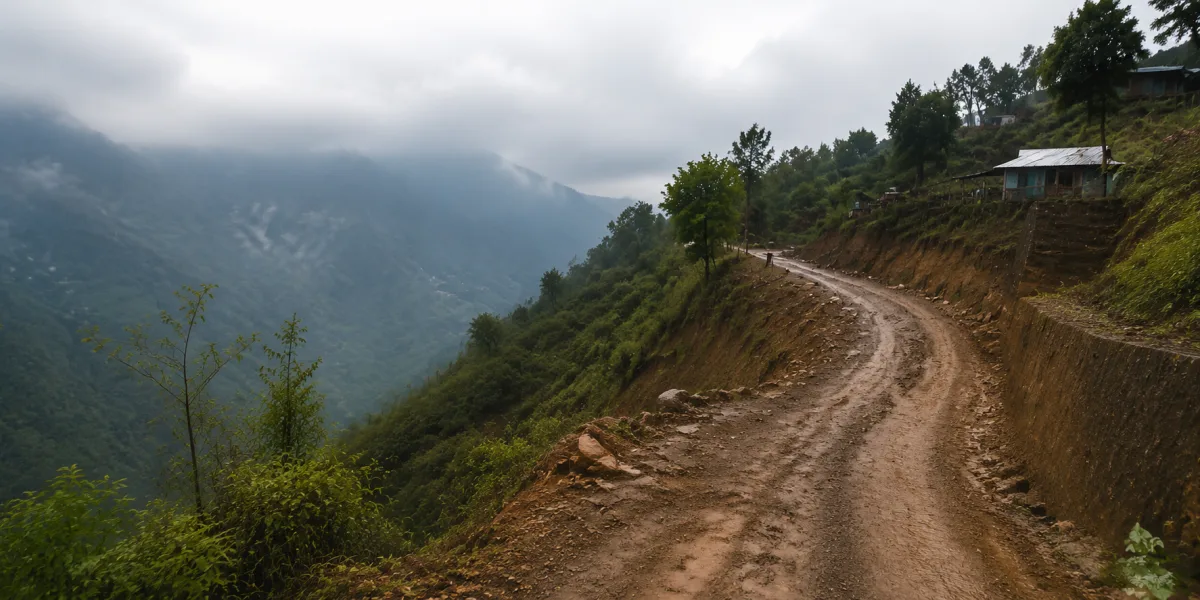
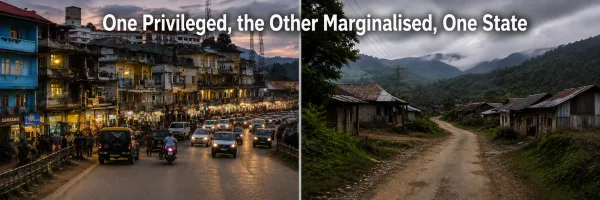
The monsoon had softened the earth for three weeks when the only motorable approach to a village in the Manipur hills finally gave way. It was not a state highway, merely a dirt track carved into the hillside years ago by the Public Works Department and left to the rain ever since. During the dry months, motorcycles and small trucks negotiated its ruts with care. Now the stream that ran beside it had undercut the foundation, and the surface had collapsed into the gorge below. Children who walked this path to the primary school would need to wade through knee-deep mud on the longer forest route. A pregnant woman requiring the sub-centre two villages over would need to be carried on a makeshift stretcher. The Village Authority chairman stood at the edge of the breach and understood, as every villager did, that his council possessed no statutory power to repair what the rain had taken. The Manipur (Village Authorities in Hill Areas) Act, 1956, assigns his office the duty to maintain law and order, to report deaths and offences to the magistrate, and to assist the police. Section 16 of that Act says nothing about roads.
The Autonomous District Council, which might have claimed some responsibility, can act only on roads formally transferred to it under Section 29(ii) of the Manipur (Hill Areas) District Councils Act, 1971. Its budget, in any case, depends on state grants that require the Administrator's sanction. The PWD subdivision office sits two districts away, staffed thinly and responsible for state highways that connect towns, not tracks that connect homesteads. And so the village waits, as hill villages across Manipur have learned to wait, for the annual list that the local Member of the Legislative Assembly submits under the MLA Local Area Development scheme. If this village was included in the MLA's quota, the track may be repaired before the next rains. If it was not, it will not. A citizen's access to his own home, his school, his clinic, becomes a question of political discretion.
This is the daily reality behind a constitutional question that few outside the hill areas examine with care. The question is not why a particular MLA has failed to deliver a road. It is why no institution in Manipur's tribal hill areas possesses a statutory duty to provide one.
That question leads to a constitutional settlement made more than five decades ago, and to the statutory architecture that followed it. When Manipur attained full statehood in 1972, the Constitution was amended to insert Article 371-C, establishing the Hill Areas Committee comprising all MLAs elected from the twenty hill constituencies. The 1972 Presidential Order defined "Scheduled Matters" on which the HAC could recommend legislation, including development planning and village administration. Roads were not explicitly listed. What the hill areas received was a committee with collective recommendatory powers. What they did not receive was the Sixth Schedule.
This distinction is decisive, and it shapes every argument about local governance in the hills today. In Assam, Meghalaya, Tripura and Mizoram, the Sixth Schedule entrusts Autonomous District Councils with explicit constitutional authority to establish, construct and manage roads, road transport and waterways. These are constitutionally entrenched powers. They do not depend on executive grace. Manipur's ADCs are not constitutional bodies. They are statutory creations of the Manipur (Hill Areas) District Councils Act, 1971, and their powers are contingent, not autonomous. Section 29(ii) permits them to construct and repair only "such of the roads, bridges, channels and buildings as may be transferred to that Council by the Administrator." Roads not formally transferred remain with the state government and its PWD.
At the village level, the 1956 Act confines the Village Authority to law-and-order and judicial functions under Section 16. A 1971 Chief Secretary's circular urged Village Authorities to "help generate peoples' effort to supplement Governmental efforts in construction," but this is an auxiliary coordinating role, not a statutory mandate for infrastructure. The Manipur Panchayati Raj Act, 1994, which empowers Zilla Parishads in the valley to construct and maintain rural roads under Section 88, explicitly excludes hill areas from its ambit under Section 1(2). The same state contains two systems of local self-government: one in which elected bodies possess statutory road-building powers in the valley, and one in which no elected body possesses them in the hills. The disparity is not accidental. It is written into the statute.
That tension between constitutional promise and executive practice was visible as recently as 2021, when the HAC drafted a Bill to strengthen district councils. But that Bill did not advance to enactment, and the available record indicates that the state government declined to table it. Article 371-C gives the HAC the right to recommend legislation; it does not oblige the government to enact it without reservation. The result is a constitutional mechanism that exists on paper but rarely alters the distribution of power on the ground.
Against this statutory background, the role of the individual MLA shrinks to its proper constitutional dimensions, and then expands again through political necessity. Under India's constitutional design, an MLA is a legislator, not a local contractor. The primary functions are lawmaking, policy debate, grievance representation, and executive oversight. There is no statutory obligation on any Manipur MLA to construct, repair or maintain intra-village roads. The MLALAD scheme, under which MLAs recommend works including village roads to the Deputy Commissioner, is discretionary capital expenditure. It is not an entitlement. The MLA recommends; the executive implements. The scheme creates a channel for political influence, not a duty of public service.
Collectively, the HAC possesses constitutional rights under Article 371-C to recommend legislation on Scheduled Matters. Paragraph 4(3) of the 1972 Presidential Order states that the HAC "shall have the right to consider and pass resolutions recommending to the Government of the State any legislation or executive action affecting the Hill Areas." This is a committee-level legislative function. It does not translate into an individual MLA's administrative obligation to pave village lanes. Yet because no other institution holds that obligation, voters naturally turn to the one person who controls discretionary funds. The MLA becomes, in effect, the only accessible point of contact for a public good that the statute has left unassigned. The constitutional office of legislator is transformed into a de facto local patronage channel.
For the ADCs, the consequences are documented in the available record. An ADC Chairman and academic studies have described them as "percentage District Councils," bodies that receive a fraction of the powers and funds necessary to govern. Without independent legislative authority, without assured revenue, and without the transfer of roads from the PWD, they remain spectators in their own districts. The state government has long characterized the weakness of local bodies as a phased devolution that is "still in process". A position the documentary record confirms it has maintained for five decades.
The same explanation has been offered for fifty years. In the valley, a Zilla Parishad member can be held accountable for road maintenance because Section 88 of the 1994 Act gives him the duty. In the hills, no elected local body carries that accountability. The PWD remains the default executive agency, distant from village-level reality, and the MLA's fund remains the only bridge between administrative absence and citizen need.
Each MLA is allocated development funds for recommendatory works, including village roads, bridges and drainage. But the allocation is an annual budgetary decision, not a statutory guarantee. Works must normally be completable within one financial year and must create durable assets. The scheme was designed to allow legislators to address local needs. In Manipur's hills, it has become the primary, and sometimes only, mechanism for village connectivity. Where the statutory framework withholds local self-government, discretionary patronage rushes in to fill the gap.
Two competing narratives obscure this structural failure, and both deserve scrutiny. The first is the popular expectation that the MLA is personally responsible for local infrastructure. This expectation is real, and it shapes electoral politics across Manipur. But it is a political convention, not a legal mandate, and its very existence is a symptom of the vacuum the statute has created. When citizens believe their only recourse is to petition an elected representative for a discretionary favour, representative democracy has been replaced by patronage politics. The voter who punishes his MLA for a washed-out road is not wrong to demand accountability. He is wrong only in believing that the accountability should rest with one individual rather than with an institution.
The second narrative holds that the ADCs already possess adequate powers and merely fail to use them. This reading does not survive contact with the text of the 1971 Act. Section 29(ii) does not grant road powers; it grants the possibility of road powers, contingent upon executive transfer. A council that must wait for the state to hand over functions and funds cannot be described as autonomous. The statutory framework renders ADCs financially dependent and administratively subordinate. The problem is not administrative incompetence. It is statutory design. The solution will not arrive through electing better MLAs or appointing more energetic council secretaries. It requires the Legislative Assembly to alter the law.
The correction must therefore be legislative and institutional, not electoral. The Manipur government should publish a comprehensive record of all roads transferred to ADCs under Section 29 of the 1971 Act, and transfer all intra-village and rural roads not classified as state highways or major district roads to the appropriate Councils with commensurate maintenance budgets. The Autonomous District Councils cannot exercise powers they do not possess, and they cannot maintain roads they do not own.
The Manipur Legislative Assembly, acting on HAC recommendations under Article 371-C, should enact legislation to strengthen ADC powers over local infrastructure. This should include independent legislative authority for local roads, revenue powers drawn from Sixth Schedule precedents, and budgetary autonomy that does not require annual executive sanction. The state government must either extend the Panchayati Raj Act, 1994 to hill areas with culturally appropriate safeguards, or create an equivalent elected local body with explicit statutory responsibility for village roads and rural infrastructure. The present exclusion under Section 1(2) creates unequal local self-government within the same state. That inequality has persisted for three decades.
The HAC should exercise its Article 371-C powers to draft and recommend comprehensive legislation on hill area governance, including a specific mandate for village road accountability. The constitutional mechanism exists. Its underutilisation serves no public interest. Finally, the state government should publish annual, constituency-wise data on MLALAD expenditure on roads versus departmental, PWD and central scheme expenditure. Citizens have a right to know whether discretionary patronage is substituting for statutory public works delivery. Transparency will not repair the roads. But it will reveal whether the institutions responsible for repairing them are functioning at all.
The monsoon will return next year. The dirt track will soften again. In some villages, the MLA will arrive with a banner, cut a ribbon for five hundred metres of paving, and depart with photographs for the annual report. The Village Authority will watch, knowing it has no power to do the work itself. The District Council will watch, knowing it has no funds to intervene. The PWD will remain two districts away, responsible for highways that bypass the village. And the constitutional question of who is actually responsible for the road beneath the villagers' feet will remain unanswered, not because the answer is complicated, but because the law has never assigned the duty to anyone at all.
A citizen's right to a road should not depend on an MLA's discretion. It should rest on an institution that the statute has made accountable. Fifty years of waiting for executive grace has produced a governance vacuum that turns basic connectivity into a political favour. The hills deserve what the valley already possesses: elected local institutions with statutory duties, independent revenues, and the power to answer to their own people. Until that happens, the ribbon-cuttings will continue, and the roads will continue to wash away.
— The Editorial Team, NEWire.in



Comments