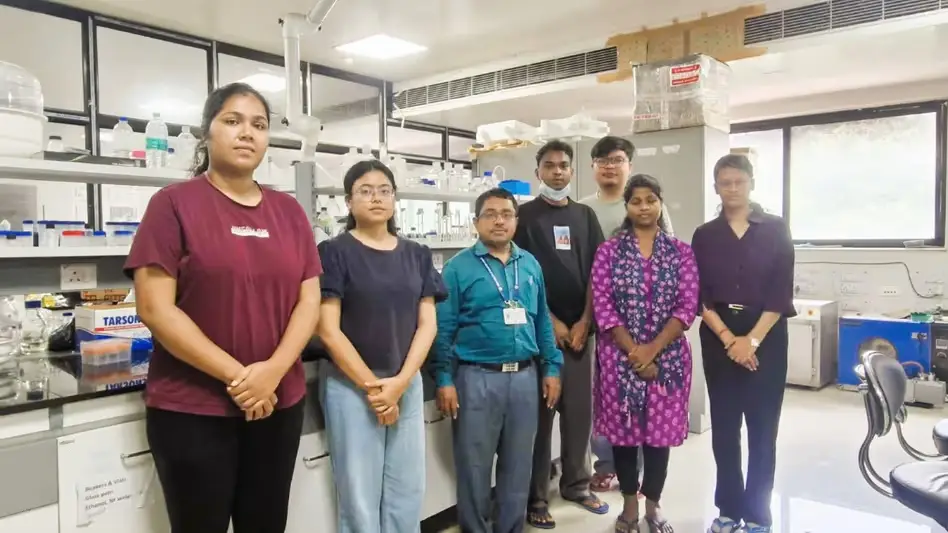
 Photo Courtesy: India Today Group
Guwahati: Researchers at IIT Guwahati have launched E-Eye, a portable optical sensor designed to detect toxicants in water and biological samples instantly. The device provides a low-cost alternative to traditional laboratory equipment. It supports the Centre's Jal Jeevan Mission by enabling on-site testing and wireless data transmission to treatment facilities.
The unit functions by triggering a chemical reaction that creates a colored compound. Optical sensors then read the color intensity to determine concentration levels. It converts these readings into digital data for immediate review.
Prof. Tapas K. Mandal of the Department of Chemical Engineering led the development. He noted the device’s precision in a statement: "Our device operates on the Beer-Lambert law and combines optical sensing with digital electronics to generate accurate quantitative measurements. Our device has successfully detected toxicants such as arsenic, lead, iron, chromium, fluoride, and Escherichia coli bacteria."
The prototype costs roughly Rs 3,500 to produce, with individual tests running about Rs 2. Testing on 2,700 samples confirmed the device performs as well as standard UV-Visible and Atomic Absorption Spectrophotometers. Beyond water, it can screen milk, soil, vegetables, tea, and industrial effluents.
Co-author Prof. Harshal B. Nemade of the Department of Electronics and Electrical Engineering stated the tech serves government agencies and private industries alike. The project received funding from the Ministry of Electronics and Information Technology. To push the product to market, the team formed a startup called ENVIONIX Labs Pvt. Ltd.
Future updates include solar power integration and cloud connectivity. Researchers published these findings in the IEEE Sensors Journal. The research team included Shrikant Kashyap, Smriti Sachan, Neha Majee, Maitrayee Bhuyan, and Humayun Kabir.





Comments