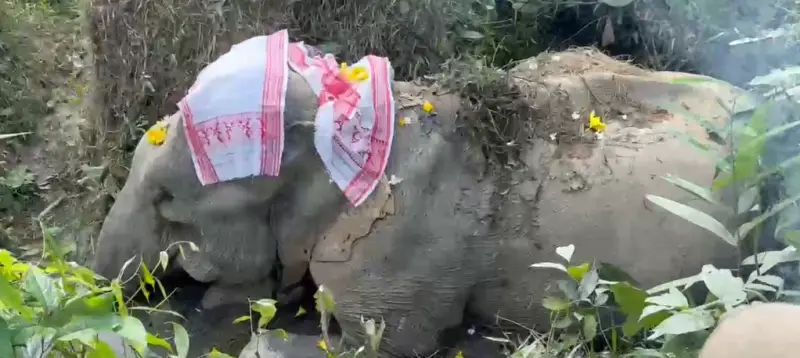
 Photo Courtesy: nenow
Guwahati: A pregnant wild Asian elephant died in Assam’s Golaghat district, sparking outrage over state negligence. The elephant, named Durga, died on August 17 in the Doigrung area of Numaligarh. She carried a 20-kg malfunctioning radio collar. A post-mortem examination confirmed she was carrying a nearly fully developed calf.
Conservationists and locals want answers. They claim officials ignored repeated warnings about the animal's failing health. Elephant Monitors Assam stated they campaigned since March to remove the restrictive collar and provide treatment. In January, a government vet acknowledged the elephant was sick. By March 27, the Golaghat Divisional Forest Officer, Mukutchandra Das, labeled the animal healthy. He refused help.
The activists took their fight to the top. They petitioned Chief Wildlife Warden Vinay Gupta on April 5 and Khumtai MLA Mrinal Saikia on April 14. They followed up with the DFO on May 24 and met Assam Forest Minister Jayanta Malla Baruah on June 19. None of these actions triggered a response.
The group noted the failure clearly. "Despite our best efforts to alert the authorities, there was no effective intervention," the organization said. By August 14, Durga passed blood in her urine and stopped eating. Her condition turned critical on August 15. A team from the Centre for Wildlife Rehabilitation and Conservation, led by Dr. Bhaskar Choudhury, examined her. They claimed the elephant would recover and provided no treatment.
The Gaja Mitra Group, based in Bokial, sent a formal complaint to Chief Minister Himanta Biswa Sarma on August 19. They allege the animal suffered for 18 months while forest staff visited only to take photographs. Durga died at 1:30 pm on August 17. The department buried her in the tea garden.
Critics now demand a high-level probe. They argue that the state failed its duties to a Schedule I species. The incident forces a rethink of how authorities monitor wild elephants using radio collars. Activists insist this was not an isolated failure.
Updated at 22nd August 2026 at 5:49pm
Activists claim that local residents in the Numaligarh area stepped in to feed the animal while she languished in the tea garden, filling a gap left by the Forest Department. The Gaja Mitra Group added that the department’s veterinary teams periodically visited the site but failed to provide actual medical care, treating their visits more like photo opportunities than professional welfare checks.
Beyond immediate calls for a probe, wildlife advocates are pushing for an overhaul of state policy. They want strict, codified protocols for how the department installs and monitors radio collars, especially when a tagged animal shows clear, documented signs of failing health.





Comments