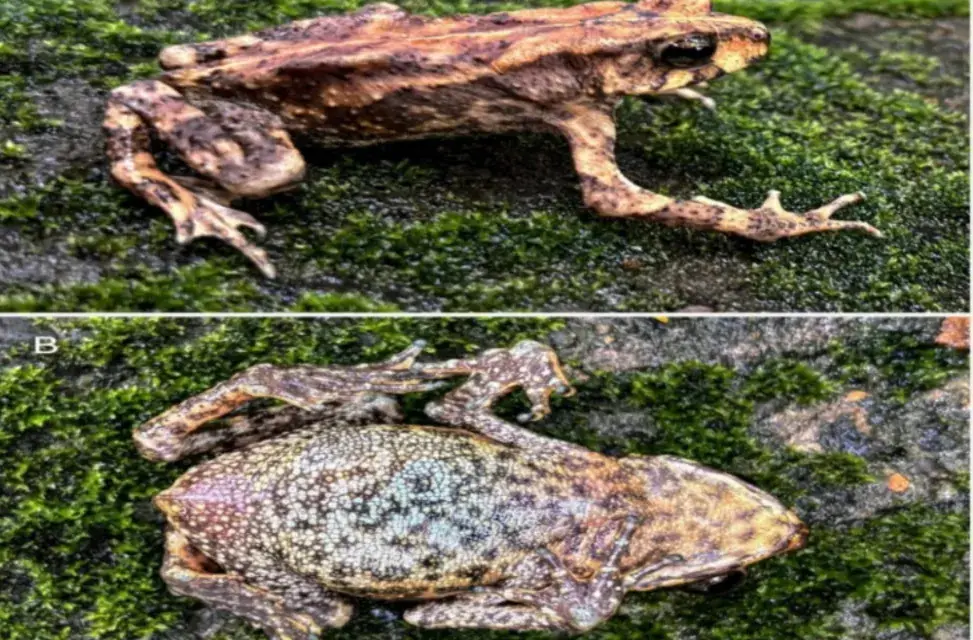
 Photo Courtesy: nenow
Aizawl: Scientists discovered a new montane toad species, Duttaphrynus phawngpui, tucked away in the high-elevation forests of Mizoram. The team found the specimens 2,144 meters above sea level within the Lawngtlai district’s Phawngpui National Park, often called Blue Mountain. It is a big find. Researchers from Mizoram University, Assam Don Bosco University, Indonesia, and Help Earth, Guwahati, published the results in Taprobanica.
The study authors include Malsawm Dawngliana, Holiness Warjri, A. A. Thasun Amarasinghe, Amit K. Bal, Vanlal Hruaia, Mara D. Hlychho, Hmar T. Lalremsanga, Mathipi Vabeiryureilai, and Jayaditya Purkayastha. They confirmed the toad as a distinct evolutionary lineage through physical measurements and mitochondrial DNA analysis. The 16S sequence data showed a 3.8% to 5.5% divergence from close relatives. Morphometric testing showed a clear cluster separation from D. stuarti, D. chandai, and D. dhara, with the first two principal components explaining 94% of the variation.
The toad measures between 47.72 and 56.26 mm in snout-to-vent length. Physical traits include an indistinct tympanum, moderate toe webbing, and skin covered in glandular warts. A thin, pale mid-dorsal stripe marks its yellowish-brown back, while the underside features dark marbling on cream skin. Experts spotted the toads on the forest floor, living among leaf litter in humid bamboo patches and shrubs. They likely hunt small invertebrates at night.
Conservation status remains unclear. Because the toad is known only from one spot, experts cannot yet define its population size or full geographic range. The team noted, "The researchers said there is not enough information on its population size, wider distribution or ecological requirements to assess its conservation status." They are calling for urgent, wider surveys across southern Mizoram. The team warned that these high-altitude sky islands face threats from warming temperatures, which could force species into shrinking habitats at higher elevations.





Comments