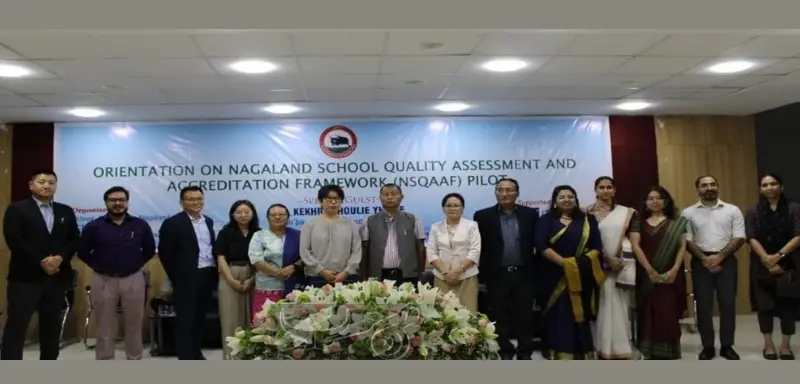
 Photo Courtesy: nenow
Kohima: Nagaland has achieved a teacher-student ratio of 1:12, a figure Adviser to School Education Kekhrielhoulie Yhome recently described as very healthy. The state currently maintains approximately 1,900 government schools, 880 private institutions, and a dozen central schools staffed by about 34,000 teachers.
Speaking at an orientation programme in Kohima, Yhome addressed the difficulties faced by schools with low enrollment numbers. To manage these operational challenges, the government is amalgamating underutilized schools while simultaneously restructuring the system to protect the Right to Education for local students. He noted that the government is opening new schools and regulating existing ones through a systematic reauthorisation process.
The state is also launching the Nagaland School Quality Assessment and Accreditation Framework, a pilot project backed by the Central Square Foundation. This initiative includes 100 schools, split evenly between public and private sectors, to evaluate performance across five specific domains: administration, curriculum, assessment, infrastructure, and inclusiveness. Yhome urged participants to view this as a development opportunity, stating, "The new framework would help schools understand their strengths and areas for improvement through a structured assessment across these five key domains."
Kevileno Angami, Commissioner and Secretary of School Education, explained that the framework introduces standardized criteria to assess quality and performance consistently across all institutions. Unlike temporary measures, this programme will eventually operate under a permanent, independent regulatory body to ensure ongoing academic improvements across the state.




Comments