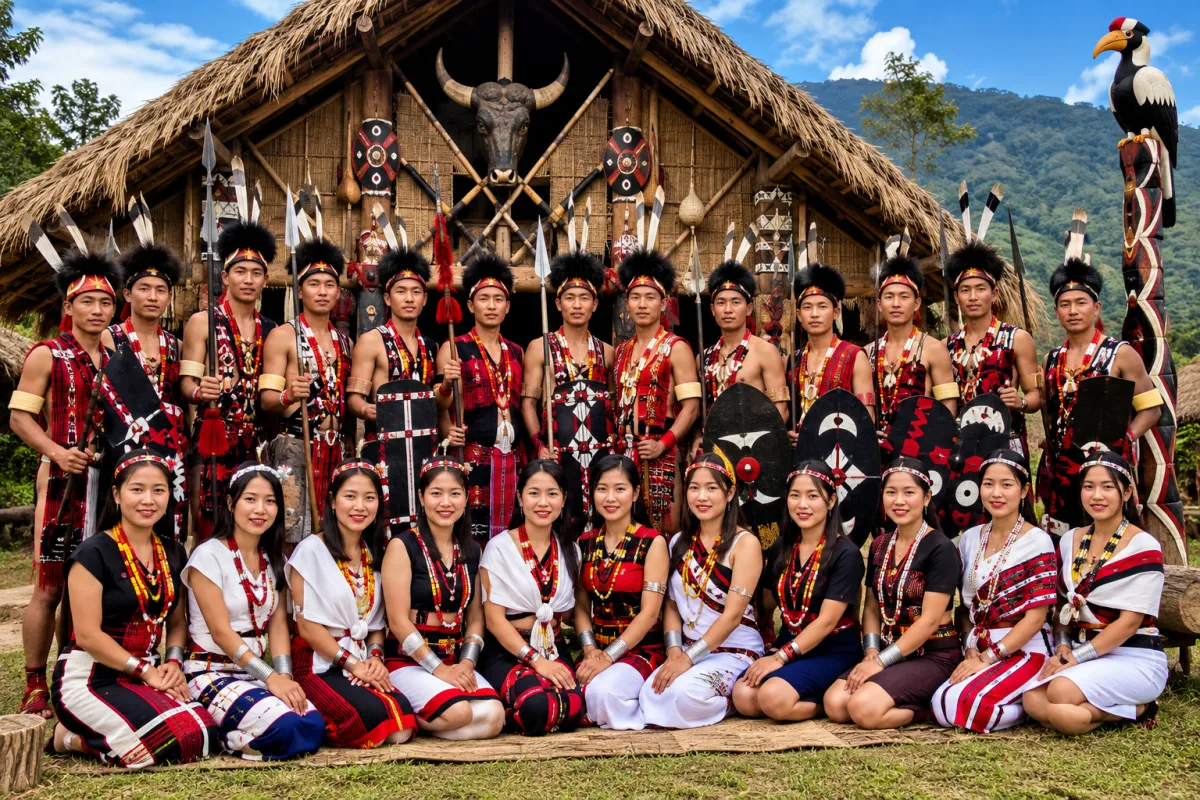
Imphal: In recent years, the phrase "Kacha Naga" has been adopted by some individuals from Kuki communities to describe the Nagas from Manipur. This terminology suggests a limited familiarity with Naga history among some members of Kuki communities, many of whom settled in India more recently and may not have had extensive exposure to Naga historical scholarship. The use of the term "kacha" in this manner appears to stem from an incomplete understanding of its origins.
It is believed that Kuki groups refrain from using the term "Naga" due to a fear of addressing the Naga community, which encompasses Nagas from Manipur, Nagaland, and Assam. Instead, they prefer the term "Kacha Naga" to specifically denote Nagas in Manipur, thus establishing a distinction within the broader Naga community.They always seem to play tactical games and the victim card while trying to create divisions among the Nagas by using different labels, sometimes mentioning only Kacha naga, Tangkhul and Liangmai instead of referring to the Naga community inclusively.They are afraid to called Nagas, reluctant to refer to as Nagas.
Before the British arrived in the Naga Hills, there was no concept of "Kacha Naga". Among the Nagas, there has never been any distinction such as "Paka Naga" or "Kacha Naga." Every Naga tribe has traditionally enjoyed equal social, political, and cultural rights, with equal dignity and mutual respect. Naga society does not divide people into privileged or underprivileged groups based on birth or tribal identity. There is no privileged or underprivileged group, no superior or inferior tribe. During the British colonial period, when officials conducted surveys and census operations, they asked local people about the communities living beyond the mountains and deep forests. The locals explained that some Naga groups lived beyond the mountains in the thick forests. The Angami word Ketsa, meaning "thick forest," was used to describe those areas. It refers to the Zeliangrong people (Zeme, Liangmai, and Rongmei), who traditionally inhabited the dense forests and hilly regions of Manipur, Nagaland, and Assam. They have occupied one of the largest contiguous Naga ancestral territories across these three states and are among the largest Naga communities by population.
As the British were not native speakers of the local languages, they frequently misheard and altered indigenous words. Over time, the Angami word Ketsa was recorded and pronounced by British officials as "Kacha." Like many other Indian names and terms that were changed during the colonial period. For example, the Hindi word "sipahi" (soldier) became "sepoy" in British English. Similarly, many indigenous names and terms were recorded with altered spellings or pronunciations.
The term "Kacha Naga" was never a term used by the Nagas to classify themselves. It was a colonial label that emerged from linguistic misunderstanding rather than from Naga tradition.
Outsiders should first understand Naga society before using terms such as "kacha Naga" or "pakka Naga." Such concepts do not exist in Naga society. There is no hierarchy that classifies one Naga tribe as superior or another as inferior. Unlike the caste hierarchy historically associated with parts of Hindu society, traditional Naga society does not divide people into higher or lower groups. All Nagas are equal, and every tribe enjoys the same dignity, social status, rights, and respect. No Naga is superior or inferior by birth or tribal identity.
Naga society does not recognize upper or lower castes among Nagas. Our identity is based on mutual respect, equality, and shared heritage. I urge members of Kuki communities, and all those who have more recently settled in India, to understand Naga society in its own context rather than through assumptions or labels that do not reflect our traditions.




Comments