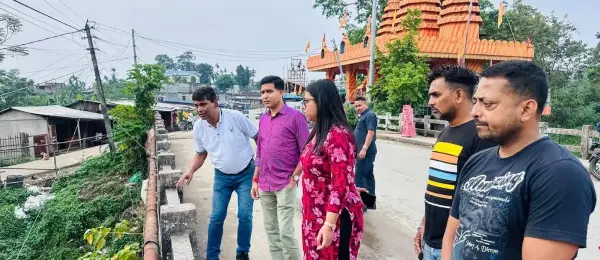
 Photo Courtesy: nenow
Guwahati: Assam is drowning. The latest surge, peaking between 19 and 22 July 2026, submerged the Sivasagar, Charaideo, and Jorhat districts under a wall of water. By 6 August, the death toll reached 97, though Congress leader Ripun Bora claims the number is already 99 and rising. Many bodies remain unrecovered. "So far, 99 people have died as per the official report. But the figure may be higher, and there are still many dead bodies that have not been recovered," Bora said.
The devastation hit hardest in Nepalikhuti. On 19 July, the Dikhow river surged, sweeping away nearly 200 homes in less than one hour. Extreme rainfall in the Nagaland hills triggered the disaster. Between 18 and 20 July, Charaideo saw 436 percent more rain than normal, while Sivasagar saw 134 percent. Experts suspect a landslide lake outburst flood, or LLOF, as debris likely blocked a stream before bursting downstream.
Assam remains perennially fragile. 39.58 percent of the state is flood-prone. Since 1950, riverbank erosion has consumed 4,270 square kilometers of land. The world’s largest river island, Majuli, has lost 35.5 percent of its area since 1915. Annual flood damages are estimated at Rs 3,500 crore, but real economic losses likely exceed Rs 10,000 crore yearly.
Infrastructure is failing. The state’s 4,474 kilometers of earthen embankments are mostly over 50 years old and prone to breaches. While the government proposed 50 storage ponds in 2016, the massive land requirements make the plan impractical. Meanwhile, Congress alleges the state government’s response has been incompetent. Bora claims relief is minimal and that corruption has led to the looting of essential supplies, leaving private citizens to cover the gap.
Critics of hydropower projects are misguided, according to the Thatte-Reddy Committee. The panel noted: "Agitating against a dam while demanding flood control is self-defeating." Projects like the Dibang Multipurpose Project reserve significant capacity to cushion flood peaks. Long-term survival for Assam demands modern engineering, robust early-warning systems, and large-scale reservoirs to manage the Brahmaputra’s volatile tributaries. Piecemeal relief is not a substitute for permanent protection.
Updated at 10th August 2026 at 1:47am
The death toll climbed to 100 by August 9 following two more drownings in Golaghat and Karbi Anglong. While the total number of affected people dropped slightly to roughly 1.37 lakh, over 49,000 residents are packed into 125 relief camps. Agriculture remains hammered, with nearly 12,000 hectares of cropland ruined and over 43,000 domestic animals and poultry caught in the deluge.
As the waters recede, the Assam State Museum has deployed experts to Nazira, Sivasagar, and Charaideo to survey damaged cultural artifacts and historic sites. The team is racing to document the decay and perform emergency conservation on relics waterlogged by the floods, calling on locals to report any ruined heritage objects that require immediate attention.
Frustrated by broken communication lines, local tech workers launched a platform called Axom Relief to map requests from isolated villages that were invisible to state agencies. The platform helped bridge the gap by channeling specific aid, such as boats or medical supplies, directly to cut-off areas. Another tool, Jabor, is now being used to track waste management issues in relief camps, turning the spotlight on the garbage left behind by the influx of aid supplies.
Updated at 10th August 2026 at 9:48am
The state flood toll hit 100 on August 9 after two more drownings in Golaghat and Karbi Anglong. While water levels dropped slightly, the disaster still grips seven districts, with 1.37 lakh people struggling to survive. Nearly 50,000 residents remain huddled in 125 state-run relief camps, while 12,000 hectares of farmland and over 43,000 head of livestock and poultry are lost to the mud.
A failure in the state cell broadcast alert system meant most residents in Upper Assam received no warning before the water hit. In the chaos, tech workers launched Axom Relief to bypass broken communication lines. The platform ditches registration logins for speed, allowing victims with poor mobile data to tag their exact location and request specific aid like boats or medical supplies. It successfully logged 150 registrations, proving that help existed but often failed to reach villages just two kilometres off the main roads.
As the surge dies down, a second tool called Jabor is tracking the fallout in relief camps. The software lets users anonymously flag garbage piles, automatically emailing local MLAs and municipal offices to force a response. The move targets a grim secondary crisis: tonnes of plastic bottles and food packaging dumped by aid convoys into the very floodwaters that brought the misery in the first place.
Updated at 10th August 2026 at 2:03pm
Museum experts are on the ground in Nazira, Sivasagar, and Charaideo through August 12 to perform emergency conservation work. The team is not just documenting decay. They are actively applying protective measures to waterlogged relics and historical sites to halt further rot after prolonged submersion.
The Assam State Museum is asking locals to flag damaged heritage items. They hope to identify and stabilize private or institutional collections that might otherwise be lost if left to sit in the damp.
Updated at 11th August 2026 at 1:50am
The flood death toll hit 101 by August 10 as the disaster footprint expanded. While previous reports focused on seven districts, the Disaster Reporting and Information Management System now tracks chaos across 10, adding Hojai, Lakhimpur, and Cachar to the list of impacted areas. Golaghat remains the epicenter with over 71,000 people struggling in the wake of the surge.
As of late August 10, the number of residents huddled in government relief camps dropped to 8,447. The damage tally includes 532 houses either fully destroyed or partially mangled, alongside 28 other structural losses. Transportation is fraying under the pressure, with 24 stretches of road and a bridge in the Amguri circle of Sivasagar giving way to the currents.
Rescue crews have scrambled to keep pace, deploying 58 boats to pull 40 stranded people to safety. Mobile medical teams have set up shop in four locations to manage the fallout, while authorities continue to track the Dhansiri and Kushiyara rivers, which remain stubbornly above danger levels.
Updated at 11th August 2026 at 9:47am
The disaster footprint expanded further by August 10. The Assam Flood Report now confirms 10 districts are grappling with the deluge, specifically adding Nagaon, Darrang, and others to the ongoing crisis. Across 25 revenue circles and 458 villages, 1,26,431 people are reeling from the impact.
Golaghat remains the hardest hit, accounting for over 71,000 of the affected population. Nagaon also reports significant crop losses, with over 4,194 hectares of farmland submerged in that district alone. In total, 11,287 hectares of crops have been ruined across the state. Authorities are currently managing 89 relief camps and distribution centers to house the 8,447 displaced residents, including 3,648 men, 3,593 women, and 1,143 children.
Structural damage continues to climb. The official count lists 168 houses fully destroyed, 364 partially damaged, and 28 other structures ruined. Beyond the widespread road damage and the bridge failure in Sivasagar, engineers report an embankment breach in the Samaguri circle of Nagaon. While the Dhansiri and Kushiyara rivers remain a threat, the Central Water Commission confirms no rivers have yet reached their highest recorded flood levels.
Updated at 11th August 2026 at 1:50pm
Education Minister Ranoj Pegu announced that classes in Sivasagar, Nazira, and Charaideo will stay offline until at least August 15. More than 150 schools across the region remain unusable, buried under thick layers of mud and silt or still sitting in standing water.
The Education Department is currently scrambling to assess the wreckage. Restoring the campuses requires a massive cleanup effort before classrooms can be considered safe for students to return.
Updated at 11th August 2026 at 5:49pm
State figures now confirm five people remain missing across the broader disaster timeline starting in late April. In the hard-hit village of Nepalikhuti, residents are digging out from the destruction left by the Dikhow River. Families who lost everything are moving into temporary shelters built from bamboo and tarpaulin, a project led by community groups like the Alpine Riders Crew Motorcycle Club. Survivors face a secondary battle against snakes, lack of electricity, and damaged sanitation infrastructure.
Education Minister Ranoj Pegu has ordered schools in Sivasagar, Nazira, and Charaideo to stay shut until August 15. More than 150 campuses across the region are unusable, choked with mud and silt that requires massive manual cleanup efforts before classrooms can be considered safe for students.
Updated at 11th August 2026 at 9:52pm
While state authorities manage their own camps, the Sivasagar Gurudwara Sahib has emerged as a vital hub for flood victims. For nearly three weeks, its kitchen has operated non-stop, sheltering about 500 people and serving three meals a day to between 1,000 and 1,500 displaced residents. Sevadar Ashok Sharma, whose own home was inundated, noted that the facility provided generators, fans, and phone-charging stations to combat local power outages. The effort is open to all, regardless of religion or residency status.
External aid is bolstering these local efforts. The organization Global Sikhs has been distributing mattresses, hygiene kits, and essential supplies across the region. Actor Randeep Hooda also joined the relief mission in early August, distributing supplies and assisting at a secondary langar established at the Sivasagar railway station.
Despite the reopening date for schools being set for after August 15, officials acknowledge the scale of the task ahead. More than 150 schools remain choked with mud and silt, requiring significant cleanup before students can safely return. The education department is currently evaluating the extent of the damage to determine which facilities require major repairs before classes can resume.
Updated at 12th August 2026 at 1:48am
Health Minister Ashok Singhal confirmed August 11 that the state has shifted gears toward preventing a secondary health catastrophe. Medical teams have treated 2,06,442 people through 3,103 mobile camps. Specialists from Dibrugarh and Jorhat medical colleges staffed 11 mega health camps in Charaideo and Sivasagar between August 5 and 9 to manage the influx of sick residents.
The department is tracking 387 pregnant women, 462 mothers, and over 2,200 infants and young children, providing them with targeted nutritional support and monitoring. To fend off outbreaks of diarrhea and vector borne disease as water levels drop, the state has stockpiled zinc tablets and ORS, while intensifying efforts to neutralize mosquito breeding sites.
Engineers and health workers are testing water sources to clear them for safe use. Lab technicians under the Integrated Disease Surveillance Programme have processed 511 samples, clearing only those wells and supplies that passed strict disinfection protocols. Officials are also disposing of animal carcasses under strict safety guidelines to prevent water contamination and further spread of infection.
Updated at 12th August 2026 at 10:00am
The flood death toll hit 101 by August 11, with the disaster footprint widening to 10 districts including Nagaon, Hojai, Lakhimpur, and Cachar. While water levels in some areas showed marginal signs of easing, 1,12,718 people remain stranded across 441 villages. Agricultural losses now span 10,879 hectares of cropland, with over 29,000 animals affected by the surge. State authorities are managing 47 relief camps and 45 distribution centers to house the displaced.
Support for the recovery is crossing state lines. The Manipur government sent Rs 1 crore to the Assam Chief Minister's Relief Fund to bolster response efforts. Chief Minister Himanta Biswa Sarma labeled the two regions sister states and thanked the people of Manipur for the financial infusion.
The path to normalcy remains obstructed by heavy silt and debris. Education Minister Ranoj Pegu confirmed that over 150 schools will stay shut until at least August 15. The education department is currently evaluating the wreckage to determine which campuses require massive cleanup efforts or major repairs before students can safely return to class.
Controversy surrounds the environmental cost of the disaster. While state officials point to heavy rainfall, local leaders and researchers have flagged unchecked coal, sand, and stone mining in both Assam and Nagaland as catalysts. Critics argue that unregulated industrial activity and the disruption of natural drainage systems have transformed a weather event into a man-made catastrophe.
Updated at 12th August 2026 at 1:48pm
Beyond the immediate death toll and infrastructure decay, the crisis has sparked a regulatory push. Chief Minister Himanta Biswa Sarma announced on August 12 that the state will audit funds raised by 72 YouTubers from across India. While the government plans to honor creators like Samay Gogoi for their grassroots aid, state officials are tracking accounts to ensure relief money reaches its target and does not result in redundant or mismanaged efforts.
The ecological debate has sharpened, with researchers and local leaders pointing to unchecked coal, sand, and stone mining as primary drivers of the catastrophe. In Nagaland, the Mon district suffered massive landslides that severed power and roads, while a captive elephant was swept across the state border into Assam. Rescuers report that snake and insect bites have become a major secondary health threat as thousands of families remain trapped in knee-deep mud and filth, struggling to return to homes buried in silt.
As the administration attempts to coordinate fragmented aid, reports indicate that over 5,000 head of cattle were lost in the village of Nepalikhuti alone, devastating the local economy. While government relief was slow to penetrate remote zones in the opening days of the deluge, NGOs and private networks filled the void to provide essential supplies, food, and temporary shelter to the thousands displaced by the surging Dikhow, Disang, and Dhansiri rivers.
Updated at 12th August 2026 at 2:16pm
Manipur has stepped in to help, contributing Rs 1 crore to the Assam Chief Minister's Relief Fund. Chief Minister Himanta Biswa Sarma hailed the move as a sign of kinship between the sister states, pledging that the funds would bolster ongoing rescue and recovery operations.
The state government has started rolling out direct cash support to help survivors recover. Officials are sending Rs 15,000 to each affected family via Direct Benefit Transfer. So far, over 64,000 families have received the cash, with thousands more processed for payment. The aid package covers immediate needs like clothing, kitchen utensils, and basic livelihood support.
The physical toll on state infrastructure is mounting. Damage reports confirm 49 breaches in embankments and destruction to 104 others. Transport networks are in shambles, with 36 bridges down and over 1,100 roads carved up by the currents. Preliminary estimates suggest the state has lost roughly two lakh animals, including poultry and livestock.
As the monsoon rages on, the India Meteorological Department has warned of more thunderstorms and heavy rain hitting Charaideo, Dibrugarh, Jorhat, Sivasagar, and Tinsukia. Officials have issued a strict alert for residents to avoid the banks of the Dhansiri river, which continues to surge at Numaligarh.
Updated at 12th August 2026 at 5:49pm
The official death toll has ticked up to 102 as authorities continue damage assessments. While some areas see marginal improvements, the disaster remains a massive logistical headache across 25 revenue circles, with thousands still squatting in 47 government relief camps.
The government is now pushing cash directly into the pockets of the survivors. Each affected family is slated for Rs 15,000 via Direct Benefit Transfer, covering clothing, utensils, and livelihood repairs. Over 64,000 families have already pocketed the cash, with thousands more checks currently in the pipeline.
The scale of the wreckage is staggering. Preliminary counts now verify 49 breaches in embankments and 104 damaged ones, plus 36 bridge failures and 1,108 roads torn apart by the currents. Officials warn the numbers will likely climb as teams reach deeper into the mud-choked hinterlands.
As water levels fluctuate, the state is rushing to unload relief supplies to keep the camps running. Warehouses have moved 48,558 quintals of rice and over 79,000 tarpaulin sheets to help those who lost everything in the deluge. Meanwhile, residents in Golaghat and nearby districts are being told to keep their distance from the Dhansiri and Kushiyara rivers, which remain stubbornly above danger marks.
Updated at 12th August 2026 at 9:52pm
The flood death toll hit 103 by August 12 after two additional drownings occurred in Sivasagar and Karbi Anglong. While the total number of affected residents has dipped to roughly 87,000 across four districts, the physical destruction remains profound. Damage reports now verify 49 breaches in embankments and 104 damaged structures, alongside 36 bridge failures and 1,108 roads carved up by the currents.
The government is now pushing cash directly into the pockets of survivors to help stabilize local economies. Each affected family is slated for Rs 15,000 via Direct Benefit Transfer, covering clothing, utensils, and livelihood repairs. Over 64,000 families have already received the cash, with thousands more checks currently in the pipeline. State authorities have also waived off electricity bills of up to 300 units for the month of July in the hard-hit Charaideo and Sivasagar districts.
As the water recedes, the extent of the ecological and logistical fallout is coming into sharper focus. A captive elephant was swept from Mon district in Nagaland and found across the border in Bihubor, Sivasagar, suffering from superficial injuries. Meanwhile, medical experts are battling a spike in insect bites linked to the heavy mud and filth left behind. In some remote zones, locals report that snakes like the banded krait have emerged as a significant threat, forcing residents to seek emergency treatment.
Political debates over the root cause of the disaster have intensified. Congress leader Debabrata Saikia has labeled the floods a man-made catastrophe, citing illegal sand, stone, and coal mining that he claims has disrupted natural drainage and left artificial ponds in the wake of unfilled mining pits. While the government maintains that extreme weather is the primary driver, researchers warn that rampant wetland degradation and unscientific infrastructure development have permanently compromised the region's ability to shed floodwaters.
Updated at 13th August 2026 at 5:50pm
Corporate interest joined the relief effort on August 13. A delegation from the Federation of All India Tea Traders Association met with Chief Minister Himanta Biswa Sarma to drop off a cheque for Rs 81.36 lakh for the relief fund. The industry group, featuring heavyweights from Wagh Bakri, HUL, and Tata Consumer Products, pledged the cash to assist communities battered by the rising rivers.
Relief logistics are evolving on the ground. State agencies are now distributing daily rations, including 96.55 quintals of rice and over 200 litres of mustard oil, to those sheltering in 79 camps across five districts. While the number of displaced residents has settled at 13,011, the wreckage remains expansive, with 433 villages still submerged.
Updated at 14th August 2026 at 2:00am
The flood situation eased slightly by August 13. State records show the number of affected residents dropped to 77,500 across four districts. Golaghat remains the hardest hit with 35,000 people reeling from the surge, followed by 20,000 in Nagaon and 13,000 in Sivasagar. While 370 villages remain waterlogged, the total count of displaced people housed in 70 relief camps has settled at 7,358.
Corporate heavyweights are bankrolling the cleanup. A delegation representing the Federation of All India Tea Traders Association, including executives from Wagh Bakri, Hindustan Unilever, and Tata Consumer Products, met with the Chief Minister to deliver a cheque for Rs 81.36 lakh for the relief fund. The industry leaders used the meeting to press officials on ongoing trade issues while pledging further solidarity with displaced communities.
Updated at 14th August 2026 at 1:49pm
Bhutan King Jigme Khesar Namgyel Wangchuck reached out to Chief Minister Himanta Biswa Sarma on August 3 to offer support for the state's recovery efforts. In a formal letter, the monarch expressed solidarity with the flood victims and noted that the increasing severity of such disasters highlights the need for regional cooperation against climate change.
The delegation of industry heavyweights from the Federation of All India Tea Traders Association, including representatives from Wagh Bakri, HUL, and Tata Consumer Products, also used their meeting with the Chief Minister to discuss outstanding grievances within the tea trade and industry alongside their donation to the relief fund.
Updated at 14th August 2026 at 9:51pm
The flood death toll hit 104 on August 14 after one more person perished in Sivasagar. The crisis persists across seven districts, with the number of affected residents rising marginally to over 78,000.
While the Disaster Management Authority reports 313 villages are still swamped across 20 revenue circles, the state has scaled back its emergency footprint, operating 31 relief camps and 37 distribution centers to house the 5,000 people still displaced by the water.
Updated at 15th August 2026 at 9:46am
ASDMA data now confirms the crisis area holds steady across seven districts: Nagaon, Golaghat, Sivasagar, Kamrup, Hojai, Jorhat, and Lakhimpur. Golaghat continues to bear the brunt of the disaster with 30,778 residents affected, followed by Nagaon at 26,292 and Sivasagar at 12,480. Current assessments account for 8,268.71 hectares of swamped farmland and 42,105 animals trapped in the flood zone.
Updated at 15th August 2026 at 1:49pm
Reinforcements reached the state on Friday as an eight-member team of doctors from the Jawaharlal Nehru Medical College at Aligarh Muslim University touched down to bolster health services. The squad, dispatched by the university's Resident Doctors Association, arrived armed with essential medicines and supplies to stage mobile health camps. These medics plan to spend at least four days in the worst-hit zones, treating patients and distributing aid to families trapped in the aftermath of the surge.
Updated at 16th August 2026 at 1:47am
New data from the World Weather Attribution study has shifted the debate over the floods. Scientists from across the globe found no clear evidence that human-caused climate change fueled the record-breaking rains. Instead, the report blames the carnage on rapid urbanization, deforestation, and the destruction of wetlands. Researchers warned that hard-engineered embankments have backfired by trapping silt and blocking natural drainage, essentially turning manageable monsoons into man-made disasters.
The situation on the ground continues to stabilize as of August 15. The number of flood-hit districts dropped to five, and the affected population dipped to 62,443. While the death toll holds at 104, recovery efforts have pivoted toward long-term resilience. Experts now argue that future survival depends on ditching reliance on concrete structures in favor of restoring floodplains and improving localized early warning systems to protect vulnerable communities living on low-lying sandbars.
Updated at 16th August 2026 at 9:45am
The flood situation continues to improve as of August 15. The deluge now impacts five districts, down from seven just 24 hours prior. Official bulletins show the affected population dropped to 62,443 across 235 villages and 16 revenue circles. Nagaon is currently the hardest hit, with 33,332 residents grappling with the aftermath, followed by Golaghat and Jorhat.
Relief infrastructure is downsizing to match the retreating water. The state now runs 28 camps sheltering 4,800 people and nine distribution centers. Agricultural damage covers 4,954.43 hectares, with over 21,000 animals affected, including 10,000 large livestock and 3,500 poultry. Reported losses extend to residential properties, fish farms, and medical facilities.
Reinforcements for the public health response arrived Friday. An eight member team from the Resident Doctors Association of Aligarh Muslim University touched down to run mobile health camps. Dr. Akhtar Ali, the association president, confirmed the squad brought essential medicines to treat victims and will work in the flood zones for at least four days.





Comments