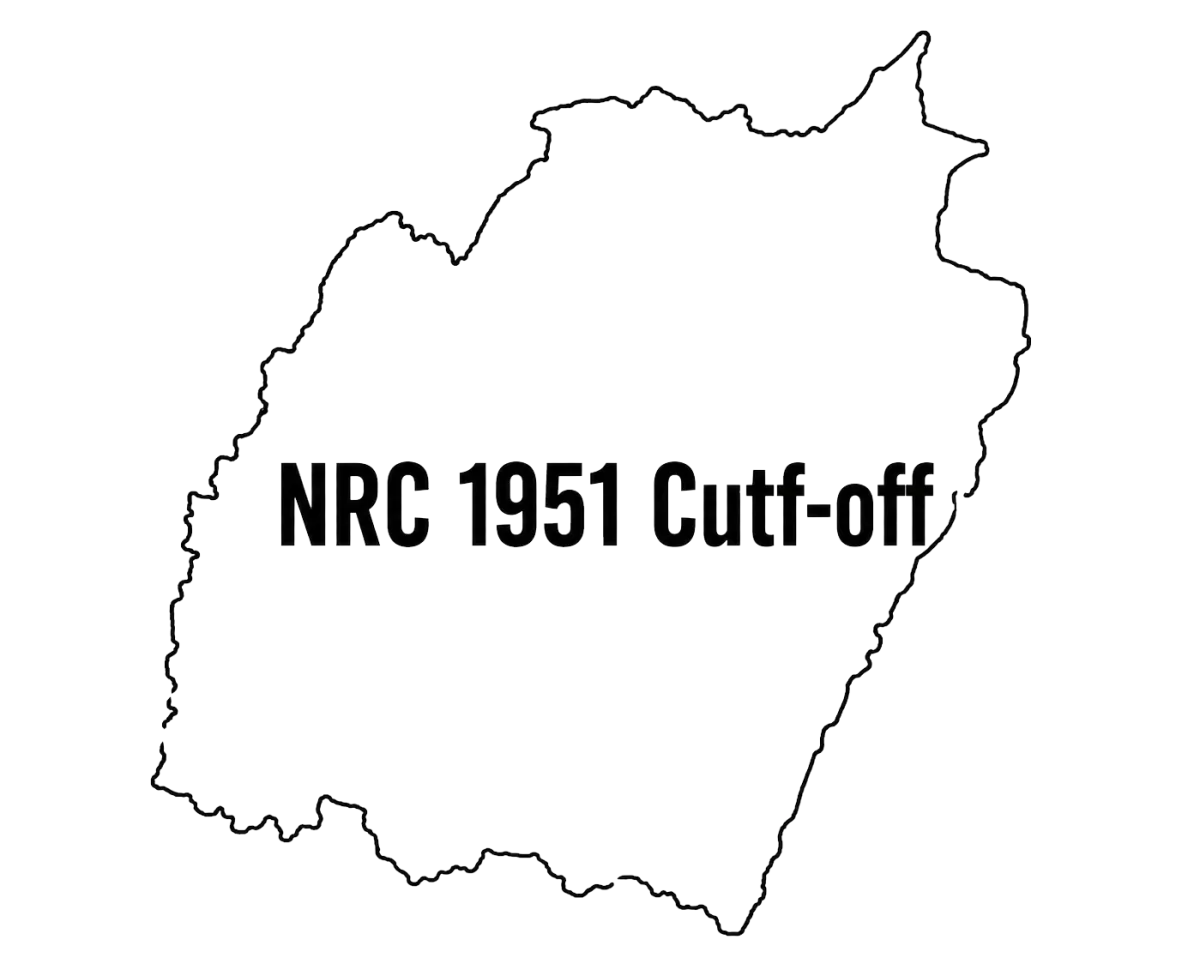
 Photo Courtesy: Representative Image
"Manipur's NRC debate exposes a demographic fault-line: why Kuki-Zo groups fear a 1951 citizenship audit while Naga and Meitei communities demand it."
In February 2024, the Manipur Assembly passed a resolution urging the Centre to implement a National Register of Citizens. By July, the United Naga Council and the valley-based Coordinating Committee on Manipur Integrity had jointly petitioned the Governor, insisting the exercise use 1951 as the base year. The Kuki Inpi Manipur, the apex body of the Kuki-Zo community, offered a conditional yes, provided the Supreme Court supervised the process and state officials stayed out of Kuki-inhabited areas. The asymmetry is striking. The Nagas and Meiteis want the NRC. The Kuki-Zo want it only if they can control who conducts it, and where.
The reason is not abstract. It is written in the census ledgers.
The Census of India 1951, Part XII, Assam, Manipur & Tripura, pages 86 and 87, as compiled by the Kuki Reformation Forum from the original census tables records the population of Manipur at 5,77,635. The tribes that identify as Kuki; Khongzai (6,199), Zo/Zou (3,062), Simte (5,084), Rangkhol (538), Kuki unspecified (29,405), Paite (10,672), Lamhao (374), Ralte (39), Hmar (9,793), Vaiphei (4,252), Thadou (8,284), Hangseen (8), Haokip (2,628), Keepgen (224), Lushei (1,743), Gangte (2,496), and Mizo (140)—together numbered 84,941, or 14.7 per cent of the total. This figure does not include the Anal (3,239), Maring (4,987), Kom (2,490), Tarao (160), Chothe (695), Aimol (335), Moyon (521), Lamkang (1,688), Chiru (1,074), Purum (43), Kharam (90), or Koilhreng (496). These twelve tribes, though listed in some colonial classifications as "Old Kuki," have never accepted the Kuki identity. The Anal declared themselves Naga in 1963. The Maring are recorded by the e-pao.net ethnographic archive as "Naga inhabiting mainly in Chandel district." The Lamkang are recognised by the Central Institute of Indian Languages as "one amongst the 16 Naga indigenous tribes of Manipur." The Chothe passed a resolution in February 2024 through their tribe union CLAM, declaring themselves "Chothe Naga" and warning against unauthorised research that misclassifies them. The Kom formed the Kom-Rem Association in 1947 and maintain a position of neutrality, rejecting both Kuki and Naga labels. To count these tribes as Kuki is not a demographic exercise. It is a political appropriation that the tribes themselves have rejected.
Six decades later, the Census of India 2011, published by the Office of the Registrar General & Census Commissioner, India, shows the Kuki-accepting tribes at 4,48,214. That is a growth of 427.7 per cent over sixty years. The state's total population grew by 394.4 per cent in the same period. The Meitei population grew by 284.4 per cent. According to the Delhi Manipur Society's 2023 report, Violence in Manipur: The Larger Story, the Kuki share of the total population rose from 14.7 per cent to 15.7 per cent, while the Meitei share fell from 65.3 per cent to 50.8 per cent. The report interprets this divergence as evidence that "continuous replenishment from across the Myanmar border" contributed to Kuki-Zo demographic expansion. Demographers note that such growth patterns are atypical for isolated indigenous populations with limited migration.
The split within the Kuki category is revealing. The Kuki Thadou alone grew from 8,284 in 1951 to 2,15,913 in 2011, a 2,507 per cent increase. Paite grew from 10,672 to 55,542. Hmar from 9,793 to 48,375. The Delhi Manipur Society describes these figures as "strong evidence of migration from outside of Manipur." Whether this constitutes illegal infiltration or legitimate internal movement is a question the NRC is designed to answer. The 1951 Aggregate Naga Population was ~174,937, and 2011 Aggregate Naga Population was ~623,441 (up to ~673,803 depending on intermediate/aligned classifications) and the Overall Growth Rate rate was between ~256% and 285%.
The colonial record explains how Kuki presence in Manipur began. Major W. McCulloch, Political Agent in Manipur from 1844 to 1863, wrote that the Kukis were "driven from their native hills" and "scattered around the valley of Munnipore." James Johnstone, who succeeded McCulloch, recorded in 1896 that the Kukis were "first heard of as Kukis, in Manipur, between 1830 and 1840," and that "new immigrants began to cause anxiety about the year 1845, and soon poured into the hill tracts of Manipur in such numbers, as to drive away many of the older inhabitants." Captain R.B. Pemberton, in his 1835 report on the eastern frontier, placed the Kuki native hills south of the Manipur valley, in what is now Myanmar's Chin State and Arracan. Lt. Col. John Shakespear's 1912 monograph The Lushei Kuki Clans traced their northward migration from the Chin-Lushai Hills. Colonial records indicate that the Kukis were not described as an indigenous Manipuri population by British administrators. They were described as migrants, pushed northward by stronger tribes.
Johnstone was explicit about the colonial design. "Colonel McCulloch's policy of planting Kuki settlements on exposed frontiers," he wrote, "induced the Government of Bengal to try a similar experiment, and a large colony of Kukis was settled in 1855 in the neighbourhood of Langtang, to act as a barrier for North Cachar against the raids of the Angami Nagas." The British granted them land, armed them, and exempted them from taxes. The 1872 census recorded zero Kuki households in the Naga Hills. By 1951, Kuki villages had spread across the southern and western hills. By 2011, they dominated districts that Naga organisations contend were historically Naga territory.
Kangpokpi is the most contested case. The Delhi Manipur Society's 2023 report recorded 355 new villages in Kangpokpi in the last five decades, compared to 14 in Naga-dominated Senapati. Churachandpur saw 262 new Kuki villages in the same period, against 42 in Naga-dominated Tamenglong. Naga organisations describe this as encroachment on historically Naga land. The Kuki-Zo community disputes this characterisation, asserting that the land was vacant or legitimately settled. The NRC, if implemented, would test these competing claims against documentary evidence.
The post-1967 refugee influx added a further layer of complexity. In 1967, the Burmese military junta under General Ne Win launched Operation Khadawmi, purging non-Burmese residents from the Chin Hills. Thousands of Kukis fled across the border. The Indian government, through Notification D.O. No. B-R/67/DC/1314-6 dated 6 June 1968, resettled a small population in Kongkhanthana, Ukhrul district territory that Naga organisations claim as historically Naga. District Commissioner S.C. Vaish signed the order. Suisa Tangkhul, the MP from Outer Manipur, was associated with the relief effort. This was humanitarian resettlement. Whether it conferred permanent land rights on descendants is a legal question that remains unresolved. Some Kuki-Zo families trace their presence to this post-1967 displacement, while Naga organisations argue that humanitarian shelter does not transfer territorial sovereignty.
The Kuki Inpi's conditional acceptance of the NRC, announced in July 2024, reveals the community's strategic calculus. KIM leader Janghaolun Haokip stated that the Kuki-Zo would not oppose the NRC if conducted under Supreme Court supervision, but demanded that the Manipur state government limit its reach to "buffer zones" outside Kuki-controlled territories. The Imphal Times described this as "functionally equivalent to demanding separate administration." The condition is not about fairness, according to Naga and Meitei analysts. It is about keeping state officials away from areas where post-1951 and post-1967 settlement cannot be documented.
The Naga and Meitei communities do not face this vulnerability, according to their own assessments. The Nagas, numbering 6,23,441 in 2011, with habitation documented across multiple colonial and post-colonial censuses. The Meitei, as the valley-dwelling majority, have held political and administrative primacy since 1949. For both groups, the 1951 base year is a neutral benchmark. For the Kuki-Zo, according to their own leaders, it is an existential threat because it would expose the post-1951 influx that transformed their demographic position.
NEWire.in holds that the case for an NRC with a 1951 base year rests on two pillars. First, it is the only objective benchmark that predates the post-1967 refugee influx and the colonial-era buffer settlements. Second, it offers a mechanism to test competing territorial claims against documentary evidence rather than force. The Kuki-Zo fear of the NRC is understandable. Some Kuki-Zo families trace their presence to Burmese military displacement, Indian humanitarian shelter, and absorption into a broader community. But the question remains whether humanitarian resettlement confers permanent land rights on refugees, and whether it grants their descendants the right to claim territory that Naga organisations describe as ancestrally Naga. The 1968 notification was an act of compassion. Seven decades later, its legal implications for territorial sovereignty remain contested.
For the Naga communities and for the Meitei people of the valley, the NRC raises the question of whether documentary verification can still protect what remains of their ancestral land. Whether it can be implemented without delay, under judicial oversight, and without ethnic exceptions, depends on whether the Centre is willing to confront a demographic transformation that began with colonial frontier policy and accelerated with post-1967 refugee flows. The answer will shape Manipur for generations.
Demographic analysis presented here reflects published interpretations of census data and does not constitute legal findings on citizenship status.
SOURCES CONSULTED
Carey, Bertram S., and H. N. Tuck. The Chin Hills: A History of the People, British Dealings with Them, Their Customs, and a Gazetteer of Their Country. Vol. 1, Superintendent, Government Printing, Burma, 1896.
Census of India 1951. Part XII, Assam, Manipur & Tripura. Manager of Publications, Government of India, 1953, pp. 86–87. [As compiled by the Kuki Reformation Forum from original census tables.]
Census of India 2011. Table A-11 Appendix: District Wise Scheduled Tribe Population, Manipur. Office of the Registrar General & Census Commissioner, India, Ministry of Home Affairs, 2011.
"Chothe Tribe Union Resolution." Chothe Lim Abom, Manipur (CLAM), 3 Feb. 2024.
"Demography May Change, But History of Manipur Does Not." India Today NE, 19 Nov. 2025, www.indiatodayne.in/opinion/story/demography-may-change-but-history-of-manipur-does-not-1305814-2025-11-19.
Guite, Jankhomang. "Civilisation and Its Malcontents: The Politics of Kuki Raid in Nineteenth Century Northeast India." The Indian Economic and Social History Review, vol. 48, no. 3, 2011, pp. 337–67.
Johnstone, James. My Experiences in Manipur and the Naga Hills. Sampson Low, Marston and Company, 1896.
"Kuki Inpi's NRC Stand Is Akin to Demanding Separate Administration." Imphal Times, 13 July 2024, www.imphaltimes.com/editorial/kuki-inpis-nrc-stand-is-akin-to-demanding-separate-administration/.
"Kuki Inpi Manipur Says 'Will Not Oppose if Central Govt Implements NRC'; Reiterates UT Demand." Ukhrul Times, 5 July 2024, ukhrultimes.com/kuki-inpi-manipur-says-will-not-oppose-if-central-govt-implements-nrc-reiterates-ut-demand/.
"Kuki-Zo Groups Ready for NRC in Manipur, but Conditions Apply — 'Should Be Done under SC Supervision.'" The Print, 6 July 2024, theprint.in/india/kuki-zo-groups-ready-for-nrc-in-manipur-but-conditions-apply-should-be-done-under-sc-supervision/2163111/.
"Lamkang." Bhasha Sanchika, Central Institute of Indian Languages, sanchika.ciil.org/communities/03aa6533-5afe-436c-bca7-f6c4270592a7.
"Lamkang in India Profile." Joshua Project, joshuaproject.net/people_groups/print/17358/IN.
Mackenzie, Alexander. History of the Relations of the Government with the Hill Tribes of the North-East Frontier of Bengal. Home Department Press, 1884.
McCulloch, Major W. Account of the Valley of Munnipore and of the Hill Tribes; with a Comparative Vocabulary of the Munnipore and Other Languages. Bengal Printing Company Limited, 1859.
Newmai, A. "The Kuki Aggression: How British Frontier Policy Engineered Two Centuries of Blood." NEWire.in, 2026, newire.in/articles/the-kuki-aggression-how-british-frontier-policy-engineered-two-centuries-of-blood.
Pemberton, Captain R.B. Report on the Eastern Frontier of British India. Baptist Mission Press, 1835.
Shakespear, Lt.-Colonel J. The Lushei Kuki Clans. Macmillan & Company, Ltd., 1912.
Singh, K. Yugindro. "Colonial-Era Documentation of Kuki Raids in Northeast India: Massacres Perpetrated by the Kukis during the British Rule in India." NEWire.in, 2026, newire.in/articles/colonial-era-documentation-of-kuki-raids-in-northeast-india-massacres-perpetrated-by-the-kukis-during-the-british-rule-in-india.
"Small Manipur Tribe Caught Between Kukis and Nagas." The Hindu, 27 Aug. 2023, www.thehindu.com/news/national/small-manipur-tribe-caught-between-kukis-and-nagas/article67240966.ece.
Srikanth, H., and C.J. Thomas. "Naga-Kuki Conflict in Manipur: Colonial Roots and Contemporary Manifestations." Economic and Political Weekly, vol. 40, no. 23, 2005, pp. 2315–22.
"United Naga Council Seeks NRC in Manipur." The Hindu, 3 Aug. 2023, www.thehindu.com/news/national/other-states/united-naga-council-seeks-nrc-in-manipur/article67150911.ece.
"Violence in Manipur: The Larger Story." Delhi Manipur Society, 2023.

Comments