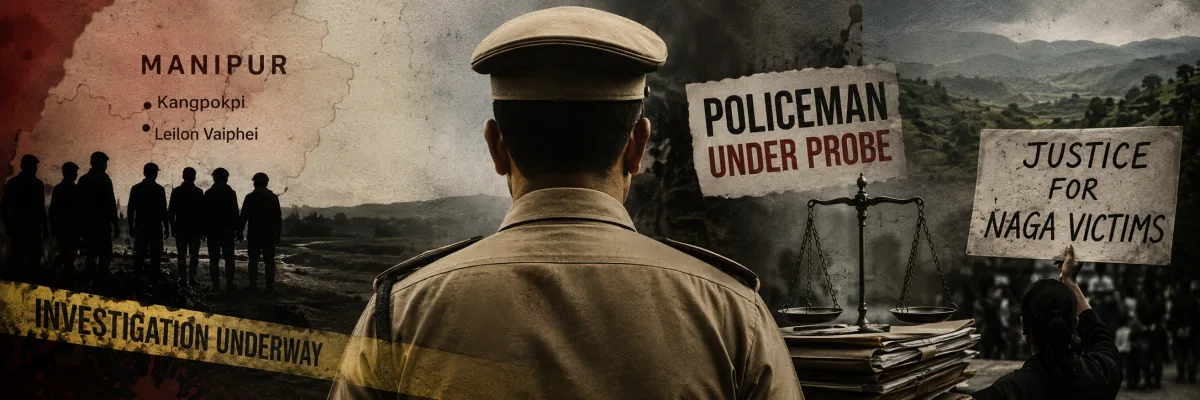
 Photo Courtesy: Representative Image
The abduction and killing of six Naga civilians in Manipur has already become one of the most disturbing episodes in the State's prolonged ethnic conflict. Their disappearance from Leilon Vaiphei village on 13 May, followed by the recovery of their bodies nearly a month later, has left grieving families seeking answers that remain elusive. The transfer of the investigation to the National Investigation Agency (NIA) reflected the seriousness of the crime and the erosion of public confidence in local investigative mechanisms.
Against this backdrop, reports that a police officer posted in Kangpokpi district has been interrogated in connection with the case raise questions that extend well beyond the conduct of a single individual. According to The Hindu, citing a senior government official, investigators questioned the policeman after released Naga hostages reportedly mentioned him in their statements. Crucially, the same official also stated that the investigation is ongoing and that the officer's exact role has not yet been established. No public record indicates that he has been arrested, charged, or named by investigating agencies.
The temptation in moments of public outrage is to equate investigation with guilt. That temptation must be resisted. India's criminal justice system is founded on the presumption of innocence, and responsible journalism carries the same obligation. Until investigators produce evidence capable of supporting criminal charges, the unnamed police officer remains exactly what the public record describes him to be, an individual under investigation.
Yet the absence of proven criminal liability does not diminish the gravity of the institutional questions now confronting the State.
A police officer occupies a position fundamentally different from that of an ordinary citizen. The institution exists to protect civilians, investigate crime and uphold the law impartially. When investigators themselves find sufficient reason to interrogate a serving police officer in relation to an incident involving abducted civilians, public confidence inevitably suffers, irrespective of the eventual outcome of the investigation.
The issue, therefore, is not whether the unnamed officer is guilty. That determination belongs exclusively to the investigative process and, ultimately, the courts. The real issue is whether existing systems of oversight, accountability and transparency are capable of reassuring citizens that allegations involving law enforcement personnel will be examined without fear or favour.
That concern is particularly acute in Manipur, where years of ethnic violence have repeatedly strained public confidence in state institutions. Communities affected by violence frequently judge not only the outcome of investigations but also the speed, independence and transparency with which they are conducted. Delays, silence and uncertainty often become fertile ground for rumour, speculation and deepening mistrust.
The Government's decision to transfer the case to the NIA was therefore an acknowledgment that the investigation required a degree of independence beyond the local police structure. It also reflected the national importance attached to a case involving multiple civilian deaths amid continuing ethnic tensions. However, transferring an investigation is only the beginning. Justice requires visible progress.
Public reporting indicates that, despite the NIA assuming control of the investigation, no arrests had been publicly announced in connection with the killings at the time of the latest reports. Union Home Minister Amit Shah has reportedly reviewed the security situation in Manipur and directed agencies to intensify action against those responsible for violence and abductions. Those directions now require measurable investigative outcomes rather than administrative assurances.
The same principle applies to the reported interrogation of the Kangpokpi police officer. If investigators ultimately conclude that the allegations are unsupported, that conclusion should be stated clearly and publicly so that suspicion does not become a permanent stain on an unnamed individual. Conversely, if evidence establishes criminal involvement, the law must proceed without regard to official position or institutional affiliation.
This case also illustrates the danger of information vacuums during conflict. At present, credible public reporting does not disclose the officer's identity, his village, or any documentary evidence explaining how investigators believe he may have become connected to the incident beyond witness statements. In an era dominated by social media, that absence of verified information has encouraged speculation. Responsible journalism requires refusing to fill evidentiary gaps with conjecture.
That restraint should not be mistaken for passivity. Journalism has an equally important obligation to continue asking difficult institutional questions.
What forensic progress has been made since the NIA assumed the investigation? Have all relevant electronic records, communications and witness statements been secured? What safeguards exist when allegations concern serving law enforcement personnel? What timelines has the investigating agency established for completing the inquiry?
These are legitimate questions directed not at an unnamed police officer but at public institutions entrusted with delivering justice.
The killing of six civilians is ultimately a test of the State's credibility. Every unresolved day deepens the anguish of bereaved families and weakens public faith in the rule of law. The investigation must therefore be judged not by public rhetoric but by evidence, procedural fairness and prosecutorial independence.
NEWire believes that neither presumption of guilt nor institutional silence serves justice. The victims' families deserve an investigation that is timely, transparent and uncompromising. The wider public deserves confidence that no office, uniform or affiliation places anyone beyond scrutiny, or beneath the protection of the law.
Until those standards are visibly met, the unanswered questions surrounding Leilon Vaiphei will remain not merely a criminal investigation, but a measure of the State's commitment to equal justice.



Comments