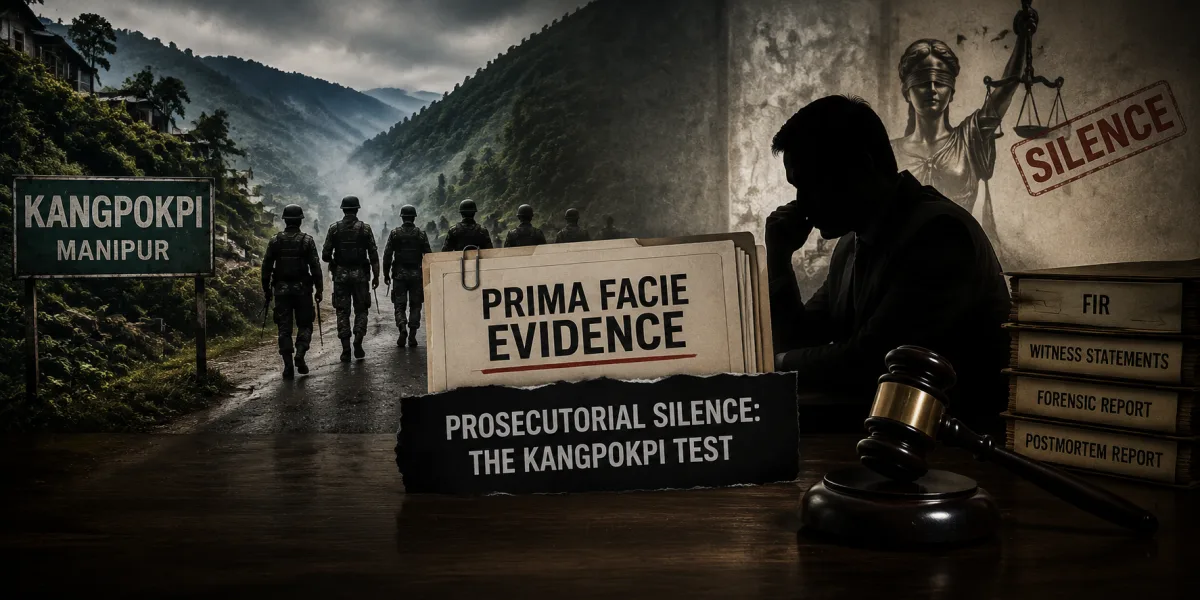
 Photo Courtesy: Representative Image
"Nearly two months after the abduction and more than a month after the recovery of the bodies, no prima facie prosecutorial action has been publicly disclosed against the individuals and groups identified by released hostages, community organisations, or government functionaries."
The Incident
On the morning of May 13, 2026, eighteen Naga civilians travelling through Leilon Vaiphei village in Kangpokpi district were pulled from their vehicles, separated by gender, and marched away at gunpoint. The women and children were released two days later. The six men, two pastors among them, were not.
For twenty-eight days, their families waited. On June 10, security forces recovered their mortal remains from a forest near Kharam Vaiphei. According to the United Naga Council (UNC), the bodies were decomposed, dismembered, and mutilated beyond easy recognition.
Fifteen days later, the Kuki-Zo Council (KZC), the apex civil society body of the Kuki-Zo tribes in Manipur, publicly acknowledged that members of the Kuki-Zo community had killed the six hostages. KZC Chairman Henlianthang Thanglet described the killings as a "great mistake" committed in an "outburst of emotion."
The State Government subsequently announced that the case had been handed over to the National Investigation Agency (NIA), while the Manipur High Court, acting on a Public Interest Litigation (PIL), sought an Action Taken Report. Yet, nearly two months after the abduction and more than a month after the recovery of the bodies, no prima facie prosecutorial action has been publicly disclosed against the individuals and groups identified by released hostages, community organisations, or government functionaries.
The question is not whether a grave crime occurred. The question is why the investigation has yet to produce visible prosecutorial action.
The Evidence
The evidence that has entered the public domain is substantial and multi-layered.
Fourteen of the abducted civilians, most of them women, were released on May 15. According to statements reported by multiple media outlets and the PIL filed before the Manipur High Court, the released hostages described how armed men in black, some carrying spades and sharp tools, separated the men from their families, blindfolded the women, and threatened them with death.
According to the PIL filed by Advocate Mark Khapai, one released hostage alleged that a Manipur Police personnel posted at the Leimakhong outpost was among those involved in the detention. The same petition identified the chief of Leilon Vaiphei village as playing a central role in the abduction.
Several released hostages also identified the Kuki National Front (Presidential) (KNF-P), a militant group operating under the Suspension of Operations (SoO) agreement, as the armed group responsible for taking the six men away. Deputy Chief Minister Losii Dikho publicly stated that the KNF-P was responsible for the killings.
On June 25, the KZC Chairman publicly acknowledged that members of the Kuki-Zo community had killed the hostages.
These are not anonymous rumours; they are allegations and statements contained in court filings, witness accounts, official statements, and public admissions that warrant thorough investigation.
The Legal Response
Despite this, the legal response has remained limited in the public domain.
- An FIR was registered at Sekmai Police Station on May 14 under provisions of the Bharatiya Nyaya Sanhita relating to kidnapping, wrongful confinement, and organised criminal activity.
- Four suspects were arrested on May 25 from the Leilon Vaiphei area, but police described their alleged role as relating to the abduction rather than the murders.
- At the time of writing, no chargesheet has been publicly reported.
- No arrests have been publicly reported in relation to the KNF-P leadership identified by the Deputy Chief Minister.
- The chief of Leilon Vaiphei village, whom released hostages identified in statements and in the PIL as playing a central role in the abduction, has not been publicly reported as arrested.
During the High Court proceedings on June 4, the State's Additional Advocate General stated that the case had been handed over to the NIA. However, the Deputy Solicitor General of India informed the same court that the NIA had not yet received official communication to that effect. That discrepancy raised legitimate questions about the pace and coordination of the investigation.
Political and Institutional Concerns
Several organisations have argued that political considerations, procedural delays, and the operation of the SoO framework may have affected the progress of the investigation.
Although the SoO agreement does not provide immunity from prosecution, critics argue that its implementation has complicated accountability in this case. The Naga Women's Union, in its representation to the NIA Director General, requested that the role of the KNF-P under the SoO framework be investigated and urged that no individual, organisation, or militant group receive political protection or immunity from criminal investigation.
The UNC has further demanded the abrogation of the SoO agreement and the declaration of the KNF-P as a terrorist organisation.
The relationship between KNF-P President Semtinthang Kipgen and Deputy Chief Minister Nemcha Kipgen has prompted allegations of a potential conflict of interest, leading the UNC to seek her removal from office.
Former Manipur Human Rights Commission Chairperson Khaidem Mani has also publicly questioned why no FIR or arrest had followed the Deputy Chief Minister's public identification of the KNF-P.
These developments raise legitimate questions about institutional independence and whether political considerations may have delayed criminal accountability.
Official Response
Official responses have also evolved over time.
- Chief Minister Yumnam Khemchand Singh has condemned the killings and promised that those responsible would be arrested and prosecuted.
- The NIA has initiated forensic examination of the recovered remains.
- The Kuki Inpi Manipur, after initially stating that all Naga hostages had been released, later condemned the killings and appealed for restraint.
- The KZC's June 25 statement represented a significant public acknowledgment of the killings but did not identify individual perpetrators or call for specific legal action. Instead, it characterised the killings as an emotional outburst while also referring to the suffering experienced by the Kuki-Zo community.
For the families of the victims, however, public statements cannot substitute for due process, investigation, and accountability. They have continued to seek concrete legal action before accepting closure.
What Remains Unanswered
What has been publicly reported so far falls short of the expectations of the victims and the wider public.
- Four suspects have been arrested.
- The transfer of the investigation to the NIA was initially the subject of conflicting statements before the High Court.
- Forensic examinations are ongoing.
- No chargesheet has yet been publicly disclosed.
While considerable security resources were deployed to recover the bodies, the investigation has yet to produce publicly visible prosecutorial progress against those identified in witness statements and official accounts.
Editorial Position
NEWire.in believes that the killing of six abducted civilians, followed by the concealment and reported mutilation of their remains, demands a thorough, impartial, and time-bound investigation.
The evidence presently available in the public domain, including witness statements, court filings, official statements, and public admissions appears sufficient to warrant urgent investigative action and, where the legal threshold is met, prompt arrests and prosecution.
The State should:
- Clarify whether the implementation of the SoO framework has affected the investigation;
- Transparently address concerns regarding potential conflicts of interest;
- Ensure that every individual identified during the investigation is examined strictly according to law, irrespective of community affiliation or official position.
As the Naga Women's Union urged, the investigation must proceed without fear or favour. Anything less risks undermining public confidence in the rule of law.

Comments