"Nemcha Kipgen's reported involvement in facilitating the negotiated surrender occurred while her husband's organization was the primary target of the security cordon."
On 21 June 2026, a CoBRA unit of the CRPF launched an operation in the Leilon Vaiphei area of Kangpokpi district, targeting cadres of the Kuki National Front (President faction), or KNF-P, and the Kuki Revolutionary Army (KRA). What began as a substantial counterinsurgency sweep, involving exchange of gunfire and reported use of explosives, ended 48 hours later with the operation withdrawn, the cordon lifted, and approximately 30 surrounded militants reportedly escaping to the KNF-P's Ebenezer Camp. The central question is whether the Suspension of Operations (SoO) agreement creates structural conditions where security operations and negotiated political interventions operate at cross-purposes, producing outcomes that satisfy neither counterinsurgency objectives nor peace process goals.
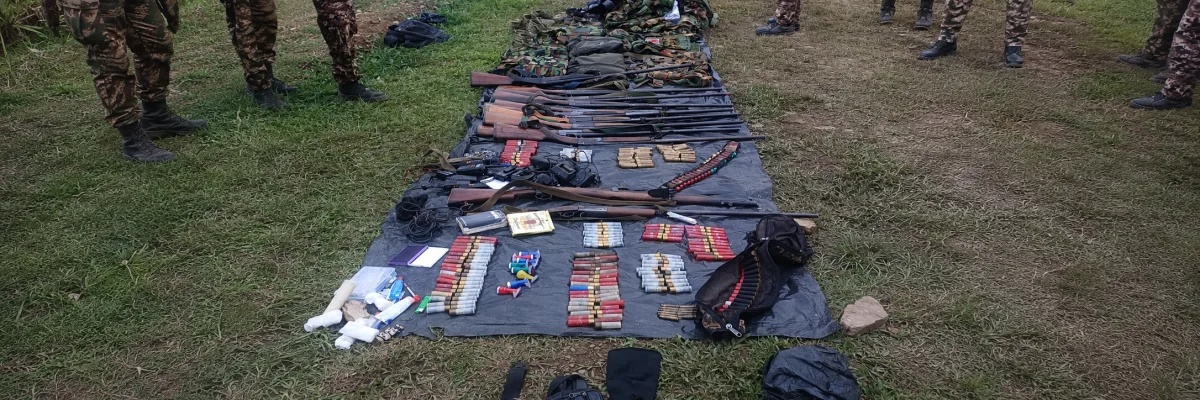
The operation was substantial. According to the Manipur Police, a joint team of Manipur Police, CRPF, RAF, CoBRA, and Army units conducted search operations across Leilon Vaiphei and surrounding areas from 20 to 22 June 2026. Security forces recovered 17 single and double-barrel guns, eight sophisticated weapons including two AK-47 rifles, one M4 carbine, two SLRs, one SKS rifle, and one improvised sniper .303 rifle, alongside 11 SBL rifles, assorted ammunition, communication equipment, and other war-like stores. An exchange of fire took place with suspected militants, and three arrests were made in separate operations. ("Manipur: Over 30 arms recovered, 3 nabbed in operations," UNI, 22 June 2026; "Huge cache of arms, ammunition recovered from Leilon Vaiphei areas," Ukhrul Times, 23 June 2026).
Then the timeline shifted from military to political. Between 21 and 22 June, Deputy Chief Minister Nemcha Kipgen was reportedly involved in efforts to facilitate a negotiated surrender of the surrounded militants. A surrender deadline was fixed for 10:00 AM on 22 June, then extended to 6:00 AM on 23 June. By 23 June, the CoBRA/CRPF operation was reportedly withdrawn, and the militants reportedly escaped from the cordoned zone and fled towards the KNF-P Ebenezer Camp. The Foothills Naga Coordination Committee (FNCC) alleged on 24 June that "nearly 100 armed terrorist groups of KNF(P), UKNA and KRA were reportedly surrounded," and that "the most disturbing aspect is that the operation was eventually withdrawn despite the Kuki narco-terrorists having been effectively encircled." The FNCC further alleged that "frantic phone calls were allegedly made to senior political and security authorities, including the Director General of Assam Rifles, the GOC of 57 Mountain Division, Leimakhong and Chief Minister Yumnam Khemchand Singh." ("Kuki militants allowed to escape, alleges FNCC," The Sangai Express, 24 June 2026; "Naga Body Demands Answers on Militant 'Escape'," Ekhon, 24 June 2026).
The structural tension is documented. Nemcha Kipgen, Deputy Chief Minister since 4 February 2026, is married to S.T. Thangboi Haokip, chairman of the KNF-P. The KNF-P is a signatory to the Suspension of Operations (SoO) agreement, a tripartite ceasefire pact signed on 22 August 2008 between the Government of India, the Government of Manipur, and Kuki militant umbrella groups, the Kuki National Organisation (KNO) and the United People's Front (UPF). The SoO agreement requires signatory groups to maintain designated camps, refrain from carrying arms in public, and abstain from violent activities. The KNF-P's Ebenezer Camp in Kangpokpi is one such designated location. The Manipur government had unilaterally withdrawn from the SoO agreement on 29 February 2024, citing ground rules violations, but the Centre continued the pact and signed a fresh agreement with renegotiated ground rules on 4 September 2025. ("India: Renewed SoO In Manipur," Eurasia Review, 9 September 2025; "Manipur Government withdraws from SoO Agreement," Next IAS, 14 March 2023).
The KNF-P has been accused of violating these ground rules. The group has been linked to the abduction and killing of six Naga civilians from Konsakhul village in May 2026, triggering fresh Kuki-Naga violence. The United Naga Council (UNC) submitted a charter of demands to Union Home Minister Amit Shah on 12 June 2026, calling for the abrogation of the SoO agreement with Kuki militant groups and stringent action against KNF-P cadres. The Konsakhul Village Authority recounted that 18 villagers were abducted on 13 May, six were subsequently murdered, and their bodies were mutilated. The Leilon Vaiphei operation appeared to be a direct response to this pattern of alleged violations. ("UNC urges Amit Shah to ban KNF-P, scrap SoO," The Assam Tribune, 13 June 2026; "Konsakhul Naga Village Condemns Attack on Leilon Vaiphei," Ukhrul Times, 15 June 2026).
The manner in which the operation concluded raises policy questions about how the SoO framework manages the intersection of political office and militant group leadership. Nemcha Kipgen's reported involvement in facilitating the negotiated surrender occurred while her husband's organization was the primary target of the security cordon. The sequence, fix a deadline, extend it, then withdraw the operation, produced an outcome where militants reportedly returned to their designated camp without apprehension. On 23 June, CoBRA commandos reportedly conducted operations at the KNF-P Ebenezer Camp, with social media videos showing armoured vehicles rushing to the area. The Sangai Express reported that "another report, which this paper couldn't verify, said security forces attempted to enter the camp, triggering protests from locals and Kuki civil bodies." The operation that began with encirclement ended with the militants back in their designated camp, under the same SoO agreement that requires them to abstain from carrying arms and engaging in violence. ("CoBRA's operation reaches Ebenezer camp," The Sangai Express, 23 June 2026).
The broader context is Manipur's three-year ethnic conflict, which has killed over 250 people and displaced more than 60,000 since May 2023. The state was under President's Rule from 13 February 2025 to 4 February 2026, after Chief Minister N. Biren Singh resigned. The new BJP government, with Yumnam Khemchand Singh as Chief Minister, included Nemcha Kipgen as Deputy Chief Minister alongside Losii Dikho, a Naga, in what was presented as a strategic pause to ease ethnic tensions. Yet the Kuki-Naga conflict has escalated independently, with clashes in Ukhrul and Kangpokpi districts since February 2026. The Leilon Vaiphei operation and its aftermath suggest that the post-President's Rule government faces the same structural challenge its predecessors did: balancing the SoO peace process with the security imperative to enforce ground rules when violations are alleged. ("President's rule revoked in Manipur after a year," The Print, 4 February 2026; "Three killed in Kuki-Naga conflict in Manipur," The Hindu, 24 April 2026).
The official position has emphasized that operations are intelligence-based and aimed at recovering arms and apprehending militants. The Manipur Police's statement on 22 June highlighted the recovery of 35 arms and three arrests. There has been no official statement explaining why the Leilon Vaiphei cordon was withdrawn, why the surrender deadline was extended twice, or why the militants were allowed to relocate to the KNF-P Ebenezer Camp rather than being apprehended. The FNCC, in its 24 June statement, asked: "Who ordered the withdrawal of troops?" India Today NE, in an editorial on 24 June, posed questions that remain unanswered: "Who ordered the operation? What was its objective? Who ordered the withdrawal? Why were the suspects not apprehended if they were surrounded?" ("Kuki militants allowed to escape, alleges FNCC," The Sangai Express, 24 June 2026; "Leilon Vaiphei Operation Must Not Become Another Unanswered Chapter in Manipur," India Today NE, 24 June 2026).
The systemic pattern seems to point to a policy gap. The SoO agreement, designed to transition Kuki militant groups from armed insurgency to political dialogue, operates in a governance environment where designated camps can function as safe havens, political connections can influence operational decisions, and security operations can be truncated by negotiated intervention. The Leilon Vaiphei incident is not evidence of deliberate sabotage by any official. It is a structural outcome of a peace process that has not resolved how to reconcile political accommodation of SoO groups with consistent enforcement of ground rules. The militants did not escape because the cordon was weak. They escaped because the cordon was lifted. And the cordon was lifted because the SoO framework, as currently structured, creates incentives for negotiated settlement over law enforcement when the two come into conflict. Until the SoO framework is revisited to clarify the boundaries between political negotiation and security enforcement, operations like Leilon Vaiphei will continue to produce outcomes that satisfy neither peace process advocates nor communities demanding security accountability.



Comments