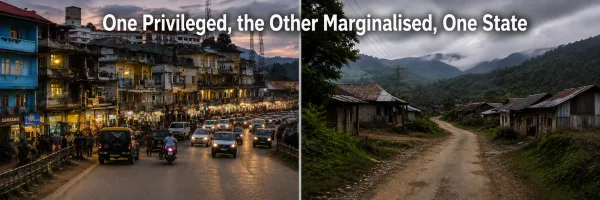
In the village of Longwa, where a single chief's house straddles the India-Myanmar border, Konyak elders still speak of the day their young men returned from France in 1919. They had gone as part of the Allied Labour Corps during the First World War, carrying supplies through trenches most had never imagined existed. Back home, they formed a club. That club became the Naga Club. And the Naga Club, in 1929, presented a memorandum to the Simon Commission asking that the Nagas be left alone.
Nearly a century later, the Konyaks are still asking to be left alone. Not from the British this time. From their own state.
The numbers are brutal. According to the 2011 Census, the Konyak tribe numbers approximately 237,568, making them one of the largest Naga tribes. Yet in the 60-seat Nagaland Legislative Assembly, the Konyaks hold influence through just a handful of constituencies concentrated in Mon district. The Ao tribe, with a comparable population of roughly 226,625, commands ten assembly seats from Mokokchung district alone. The Sema tribe, at about 236,313, dominates Zunheboto and surrounding areas with significant representation. Meanwhile, the Zeliang tribe, numbering only around 74,877, holds just two seats. The arithmetic is indefensible.
The Nut Graph
This is not a story about reservation per se. It is a story about what happens when a temporary measure calcifies into permanent injustice. Nagaland's "backward tribe" reservation policy, introduced in 1977 with a ten-year sunset clause, has become a lollipop: a sweet label that keeps certain tribes pacified while the structural rot deepens. The policy was meant to lift the disadvantaged. Instead, it has locked them into a category that no longer describes their reality, while simultaneously freezing political representation at levels that reflect 1960s demographics, not 2020s populations. The result is a state where some tribes punch far above their demographic weight in the assembly, while others, despite swelling numbers, remain politically marginal. The demand for "demographic justice" is not a call to end affirmative action. It is a call to make the system honest again.
How It Started: The Colonial Hangover
To understand the present distortion, one must return to 1963, when Nagaland became India's sixteenth state. The territory was stitched together from two unequal halves: the Naga Hills district of Assam, which had been under British administration since the mid-nineteenth century, and the Tuensang Frontier Division, which the British had left largely untouched. The former had mission schools, rudimentary infrastructure, and early exposure to colonial administration. The latter, home to the Konyak, Chang, Phom, Sangtam, Yimchunger, and Khiamniungan tribes, was the "unadministered area" where headhunting persisted into living memory and Christianity arrived decades later.
When statehood arrived, the Tuensang region was granted special status: a regional council, direct Governor administration, and a ten-year transition period. Article 371A of the Constitution, born from the 16-Point Agreement, embedded these asymmetries. The eastern tribes were, in every measurable sense, starting from behind. Literacy rates were abysmal. Infrastructure was nonexistent. Representation in the nascent state machinery was negligible.
In 1977, the state government, exercising powers under Article 16(4) of the Constitution, identified seven tribes as "backward" and reserved 25% of non-technical, non-gazetted government posts for them. The list included Konyak, Chakhesang, Sangtam, Phom, Khiamniungan, Chang, and Yimchunger. The rationale was straightforward: these tribes had "insignificant representation in the services" and were "economically very backward." The order carried a ten-year expiry date.
It never expired.
How It Grew: The Policy That Ate Itself
By 1979, the reservation was expanded to 33%, adding Zeliang and Chakhesang. In 1994, the Pochury tribe was included. A 2008 revision restructured quotas, and by 2011, the total reservation for backward tribes reached 37%. The current framework, frozen in a 2015 notification, allocates 25% to six eastern tribes (Konyak, Phom, Sangtam, Chang, Yimchunger, Khiamniungan), 4% each to Zeliang and Chakhesang, and 2% each to Pochury and the Sumis of Kiphire district.
Here is the problem. The policy was designed as a ladder. It has become a cage.
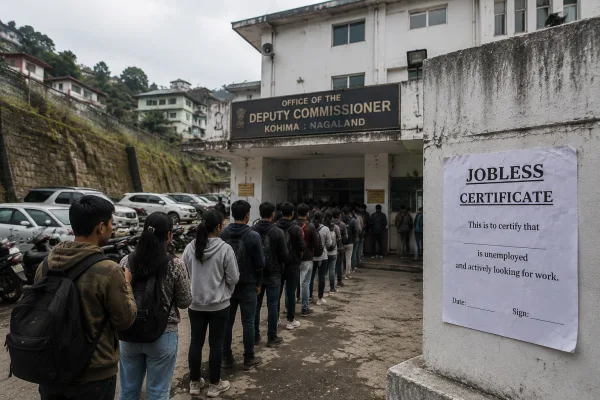
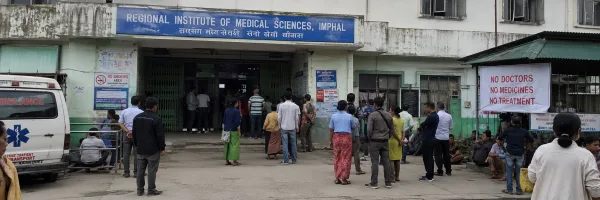
Consider the Konyaks again. They constitute approximately 12.65% of Nagaland's tribal population. Yet according to data compiled by the Eastern Nagaland People's Organisation (ENPO), the Konyak community holds only about 6% of state government jobs, yielding an employment ratio of 1:33 against the state average of 1:15. Mon district, the Konyak heartland, recorded the lowest literacy rate in Nagaland at 56.99% in the 2011 Census, below even the national average. The reservation policy has not corrected this. It has administered a placebo while the disease metastasized.
Or look at the broader picture. The six "backward" tribes of Eastern Nagaland together constitute nearly 45% of the state's indigenous population. Their share of government employment? Less than 3%, per ENPO's 2011 employment census. The "advanced" tribes of western Nagaland, meanwhile, occupy roughly 97% of government posts despite being a demographic minority.
This is not what reservation was meant to do.
The Delimitation Freeze: When Democracy Stopped Counting
If the reservation policy distorted employment, the frozen delimitation has done worse to political representation. The 84th Constitutional Amendment, read with the Delimitation Act of 2002, provided for constituency reorganization based on the 2001 Census. Most states complied. Nagaland did not.
The reasons are complex and contested. Article 371A's protections over customary practices have been invoked to resist population-based seat redistribution. Tribal hohos (apex bodies) from the western districts, whose political clout would diminish under any honest delimitation, have successfully stalled the exercise. The result is a legislative map drawn decades ago, when the state's demographic profile looked nothing like it does today.
The Joint Action Committee of Tribal Hohos on Delimitation, representing the Lotha, Zeliang, Phom, Sangtam, Yimchunger, and Rengma tribes, has documented the absurdity. As per the 2001 Census, Mokokchung district, home to the Ao tribe, had a population of 232,085 and was allotted ten assembly seats. The four districts of Wokha, Peren, Longleng, and Kiphire, home to the Lotha, Zeliang, Phom, Sangtam, and Yimchunger tribes, had a combined population of 475,002, also allotted ten seats. One district with 232,000 people got the same representation as four districts with 475,000. The population-per-seat ratio in Mokokchung was roughly 23,000. In the four eastern districts, it was nearly 48,000.
Put differently, an Ao voter in Mokokchung has approximately twice the representational weight of a Lotha or Zeliang voter in the east.
This is not federalism. It is feudalism with ballot boxes.
The JAC's alternative proposal, submitted to the Delimitation Commission in March 2007, suggested reducing Mokokchung's seats from ten to eight to reflect actual population shifts. It went nowhere. The Commission's draft proposal, which would have maintained the status quo, was denounced by the JAC as "nothing but a proposal to protect the political interest of vested few political leaders."
They were right.
The Coming Delimitation: A Double Blow to the Backward
Now a new delimitation looms. And it threatens to make things worse.
In April 2026, the Government of India introduced the Delimitation Bill, proposing a 50% increase in Lok Sabha seats from 543 to 816. Nagaland Rajya Sabha MP S. Phangnon Konyak has highlighted that this will trigger a proportional increase in state assembly seats as well. If Nagaland's current 60 seats expand by 50%, the assembly could swell to 90 members.
Where will those new seats go? The answer should alarm anyone who cares about tribal equity.
According to the 2011 Census, Dimapur district alone had 378,811 people, the largest in Nagaland, with a population density of 409 persons per square kilometre and 52.23% urbanization, the highest in the state. Kohima district followed with 267,988 people and 45.18% urbanization. Together, Dimapur and Kohima constitute nearly 33% of Nagaland's population but hold only about 15% of assembly seats. Under any population-based delimitation, these districts are guaranteed to gain seats.
But here is the catch. Dimapur and Kohima are not tribal heartlands in the traditional sense. Dimapur is a commercial hub with a heterogeneous population. The 2011 Census recorded its Scheduled Tribe population at only 59.1% of the total. The rest comprises non-tribal communities from Assam and beyond, plus migrants from virtually every Naga tribe who have moved there for education, employment, and business. Kohima, the capital, is dominated by the Angami tribe but also hosts significant populations of Ao, Sema, Lotha, and other advanced tribes who staff the government machinery.
In December 2021, the Nagaland government created three new districts: Tseminyu (carved from Kohima), and Chümoukedima and Niuland (both carved from Dimapur). Chümoukedima alone had a 2011 Census population of 125,400, with 43,516 in its urban centre, making it one of the fastest-growing areas in the state. Its town population has grown nearly fivefold in two decades.
When delimitation happens, these new districts, Chümoukedima, Niuland, and Tseminyu, will demand their own assembly constituencies. And they will get them. Because population is the only language the Delimitation Commission speaks.
But who lives in these new urban districts? Not the Konyak farmer from Tobu. Not the Phom villager from Longleng. Not the Sangtam tribesman from Kiphire. The people swelling Dimapur, Chümoukedima, and Kohima are disproportionately from the advanced tribes: Angami civil servants, Ao professionals, Sema businessmen, Lotha educators. They are the ones with the education and mobility to migrate to urban centres. The backward tribes remain anchored in their villages, in Mon, in Tuensang, in Longleng, where urbanization is 13.85%, 18.72%, and 15.04% respectively, the lowest in the state.
A draft delimitation proposal that has circulated in Nagaland indicates the likely redistribution. Districts set to lose seats include Mon (-1), Tuensang (-1), Mokokchung (-3), Zunheboto (-2), Kohima (-1), and Phek (-1). Districts set to gain include Dimapur (+4), Peren (+1), Wokha (+1), Longleng (+2), Kiphire (+1), and Pughoboto (+1).
Look at that pattern. The eastern districts, home to the backward tribes, lose a net eight seats. The western and central districts, home to advanced tribes and urban migrants, gain a net nine. Dimapur alone, the most urbanized, most heterogeneous district, gains four seats. Mon, the largest backward tribe district, loses one.
This is delimitation as displacement. The backward tribes are being pushed further south, not geographically, but politically. Their share of the assembly shrinks even as their population grows. The new seats go to districts where they are minorities, where their votes are diluted in mixed constituencies, where the Angami contractor and the Ao bureaucrat decide who gets the ticket.
The GB/Village Federation of Nagaland, Dimapur, has already warned that "delimitation of constituencies will disturb the tribal balance of the Naga society." TL Angami, its founder, argued that without an increase in total assembly seats, delimitation is "meaningless" because it forces tribes to share constituencies. He demanded at least 20 to 25 new assembly constituencies to accommodate tribal boundaries.
He is half right. Delimitation without seat increase would be a zero-sum bloodbath. But delimitation with seat increase, under the current formula, is worse. It rewards the districts that have already won, and punishes those that have already lost.
Why It Persists: The Politics of the Status Quo
The defenders of the current system are not hard to identify. In July 2025, a committee representing five major tribes, Angami, Ao, Lotha, Rengma, and Sumi, announced renewed agitation against any revision of the reservation policy. Their argument, articulated by member-secretary G.K. Zhimomi, was that a 48-year-old policy is "long overdue" for review. The Chief Minister, Neiphiu Rio, responded that any significant reform should wait until after the 2027 Census, kicking the can another two years down a road that has already stretched across five decades.
Notice the asymmetry. The tribes benefiting from the current arrangement have the political muscle to stall change indefinitely. The tribes demanding reform, the Konyak Students' Union, the Eastern Nagaland People's Organisation, the various JACs, must resort to memoranda, rallies, and election boycotts to be heard. In 2022, the ENPO resolved that the people of Eastern Nagaland would abstain from all state and central elections until their demands for a separate "Frontier Nagaland" state were met. They followed through in the 2024 Lok Sabha elections.
This is what happens when a political system refuses to recalibrate. Citizens withdraw their consent.
The Counterargument, and Its Limits
One might argue that the backward tribe reservation has, in fact, worked. Some of the originally designated tribes have seen measurable improvements in literacy, employment, and political participation. Chakhesang and Zeliang, once on the backward list, have produced educated elites who now compete in the open market. The 1977 policy gave them a foothold. Should that foothold be kicked away?
No. But a foothold is not a permanent residence.
The premise of affirmative action is that it is temporary, targeted, and subject to periodic review. The Indian Constitution's framers explicitly intended reservation as a transitional measure, not a birthright. When a policy designed for ten years remains untouched for nearly fifty, it ceases to be remedial and becomes distributive. It allocates spoils rather than correcting disadvantage.
Moreover, the current framework's rigid tribal categories ignore intra-tribe inequality. A wealthy, English-educated Konyak from Mon town has the same reservation access as a subsistence farmer from the Myanmar border. A poor Ao villager in Mokokchung has none, despite possibly facing greater deprivation. The policy has become a blunt instrument in a world that needs precision.
The Konyak Students' Union's demand for a "population-based reservation system" is not radical. It is arithmetic. If a tribe constitutes 12% of the population, it should have roughly 12% of reserved seats and jobs, adjusted for backwardness indices. The current system, where Konyaks, Phoms, and Sangtams share a 25% pool while smaller tribes claim fixed percentages, violates even the most basic proportionality.
How to Resolve It: A Roadmap
First, conduct an honest delimitation. The 2001 Census data exists. The 2011 data exists. The 2021 Census, delayed by the pandemic, will eventually be published. There is no constitutional barrier to redrawing constituency boundaries to reflect actual population distribution. Article 371A protects customary law, not gerrymandering. The argument that tribal boundaries must override population equality is a smokescreen for incumbent protection.
But delimitation must not become a tool for further dispossession. If new seats are created in Dimapur, Chümoukedima, and Kohima, the state must ensure that backward tribe populations in those districts are mapped, counted, and given fair weight. The Delimitation Commission cannot treat a mixed urban district as a blank slate where the advanced tribes automatically win.
Second, institute a sunset review mechanism for the backward tribe reservation. Every ten years, an independent commission, composed of demographers, economists, and tribal representatives, should assess which tribes still qualify as "backward" based on literacy rates, per capita income, employment data, and health indicators. Tribes that have crossed threshold metrics should graduate from the list. Newly disadvantaged tribes should be added. The 1977 list is not holy scripture.
Third, introduce a population-weighted reservation formula within the backward tribe category. If 37% of jobs are reserved for backward tribes, the internal allocation should reflect each tribe's share of the state's tribal population, modified by a backwardness coefficient. A tribe that is 12% of the population but severely disadvantaged might receive 15%. A tribe that is 2% but relatively advanced might receive 1%. The current flat allocations are indefensible.
Fourth, address the "advanced tribe" grievance without dismantling the safety net. The Committee on Review Reservation Policy, representing Angami, Ao, Lotha, Rengma, and Sumi interests, is not wrong that the 1977 framework is obsolete. But their proposed solution, stripping reservations entirely, would harm the genuinely disadvantaged. A better approach is to expand the pie: increase total reservation percentages while making the internal distribution rational. If 80% of state jobs are already reserved for indigenous tribes, the question is not whether to reserve, but how to reserve fairly.
Fifth, and critically, any delimitation exercise must include a tribal-impact assessment. Before new constituencies are carved out in Dimapur, Chümoukedima, or Kohima, the state must publish data on which tribes will benefit and which will be further marginalized. The 50% seat increase cannot become a backdoor for advanced tribes to consolidate power while backward tribes watch from the sidelines.
The Stakes
Nagaland is at a crossroads. The Frontier Nagaland movement, the ENPO's statehood demand, the Konyak Students' Union's agitation, the JAC's delimitation campaign, all these are symptoms of a single disease: a political structure that no longer maps onto demographic reality. When a state's largest tribe is classified as "backward" yet denied proportional representation, when its most populous region is its least politically powerful, when a policy designed for temporary relief becomes a permanent fixture benefiting some at the expense of others, the social contract frays.
And now, the coming delimitation threatens to pour gasoline on the fire. New seats in Dimapur, Chümoukedima, and Kohima will not go to the Konyak laborer or the Phom farmer. They will go to the Angami professional, the Ao entrepreneur, the Sema contractor. The backward tribes, already underrepresented, will find their share of the assembly shrinking further. The lollipop of "backward tribe" status will keep them docile in the job queue while the advanced tribes feast at the political table.
The pattern is unmistakable. A small group of politically dominant tribes has captured the state's institutional architecture and is defending it with the vocabulary of tradition and stability. Meanwhile, the majority of Nagaland's people, those who happen to live in the eastern districts, are told to wait. Wait for the 2027 Census. Wait for the next commission. Wait for political will that never arrives.
The Konyak elders in Longwa did not wait for the British to grant them permission to organize. The Naga Club did not wait for the Simon Commission to validate their memorandum. And the people of Eastern Nagaland are done waiting for a delimitation and reservation policy that their own leaders have no intention of delivering.
References
Bhattacharya, Alak, et al. "Revisiting the Frontier Nagaland Movement: Historical Insights and Contemporary Reflections." TIJER: International Research Journal, vol. 13, no. 5, May 2026, pp. 680-691.
"Composition of Panel to Review Job Quota in Nagaland Slammed by Tribal Group." The Hindu, 7 Aug. 2025, www.thehindu.com/news/national/nagaland/composition-of-panel-to-review-job-quota-in-nagaland-slammed-by-tribal-group/article69905699.ece.
"Delimitation Proposal Will Have Serious Consequences." Indian National Congress, 29 Apr. 2026, inc.in/congress-sandesh/others/delimitation-proposal-will-have-serious-consequences.
"Delimitation Without Increase in Assembly Seats Meaningless." Morung Express, 6 May 2026, morungexpress.com/delimitation-without-increase-in-assembly-seats-meaningless.
"Five Naga Tribes to Resume Protest Against Nagaland's Job Reservation Policy on July 9." The Hindu, 4 July 2025, www.thehindu.com/news/national/nagaland/five-naga-tribes-to-resume-protest-against-nagalands-job-reservation-policy-on-july-9/article69772142.ece.
Government of India, Ministry of Tribal Affairs. Scheduled Tribe Population by Tribe, Nagaland, 2011 Census. Lok Sabha Unstarred Question No. 1271, 2024, sansad.in/getFile/loksabhaquestions/annex/174/AU1271.pdf.
Government of Nagaland, Department of Personnel and Administrative Reforms. Reservation in Services. 2016, dpar.nagaland.gov.in/wp-content/uploads/2016/04/Reservation-in-Services.pdf.
"Govt Notifies Jurisdiction for Three New Districts." Morung Express, 20 Dec. 2021, morungexpress.com/govt-notifies-jurisdiction-for-three-new-districts.
Khiamniungan, T. Longkoi. "Inequality in Nagaland." OIDA International Journal of Sustainable Development, vol. 2, no. 8, 2019, pp. 25-38.
"KSU Demands Population-Based Reservation Policy in Nagaland." Nagaland Tribune, 13 June 2025, nagalandtribune.in/ksu-demands-population-based-reservation-policy-in-nagaland/.
"Lotha Hoho in Favour of Delimitation." Morung Express, 11 June 2020, morungexpress.com/lotha-hoho-in-favour-of-delimitation.
"Nagaland MP S. Phangnon Konyak Highlights 50% Seat Increase Under New Delimitation Proposal." Northeast Live, 2026, www.youtube.com/watch?v=XADpLShSzds.
"Roadblock to Naga Peace Process." Frontline, 21 Oct. 2019, frontline.thehindu.com/the-nation/article29656826.ece.
"Should Delimitation of Assembly Constituencies Be Taken Up?" Morung Express, morungexpress.com/should-delimitation-of-assembly-constituencies-be-taken-up.
"Union Home Minister and Minister of Cooperation Shri Amit Shah Intervenes in the Discussion in the Lok Sabha on the Delimitation Bill, 2026." Press Information Bureau, 16 Apr. 2026, www.pib.gov.in/PressReleasePage.aspx?PRID=2252748.

Comments