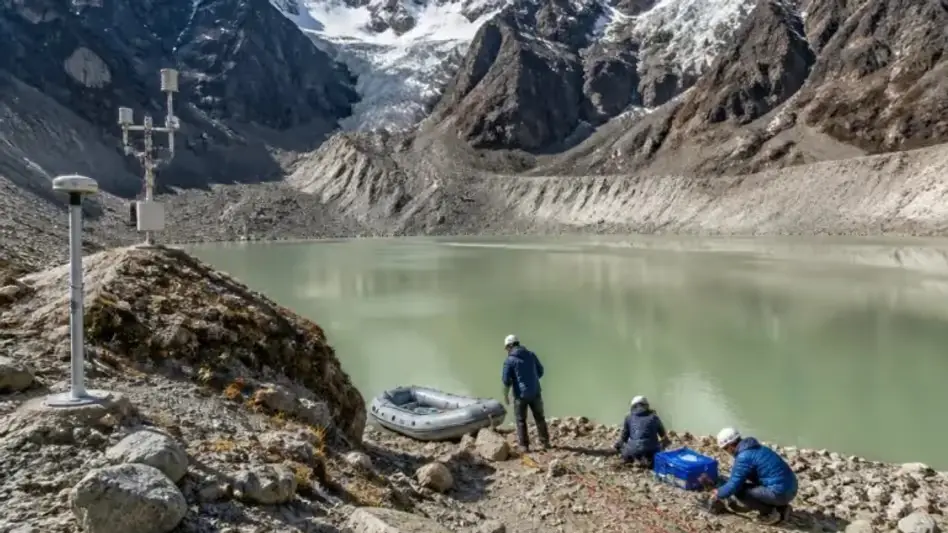
 Photo Courtesy: India Today Group
Gangtok: Sikkim scientists have finished a three-year field study on nine high-risk glacial lakes. This work provides a new playbook for stopping Glacial Lake Outburst Floods. Researchers from the Sikkim Science and Technology Department and Sikkim University led the project between 2022 and 2025. Their findings appeared in the journal Natural Hazards in 2026.
Glacial lakes hold massive water volumes. When dams fail, downstream communities face destruction. The October 2023 South Lhonak Lake disaster focused the region on these hidden dangers. Experts ditched remote satellite images for boots on the ground. They used unmanned surface vehicles for bathymetric surveys and electrical resistivity tomography to scan deep beneath moraine dams.
These tests revealed hidden hazards like saturated zones and buried ice. The team proved that surface area does not reveal true water volume. Khangchung Chho holds over 125 million cubic metres of water, making it the deepest lake in the study. Lachung Khangtse is much smaller, holding less than two million cubic metres. At Shako Chho, the team found concealed seepage channels that satellite tech missed entirely. The report notes, "The findings demonstrated that surface area alone cannot provide a reliable indication of the volume or potential hazard posed by a glacial lake."
The study proposes a four-stage risk reduction framework. This includes satellite screening, field assessments, engineering design, and physical mitigation. Lowering the water level at Shako Chho by 20 metres could drain 11 million cubic metres of water. Scientists suggest solar-powered pumps for this task. An automatic weather station is already tracking conditions at that site.
The National Disaster Management Authority tracks 189 high-risk lakes across the Indian Himalayan Region. Officials hope this model helps teams in Nepal and Bhutan protect lives. Future work needs investment in drone-based LiDAR and radar monitoring to reach inaccessible terrain. Success demands tight coordination between geologists, engineers, and disaster managers.
Updated at 4th September 2026 at 5:49pm
Sikkim has now flagged 40 glacial lakes as high-hazard sites, with 16 of those ranked at the absolute highest risk of catastrophe. These 16 fall into Category A, while two are Category B, nine are Category C, and the remaining 13 await formal classification. The state designated its Department of Science and Technology as the lead agency for these assessments in February 2025.
Authorities are moving toward a site-specific strategy rather than a blanket approach. Plans for the Lhonak Complex involve a flood-retention structure at Dolma Sampa, while a moraine plug wall is proposed for the Gurudongmar Complex. The Department of Science and Technology and the Brahmaputra Board are currently vetting that wall project, balancing flood safety with the site's religious and cultural significance.
State officials are also drafting a dedicated GLOF Risk Mitigation Protocol, which would serve as the first standard scientific framework of its kind in India. Beyond engineering, the government is considering the creation of a permanent commission on glacial hazards to fix technical gaps and clear up conflicting departmental responsibilities. Principal Secretary Sandeep Tambe confirmed that the state has already submitted a Detailed Project Report for Shako Chho to the National Disaster Management Authority.






Comments