 Photo Courtesy: nenow
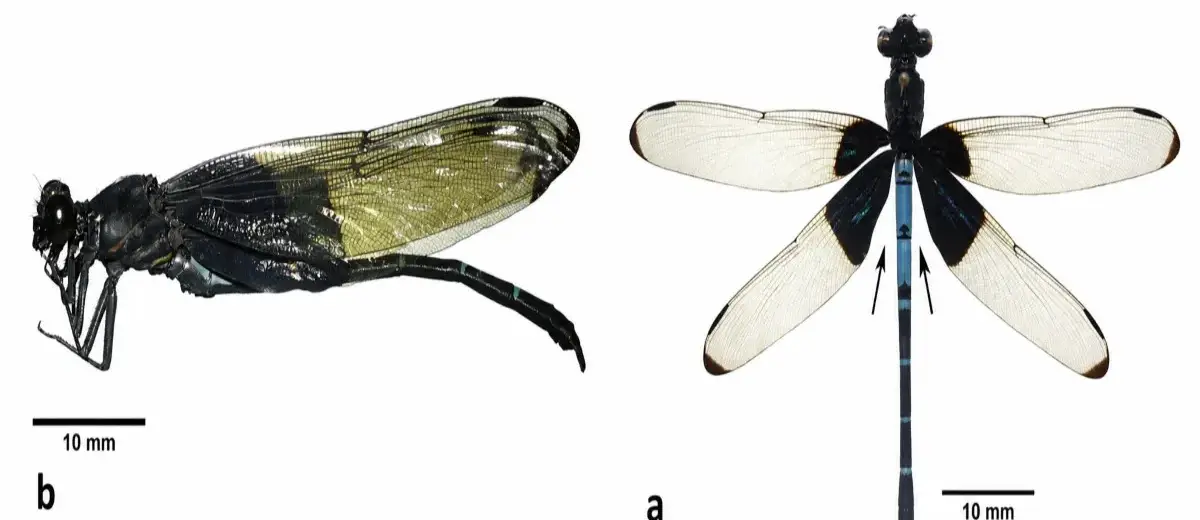
Guwahati: A new damselfly species with a distinct black body and blue abdomen stripes has officially ended a taxonomic puzzle dating back to 1927. Researchers named the insect Dysphaea assamensis. Rima Amsih from Dibrugarh University, Arajush Payra of Dr. Vishwanath Karad MIT World Peace University, K. A. Subramanian of the Zoological Survey of India, and Samrat Sengupta of Debraj Roy College published the finding in the journal Zootaxa.
Scientists previously confused this insect with Dysphaea walli, a species first described in Myanmar. For years, experts relied on photos because no physical specimens existed. The team finally collected five male specimens in Karbi Anglong during May and June 2026. This allowed them to distinguish the new species by its wing pigmentation and reproductive anatomy. "The discovery also highlights how much remains to be documented in the biodiversity-rich landscapes of Northeast India, where even familiar-looking insects can conceal previously unrecognised species."
Male specimens measure between 52.5 and 54.3 mm long. The male features opaque black wing patches that extend further on the hindwing than the forewing. In contrast, D. walli displays yellowish lateral markings on its abdomen. The researchers deposited the holotype with the Zoological Survey of India in Shillong.
The team found the insects perched on woody logs along a 13-metre-wide, 60-centimetre-deep stream in Karbi Anglong. The species also lives in Meghalaya, West Bengal, Tripura, and northeastern Bangladesh. It prefers riverbanks near mature, mixed-moist deciduous forests. While the discovery brings the global count for the Dysphaea genus to 10, habitat loss due to agricultural expansion and urbanisation poses a threat to the species.







Comments