 Photo Courtesy: nenow
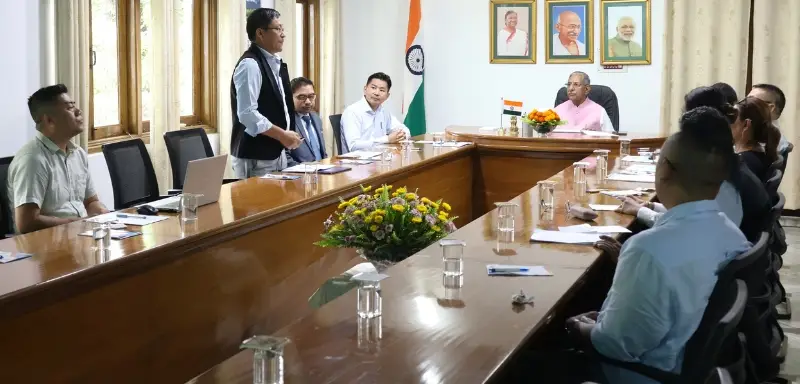
Kohima: Nagaland’s tax revenue reached Rs 1,597.51 crore during the 2025-26 fiscal year. This marks a jump of Rs 170.47 crore from the previous year. Governor Nand Kishore Yadav reviewed these figures on August 10 at Lok Bhavan in Kohima. The growth rate hit 11.9 percent annually.
The department currently manages 11,592 active taxpayers. They operate across four zones: Dimapur, Kohima, Mokokchung, and Chümoukedima. Tax officials described their primary workload in a recent statement: "Its core activities include registration, ensuring timely filing and proper payment of taxes, scrutiny of returns, audit, enforcement, adjudication and recovery, appeals, refunds, and tax education and awareness."
GST remains the state's fiscal backbone. It accounted for Rs 1,181.88 crore, or 74 percent of total revenue last year. Since 2017-18, GST collections have ballooned by 530 percent. The state even outperformed national averages, posting 37 percent growth through December 2025 and 28.4 percent for the full 2025-26 year. Collections for the current year reached Rs 450.35 crore by July 2026.
Recent administrative wins include recovering Rs 17 crore in petroleum arrears as of August 6, 2026. Nagaland now ranks first in the Northeast for its biometric Aadhaar authentication registration. The state also launched digital platforms like G-RAMS and N-GAIN to monitor compliance.
Challenges remain. Officials cited manpower shortages and the need for better IT infrastructure. They also face a hurdle in tracking interstate transactions and detecting tax evasion. To counter this, the department is pushing to make tax compliance a people's movement.
The long-term outlook is aggressive. Under Vision 2063, the state aims for Rs 2,400 crore by 2030, rising to Rs 11,000 crore by 2047, and finally Rs 50,000 crore by 2063. Finance Commissioner Kesonyu Yhome attended the review to discuss these roadmap objectives, which include forming a State Revenue Board.
Updated at 11th August 2026 at 5:48am
The department provided a five-year revenue trajectory, showing growth from Rs 1,122.71 crore in 2021-22 to the current figures. To hit long-term goals, officials mapped out seven key growth drivers: restructuring the department, building state of the art IT infrastructure, creating a legal cell, and providing better conveyance and housing for staff. They also intend to form a State Revenue Board to oversee the push.
On the ground, enforcement efforts have tightened. Officials are running inventory checks and now monitor goods at a new counter at the Railway Parcel Office. They are also using specific initiatives like GRDC-CAMS for data cleansing and market surveys to track down unregistered taxpayers. The department is also leveraging online tools including an application for TCCs and a digital platform for professional tax to plug revenue leaks.
The first quarter of the 2026-27 fiscal year brought in Rs 466.98 crore, a jump of Rs 23.96 crore over the same period last year. Despite these gains, the department is grappling with a rising backlog of GST data that requires intense risk assessment and scrutiny. They also aim to reach Rs 5,000 crore by 2038 as a mid-term milestone on the road to the 2063 target.
Updated at 11th August 2026 at 9:48am
Beyond the fiscal growth, the department provided a detailed look at its operational roadmap for the coming decades. To secure the long-term milestones, officials have committed to seven key drivers: expanding and restructuring the department, training staff, establishing a legal cell, and providing basic conveyance and housing support for personnel.
Enforcement efforts are moving beyond general monitoring. The department is coordinating directly with Central GST authorities and targeting fake invoices through specialized inspection drives. To manage the workload, they are shifting focus toward high-risk taxpayers and improving field verification for works contracts and other revenue-sensitive sectors.
Leadership frames these upgrades as a move to build a dynamic system that drives innovation and sustains governance. The department’s long-term goal is to transition away from historical resistance toward a culture of voluntary compliance across the state.
Updated at 11th August 2026 at 10:00pm
Governor Nand Kishore Yadav widened his oversight to the Department of Excise and Prohibition, meeting with officials to grill them on enforcement failures and rising contraband smuggling. The department pulled in Rs 22.51 crore in revenue over the last five years, with annual hauls climbing from Rs 3.17 crore in 2021-22 to Rs 5.92 crore in 2025-26. Enforcement squads have been busy logging cases under the Nagaland Liquor Total Prohibition Act, seizing everything from IMFL and country liquor to heroin, poppy straw, and prescription pills.
Operational reality remains bleak. The department reported a personnel to population ratio of 1:6,000, dwarfed by Mizoram's 1:2,000 count. Staff are hitting the streets with outdated firearms and limited mobility, hampering their ability to lock down porous borders. The administration confirmed that the absence of a formal cadre review since the department's inception has stalled progress. Plans are now in motion to build new offices in Phek and Peren along with a bonded warehouse in Dimapur to secure better operational control.
Updated at 12th August 2026 at 9:48am
The department operates under a legal framework encompassing the Nagaland Excise Act 1967, Nagaland Excise Rules 1972, the 1989 Liquor Prohibition Act, and federal statutes including the NDPS Act 1985 and the Drugs and Cosmetics Act 1940. Officials confirmed they are actively conducting drug awareness campaigns and destroying confiscated contraband as part of their standard enforcement cycle.
Beyond the lack of a formal cadre review, the department identified the discontinuation of inter-district check gates as a primary factor hindering their ability to manage border integrity and suppress the trade of illicit substances.






Comments