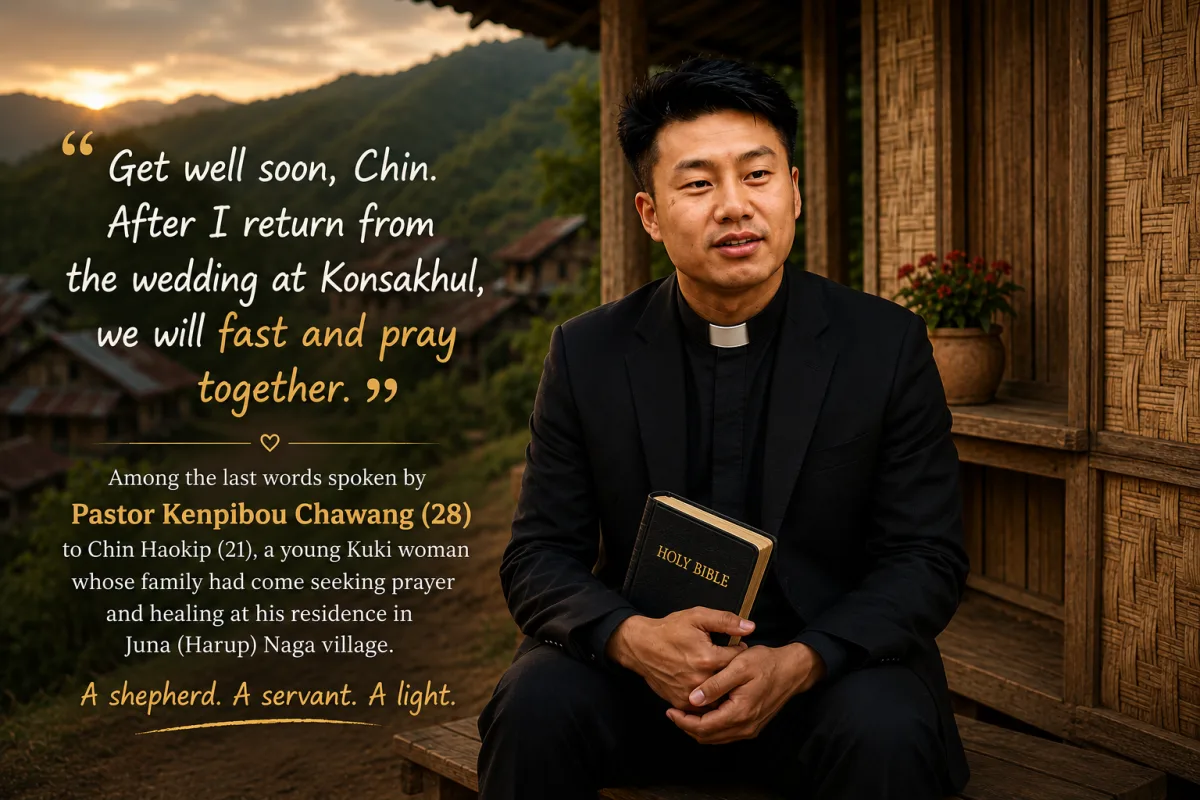
“Get well soon, Chin. After I return from the wedding at Konsakhul, we will fast and pray together.”
Those were among the last words Pastor Kenpibou Chawang (28) spoke before leaving home. He said them gently to Chin Haokip (21), a young Kuki woman whose family had come seeking prayer and healing at his residence in Juna (Harup) Naga village.
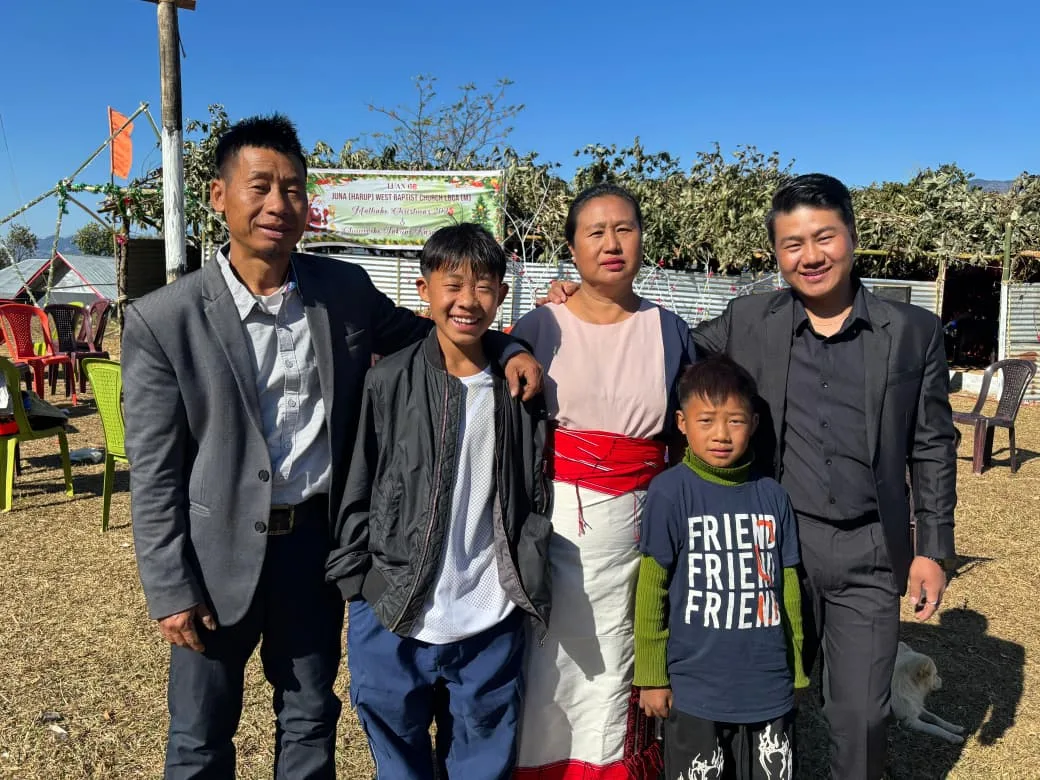
Pastor Kenpibou Chawang (to the right corner in black blazer)
For years, people suffering from ailments believed to be linked to paralysis, spiritual affliction, or possession, especially from Kangpokpi, Saikul, and Saparmeina areas, had come to the home of Caroline Chawang, Kenpibou’s mother. Known among many communities for her intercessory prayers and compassionate ministry, Caroline had quietly become a refuge for the distressed, regardless of community background.
On the morning of 11 May, Lunmang Haokip (60), his wife Ngaijahat Haokip (50), and their daughter Chin arrived from Mongpojang village. They had come with hope. Before leaving for Konsakhul, Kenpibou and the two families agreed to hold a fasting and prayer programme for Chin on 15 May 2026.
But within two days, everything changed.
On the morning of 13 May, Caroline received a phone call from Simon Tingnamai, chairman of Juna village. His voice carried terrible news: her son had reportedly been abducted by suspected Kuki militants amid mounting tensions between Naga and Kuki communities following the ambush of Thadou pastors in the Kotlen-Kotzim area.
The planned fasting programme was immediately cancelled.
Fear began to spread through the village. Social media posts about the abduction and killings inflamed emotions, and Caroline worried deeply for the safety of the Haokip family staying under her roof. She feared that angry youths, overcome by grief and rage, might target them simply because they were Kukis.
Though burdened by anxiety for her abducted son, Caroline chose compassion over suspicion. She urged the family to leave Juna as soon as transportation could be arranged. By late afternoon, the Haokip family safely departed the village. Only then did she breathe a quiet sigh of relief.
Yet even amidst fear and uncertainty, humanity endured.
On the morning of 15 May, though no longer in Juna village, Lunmang Haokip telephoned Caroline and gently reminded her of the prayer they had planned for Chin. Despite the sorrow surrounding her own family, Caroline prayed for the young woman’s healing and wished her recovery.
It was a small act of grace in the middle of unfolding tragedy.
Just days earlier, on 9 May, Kenpibou had excitedly video-called his younger sister Kaidonliu from their mother’s phone. Smiling brightly, he proudly held up a wedding invitation card bearing the words: “Pastor Kenpibou Chawang, Juna (Harup) West Baptist Church, LBCA (M), Harup Naga Village.” The invitation had come from his missionary colleague Rev. Dr. Manu Thiumai, pastor of Leimakhong Baptist Church.
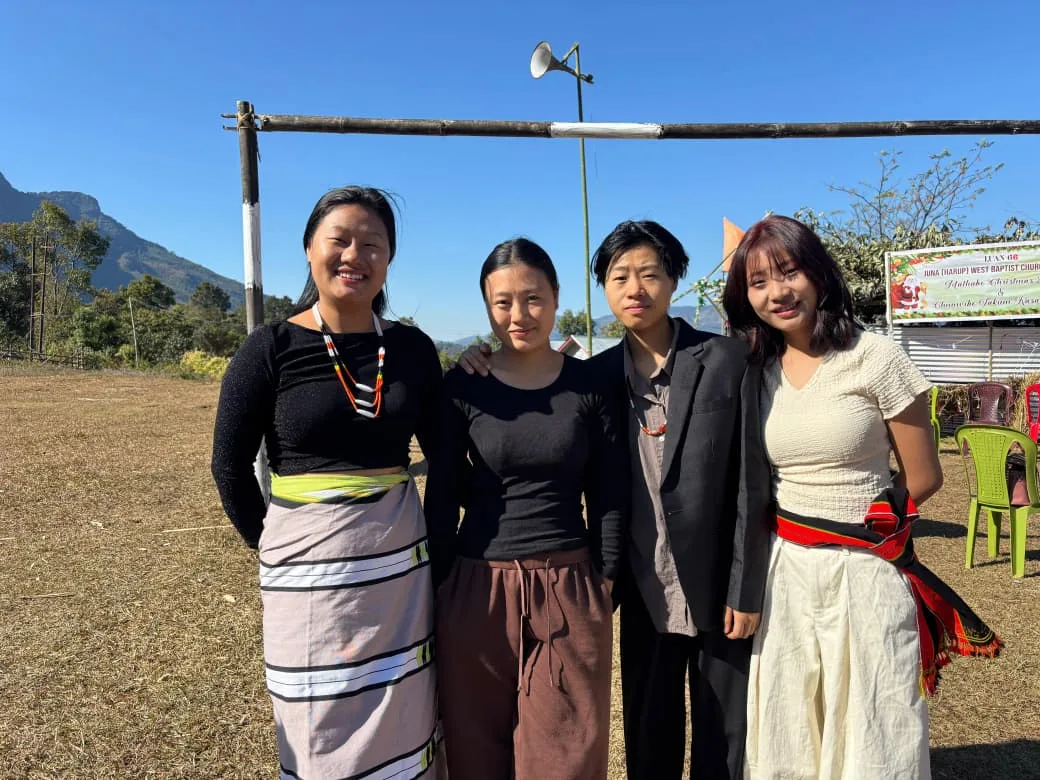
To his family, the moment felt special. After years of struggle, sacrifice, and uncertainty, Kenpibou was finally beginning to walk fully into the ministry to which he believed God had called him.
His father, Luniboi Chawang (54), however, carried unease in his heart. The growing tensions between Naga and Kuki communities worried him deeply. Before Kenpibou left for Konsakhul on a friend’s motorcycle, his own being under repair, Luniboi prayed for his son’s journey.
“Apiu, there is no conflict between Naga and Kuki,” Kenpibou reassured him gently. “Don’t worry. I’ll return home soon.”
Those words now echo painfully in the minds of his family.
Kenpibou was born on 17 March 1997 to Caroline and Luniboi Chawang after nearly five years of childlessness. His birth brought immense joy to the family. During those difficult early years of waiting and prayer, his parents had made a quiet vow before God: if blessed with a child, they would dedicate their firstborn to Christian ministry.
Though they lived modestly, his father serving as a church clerk and caretaker, and his mother working as a substitute teacher then as a faith healer, they sacrificed tirelessly to educate their children.
Caroline had worked at the UJB School in Makuinong village before marrying Luniboi in 1994. But as their children grew older, the remoteness of Makuinong, located near the Manipur-Nagaland border, made schooling difficult. In 2006, the family moved back to Juna (Harup), closer to Senapati, hoping for a better future for their children.
That future came at a cost.
Since 2020, Kenpibou had mostly lived in Bangalore, where he pursued his Bachelor of Theology and Master of Divinity degrees. Life there was far from easy. Unlike many of their friends who could afford vacations home, Kenpibou and his sister worked part-time jobs to survive and continue their studies.
“We never really had holidays in Bangalore,” Kaidonliu recalled, her voice breaking with emotion. “While others went home during vacations, we stayed back and worked to support ourselves. That is how my brother completed his theology and divinity studies at Berean Baptist Bible College.”
When Kenpibou returned home for Christmas in 2024, he never imagined he would soon be asked to lead Juna (Harup) West Baptist Church as its pastor. Pastor Benjamin Chawang had not been keeping well and could no longer continue his ministry.
But Kenpibou hesitated.
He had not even undergone water baptism.
Years of moving between schools in Senapati, Kangpokpi, and Bangalore meant he had repeatedly missed baptism ceremonies conducted in the village whenever ordained ministers visited. Ironically, the young man who would soon become a pastor was only baptised on 25 March 2026, just two days before his installation.
On 27 March 2026, Pastor Kenpibou Chawang was formally installed as pastor of Juna (Harup) West Baptist Church.
The moment carried profound meaning for the family. Out of humility and respect for the congregation, his father even resigned from his position as church clerk so that the father-son duo would not make others uncomfortable.
For Kaidonliu, her brother is a cheerful and simple soul without any ill-will or enmity than the image now debated and distorted on social media.
Responding quietly to online trolling following his abduction, she reflected with painful honesty:
“As a human being, my brother is not perfect. Like any young man, he may have weaknesses and struggles. But he is cheerful, gentle-hearted, and carries no hatred toward anyone. He loves music, plays the guitar, and has composed songs that are yet to be released.”
Today, from her home in Chennai, she waits helplessly for her brother’s return.
“Achi, come back home soon,” she says softly. “We have struggled so much together. We still have memories to create. We have not yet enjoyed the fruits of our struggles.”
Behind the family’s quiet endurance lies years of hardship. In 2024, Kenpibou’s father suffered a mild stroke while visiting his children in Bangalore. Since then, he has been unable to do heavy work.
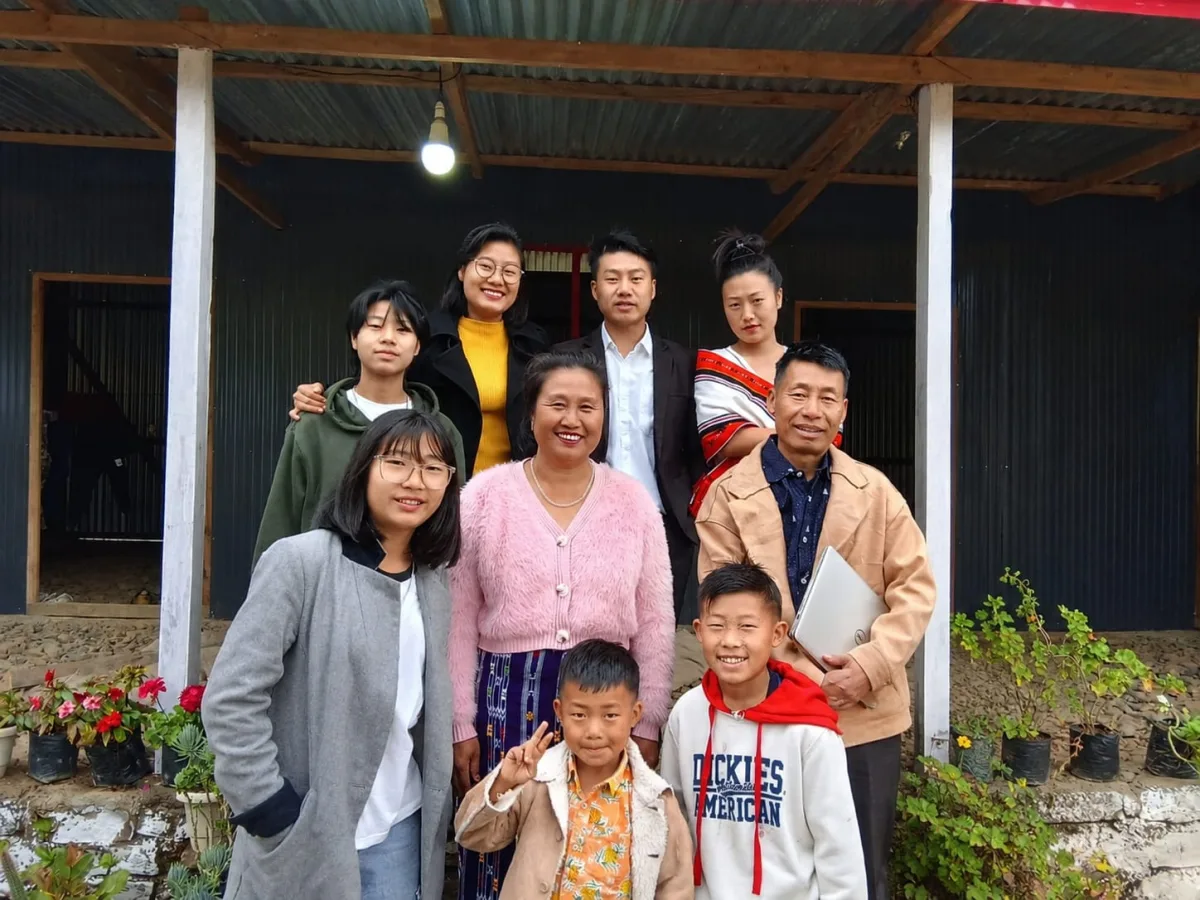
Pastor Kenpibou Chawang (standing at the back in black blazer) with love ones
That same December, after many years away from home, 10 members of the Chawang family travelled together from Bangalore to Juna village for Christmas, taking the long train journey through Howrah to Dimapur. Friends had warned Kenpibou not to return to Manipur because of the unrest. But he came anyway, to his family, his church, and his people.
Caroline often recalls how she once prayed desperately for a child during the early years of her marriage, and how she believed God answered that prayer through Kenpibou. Today, she continues to pray, not for revenge, but for her son’s safe return.
“As a mother,” she says quietly, “I want my son to come back home. But I have also surrendered myself to God’s will.”
Then, after a brief silence, she adds words that reveal the depth of her faith and the weight of her sorrow:
“I want to state clearly that I do not seek revenge against anyone for what has been done to my son Kenpibou.”
Fighting back tears, Caroline recalls the ordinary moments that now haunt her the most.
“Before going out, Kenpibou would often stand before me and ask, ‘Mother, do these clothes suit me?’” she says with a faint smile. “Sometimes if he felt that he had disappointed me in any way, he would come quietly, smile at me, and massage my shoulders or my hands without saying much. That was his way of making peace.”
For Caroline, it is these small gestures, more than anything else, that now linger painfully in her heart. The memory of her son’s gentle smile, his playful questions, and silent acts of affection have become both a comfort and a wound she carries each day.
- By Poujenlung Gonmei | Independent Researcher


Comments