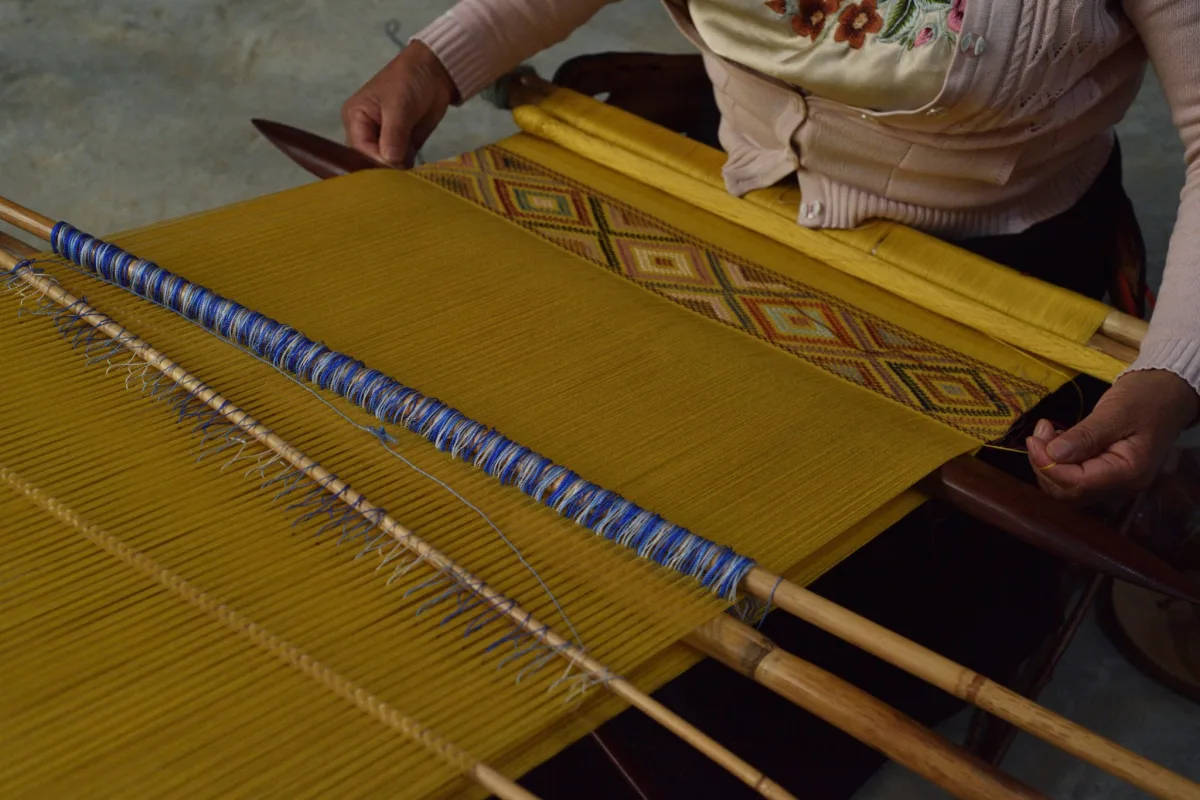
 Photo Courtesy: Representative Image
In October 2025, the Centre slashed GST on handloom shawls and textiles from 12 percent to 5 percent, a move that the Press Information Bureau claimed would boost earnings for nearly 44,000 women weavers across Nagaland. The tax cut applies to items priced up to Rs 2,500, up from the previous threshold of Rs 1,000, and official projections suggest prices could drop by roughly 6.25 percent, making Naga textiles more competitive in domestic and export markets. Yet this headline intervention, announced with the usual fanfare of "inclusive development" and "women empowerment," papers over a deeper dysfunction: the average Naga weaver still earns between Rs 23,000 and Rs 27,000 a year, a fraction of the national handloom average of Rs 64,000 to Rs 98,000 annually, and less than one-fifth of Nagaland's approximate per capita income. The question is not whether tax cuts help, but why a sector that employs tens of thousands of women, preserves irreplaceable cultural knowledge, and enjoys both GI-tag protection and ministerial attention remains locked in structural poverty.
The arithmetic of weaving in Nagaland does not add up to a livelihood. At Chizami Weaves, a producer collective in Phek district that has become something of a model for the sector, 125 weavers collectively earned Rs 29 lakhs in wages during 2023-24, rising to Rs 33.59 lakhs in 2024-25. That works out to roughly Rs 23,200 to Rs 26,872 per weaver per year, or under Rs 2,300 a month. These are not marginal or part-time workers in the conventional sense: they are skilled artisans producing GI-tagged Chakhesang shawls, working on home-based looms, often in remote villages where the nearest market is a day's journey away. The national handloom data tells a different story: average daily earnings of Rs 255 to Rs 313, with working days ranging from 251 to 313 annually. The gap is not explained by skill or effort. It is explained by who controls the yarn, the market, and the margin.
Nagaland produces no yarn locally. Every thread must be imported from Assam, Manipur, or farther afield, inflating input costs before a single shuttle moves. This dependency is not new. A 1981 Census survey of handloom weaving in the state found that "yarn which is the main raw-material required for this industry is not produced locally in Nagaland and they are imported from other parts of the country," making "the cost of production comparatively higher." Four decades later, the same report could be reprinted verbatim. The Yarn Supply Scheme, run through the National Handloom Development Corporation, promises mill-gate pricing and a 10 percent subsidy on hank yarn, but delivery remains patchy in the Northeast. Weavers either buy at retail rates or rely on middlemen who advance credit at usurious terms. The 1981 survey already identified "the role of the mahajans or the businessmen who generally get the major share of profit of the produce" as a core problem. Nothing in the subsequent policy architecture has dislodged this extraction.
The government's response has been a proliferation of schemes with acronyms and modest budgets. The National Handloom Development Programme (NHDP) offers financial assistance for raw materials, marketing, and infrastructure. The Hathkargha Samvardhan Sahayata (HSS) covers 90 percent of loom upgrade costs. The Weaver MUDRA scheme provides concessional credit at 6 percent interest. There are insurance schemes, workshed construction grants, design development programmes, and skill training under SAMARTH. In January 2026, Nagaland's Minister for Women Resource Development, Salhoutuonuo Kruse, stood before the National Textiles Ministers' Conference in Guwahati and made a frank admission: "With no such park currently sanctioned in our state, unlike the 59 parks approved nationwide, including 22 completed ones, Nagaland remains underserved." She asked for an Integrated Textile Park in Dimapur or Kohima, ring-fenced funds under the Production Linked Incentive (PLI) Scheme, and Rs 500 crore in private investment. The plea was precise because the deficit is glaring. Fifty-nine textile parks exist across India. Nagaland has none.
The policy contradiction is stark. On one hand, the Centre celebrates Naga weaving as heritage, exports it to the USA, UAE, and Europe, and collects political dividends from GI-tag ceremonies. On the other, it has not built the processing backbone, the dyeing facilities, the finishing units, or the common worksheds that would let weavers move from subsistence production to genuine micro-enterprise. The 1981 Census found that 7 out of 15 non-practicing households wanted government jobs for their children because "better prospect is not available in the craft." A 2025 study on creative industries in Nagaland confirmed that "insufficient government support" and "lack of cultural industry infrastructure" continue to push youth away from traditional crafts. The sector is aging out. Women who once wove as a matter of cultural duty now do so as a last resort, and their daughters, educated in a system that valorises government service and IT careers, are not picking up the loom.
The GST cut, then, is not irrelevant, but it is insufficient. A 6.25 percent price reduction on a Rs 2,500 shawl yields Rs 156 in savings for the consumer. If any of that flows back to the weaver, it is after the trader, the wholesaler, the emporium manager, and the online platform have taken their cuts. The weaver who sold the shawl for Rs 1,800 may see Rs 1,200 after material costs. The structure of the value chain, not the tax rate, determines who keeps what. Without organised marketing channels, without raw material banks, without the Integrated Textile Park that Minister Kruse requested, the tax cut is a gesture that flatters the policy maker more than it feeds the weaver.
Officials at the Ministry of Textiles contend that the NHDP, the GST rationalisation, and the recent push for technical textiles from bamboo and natural dyes will together lift the sector. They cite the Rs 27,434 crore in MoUs signed nationally in 2025 as evidence of investor appetite. But these are national figures, not Nagaland's. The state's handloom output, as Minister Kruse acknowledged, "lags in industrial scaling." Its potential in technical textiles, in bamboo-based fibres, in natural dyes that align with global sustainability trends, remains "underutilised." The gap between stated national priorities and actual outcomes is not a matter of incremental adjustment. It is a structural failure to treat Northeastern artisanal economies as integral to India's textile future rather than as cultural curiosities to be exhibited at craft melas.
The systemic pattern is clear. Nagaland's weavers are celebrated, photographed, and quoted in press releases. They are not, however, enabled. The policy framework treats handloom as welfare, not industry. It funds training but not market linkages. It subsidises looms but not yarn. It announces tax cuts but builds no parks. The result is a sector that survives on the invisible subsidy of women's underpaid labour, their willingness to work for Rs 2,000 a month because something is better than nothing, and because the alternative, in a state where 92 percent of the population has no vocational training and government jobs are scarce, is often nothing at all.
The question posed at the outset, why tax cuts and GI tags fail to fix a broken value chain, answers itself. They were never designed to. They are surface interventions in a deep structure of dependency, extraction, and neglect. The weaver in Chizami or Kohima or Mon does not need another scheme acronym. She needs yarn at fair prices, a workshed with electricity, a buyer who pays within the month, and a state that treats her craft as productive labour worthy of industrial investment, not as a heritage artifact to be preserved in poverty. Until that shift occurs, every GST cut, every award ceremony, every export brochure will continue to miss the point. The looms will keep clacking. The weavers will keep leaving. And the shawls will keep selling for prices that buy the middleman a car and the weaver a month's rice.
- By Angam Niumai | Independent Researcher
References
Press Information Bureau, "GST Reforms 2025: How Nagaland's Economy Will Gain Across Sectors" (October 2025)
North East Network, "National Handloom Day 2024: Nagaland" (August 2024)
Nagaland Post, "Nagaland Celebrates 11th National Handloom Day" (August 2025)
Nagaland Tribune, "Nagaland Pushes for Integrated Textile Park" (January 2026)
Office of the Registrar General, Government of India, "Handloom Weaving in Nagaland," 1981 Census Study
Ministry of Textiles, Government of India, "Final Revised Guidelines NHDP" (April 2023)
Directorate of Economics and Statistics, Nagaland, "Survey Report on Employment, Unemployment, Skill and Training"
All Social Science Journal, "The Impact of Cultural Heritage on Creative Industry Development in Nagaland" (2025)
Kohima College, "A Brief Study on Nagaland Handloom Industry with Special Reference to Kohima"
Government of Nagaland, Department of Industries and Commerce, "Textile Sector Schemes"

Comments