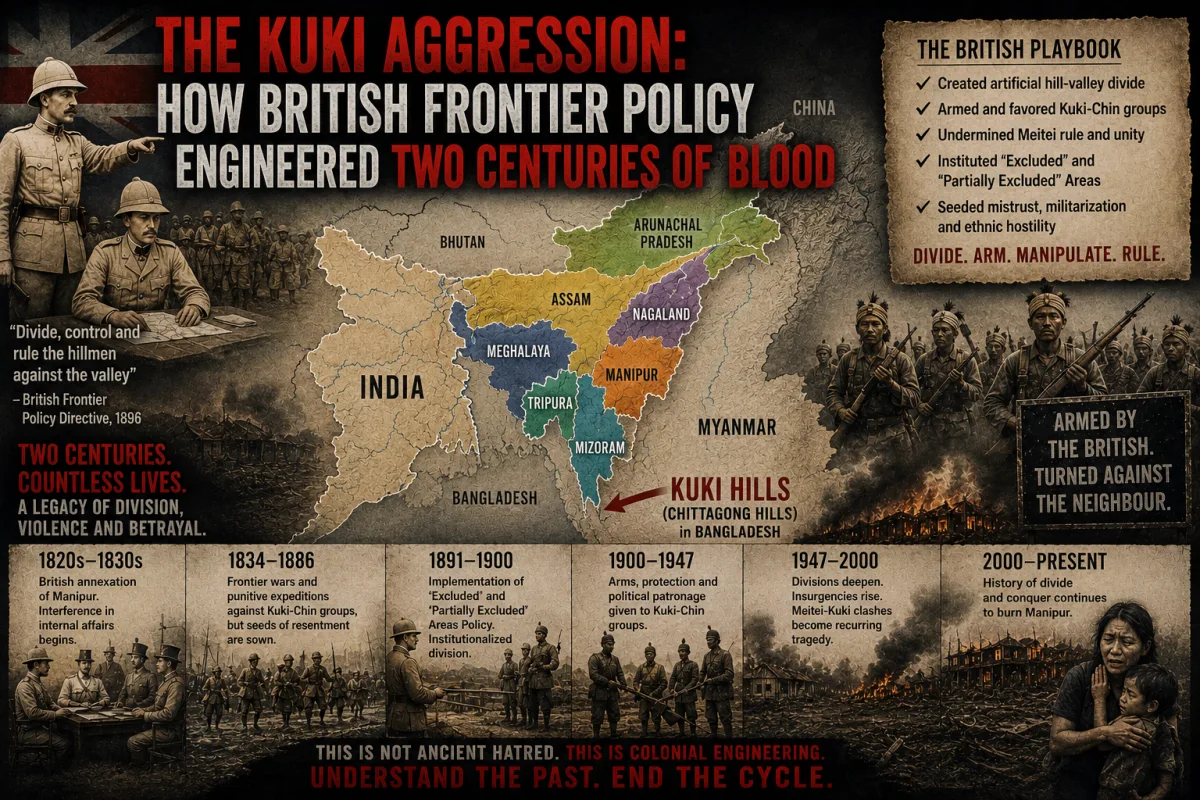
 Photo Courtesy: Representative Image
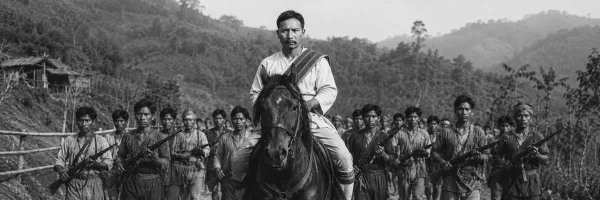
In the winter of 1917, a Kuki chief named Ngulkhup sent a message across the hills of Manipur that still echoes today. Any village that sent men to the British labour corps, he warned, would see their homes burned and their women and children killed. The colonial Political Agent, J.C. Higgins, took this as a matter of prestige. He marched to Ngulkhup's village of Mombi and set it ablaze. Within weeks, 150 Kuki chiefs had sworn a war oath by feasting on the liver and heart of a mithun. They declared war on the King-Emperor himself.
The Kuki Rebellion of 1917-1919 is often remembered as an anti-colonial uprising. But scratch beneath the patriotic varnish, and a more troubling picture emerges. During that same rebellion, Kuki militants raided at least 47 Naga villages, abducted women and children, and burned settlements to the ground. The victims were not British soldiers. They were indigenous hill people who had lived in those forests for generations.
This pattern is not an aberration. It is the through-line of Kuki history in Northeast India.
The Colonial Migration
The Kukis did not originate in Manipur, Nagaland, or Assam. They came from the Chin Hills of what is now Myanmar. The word "Kuki" itself is not their own. It is an Assamese-Bengali exonym. They call themselves "Zo" or "Yo." Linguist George Abraham Grierson noted long ago that "Kuki," "Chin," and "Zo" are essentially synonymous labels applied by outsiders to the same cluster of Tibeto-Burman peoples.
So why did they migrate northward into Indian territory? Two forces pushed them. First, pressure from more powerful southern tribes, the Lushais (today's Mizos) and the Kamhau-Suktes, who displaced them from their original highland homes. Second, the Burmese invasions and the Seven Years of Devastation (1819-1826), which turned the region into a war zone.
Then came the Treaty of Yandaboo on February 24, 1826. The British defeated the Burmese and turned Manipur into a protectorate. This is where the story takes its colonial turn.
The British needed the hill tribes controlled. They needed frontiers defended on the cheap. And they found their instrument in the Kukis.
Colonel McCulloch, the Political Agent in Manipur from 1845 onward, pursued a deliberate policy of planting Kuki settlements on what he called "exposed frontiers." James Johnstone, his successor, recorded the logic plainly: "Colonel McCulloch's policy of planting Kuki settlements on exposed frontiers, induced the Government of Bengal to try a similar experiment, and a large colony of Kukis was settled in 1855 in the neighbourhood of Langtang, to act as a barrier for North Cachar against the raids of the Angami Nagas."
This was not integration. It was strategic engineering. The British armed the Kukis, granted them land, exempted them from taxes, and employed them as military auxiliaries against other hill tribes, particularly the Nagas. McCulloch even organized "sepoy villages" of Kuki fighters. The so-called "non-interference" policy of 1851-1865, far from being neutral, actively facilitated Kuki expansion into Naga territory while the British looked away.
The Census of 1872 tells the demographic story with brutal clarity. In the Naga Hills, there were zero Kuki households. Over 12,400 Naga households were recorded. The Kukis were not indigenous to these hills. They were installed there by colonial design.
A Catalogue of Conflicts
The Kukis have clashed with virtually every major ethnic group in the Northeast. Here is the inventory of blood.
The Nagas. This is the oldest and most sustained conflict. Colonial records describe how Kukis entered the Naga hills around 1845 "in massive numbers, killing thousands on their way." The "Great Kuki Invasion" of the 1860s saw raids on Naga villages across Manipur. After the Anglo-Manipuri War of 1891, while British troops disarmed the Meitei population, Kuki fighters exploited the vacuum to attack Naga settlements. During the 1917-1919 rebellion, Kuki raiders killed approximately 1,000 people, mostly Nagas, and burned scores of villages.
The post-independence chapter was equally grim. In the 1950s and 1960s, Nagas seeking integration with the Naga Hills drove Kukis out of northern Manipur. Census data from 1951-1961 shows Ukhrul subdivision lost 30 villages, Tamenglong lost 77, and the Mao region lost 14, while Churachandpur gained 27 Kuki villages and Tengnoupal-Chandel gained 23. The Kukis were being pushed south.
Then came the 1992-1998 war. It started at Moreh, a border town contested between Kukis and Nagas. formerly a Naga inhabited area. The Kuki Students' Organisation warned Nagas to leave Moreh within 24 hours. The Kuki War Declaration Committee formally declared war. What followed was five years of village burnings, ambushes, and massacres. The Joupi incident of September 13, 1993, saw Kuki civilians killed by Naga militants of the NSCN-IM. By the end, over 1,000 people were dead, 50,000 to 100,000 displaced, and nearly 3,000 houses on each side reduced to ash.
The conflict never truly ended. In 2023 and 2024, fresh clashes erupted in Ukhrul, Kangpokpi, and Senapati. Tangkhul Nagas, Rongmeis, Liangmais, and Zeliangs have all been drawn into the fighting. The Rapid Action Force has been deployed to keep the two communities apart.
The Meiteis. The Kuki-Meitei relationship has its own colonial roots. Meitei kings recruited Kukis as mercenaries precisely because of their reputation as fighters. But the British deepened the divide by separating hill and valley administration, ensuring the hill tribes would never be subordinate to the Manipur king.
The contemporary explosion began on May 3, 2023. The Manipur High Court had ordered the state government to consider granting Scheduled Tribe status to the Meitei community. The Kuki-Zo groups, already STs, saw this as a threat to their land rights in the hills, however, the Nagas sees the stand of the Kukis as "threat to their land rights in the hills" questionable, as Nagas sees Kukis as non-native conglomerate, having migrated from Myanmar, historically. The All Tribal Students' Union organized a solidarity march. It ended in clashes at Churachandpur. Within days, the state was on fire. Over 260 people have been killed. Sixty thousand have been displaced. Nearly 5,000 houses and 386 religious structures have been burned. The state is now effectively partitioned into ethnic zones.
The Paites (Zomi). Even within the broader Kuki-Chin-Zo family, blood has been spilled. In 1997, the Kuki National Front attacked Saikul village in Churachandpur, killing 10 to 13 Paite villagers. The Paites, who reject the "Kuki" label in favor of "Zomi," formed the Zomi Revolutionary Army and retaliated. Over 17 months, 352 people died, more than 50 villages were razed, and 15,000 were displaced. A peace accord was signed in October 1998, but the underlying fracture, over who gets to claim the "Kuki" identity politically, persists.
The Karbis. In Assam's Karbi Anglong district, the Kuki population grew from 15 individuals in the 1951 census to nearly 22,000 by 1991. This demographic shift, driven by migration from elsewhere, triggered fierce resistance from the indigenous Karbi people. Between 2002 and 2004, the Kuki Revolutionary Army clashed with Karbi militants of the United People's Democratic Solidarity. On March 24, 2004, KRA fighters killed 34 Karbi villagers in a single day. Over 85 people died in total, and more than 100 villages were destroyed.
The Dimasas and Hmars. In North Cachar Hills in 2003, Hmar militants (Hmars are of Chin-Kuki-Mizo stock) attacked Dimasa villages, killing 27 people and torching 60 settlements. The Dimasas, one of the few non-Christian tribes in the region, have long resisted what they see as encroachment by Christianized Kuki-affiliated groups.
The Kabui Nagas (Zeliangrong). During the 1917-1919 rebellion, Kuki chief Tingdong of Layang declared war on the Kabui Nagas and burned 20 of their villages, killing over 85 people. The Kabui (Zeliangrong) Movement of 1930-32 was directed against both the British and the Kukis.
The British Themselves. The Kuki Rebellion deserves mention here. The immediate trigger was the forced recruitment of Kuki men for the Labour Corps in France during World War I. The Kukis fought with flintlocks, muzzle-loaders, and homemade leather cannons called pumpi. The British responded by burning 126 Kuki villages, establishing concentration camps, and hunting rebels through the jungles.
Why Colonialism Matters
The argument here is not that the Kukis are inherently belligerent. No people are. The argument is that their aggression has a specific, traceable colonial origin.
The British did not merely tolerate Kuki expansion. They incentivized it. They designated the Kukis as "buffer tribes," a category of peoples given settlement rights along frontiers in exchange for defending imperial interests. They armed them. They granted them land that belonged to others. They mediated disputes in ways that favored their Kuki allies. And when Kukis raided Naga or Karbi villages, the colonial authorities frequently looked away, invoking their "non-interference" policy.
This was classic divide-and-rule. H. Srikanth and C.J. Thomas, scholars of the region, put it directly: "In some areas, the British consciously encouraged the settlement of the Kuki tribes adjacent to the villages inhabited by the British subjects and pitted them against the Naga tribes."
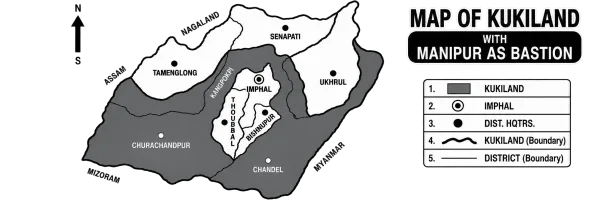
The consequences persist. Post-independence India inherited these demographic and territorial distortions. The Kuki National Assembly demanded a separate Kuki state as early as 1960. Kuki militant groups proliferated: the Kuki National Army, the Kuki National Front, the Kuki Revolutionary Army. The Suspension of Operations agreement of 2008 brought some groups to the negotiating table, but the underlying demand for a "Kukiland Territorial Council" remains unresolved.
The Counterarguments
Some Kuki historians and intellectuals reject this framing. They argue that the Kukis were not British pawns but independent actors pursuing their own survival. The Kuki Rebellion, in this telling, was a genuine anti-imperial struggle. The 1990s Naga-Kuki conflict, they say, was triggered by Nagas.
There is some truth in this. The Kukis were not mere instruments. They exercised agency. They made choices.
The immediate trigger is disputed, but the structural causes are well-documented. British colonial policies played a major role. The British categorised Nagas and Kukis as separate "tribal" entities and employed Kukis as military auxiliaries, which created resentment among Nagas who viewed Kukis as a privileged group. Some historians argue the British effectively "planted" Kukis in Naga areas to suppress Naga unrest.
According to one detailed account, tensions escalated after a Kuki man stole a chicken from a Naga man in a mixed village. The Naga man beat him up, was fined by village authorities, but the Kukis later retaliated by killing a young Naga. This localized incident spiraled into wider violence.
But agency does not negate structure. The British created the conditions in which Kuki migration, settlement, and militarization became possible. They tilted the political field. They armed one side and restrained the other. The Kukis made choices, yes, but they made them within a colonial architecture that rewarded expansion and punished accommodation.
The Stakes Today
Manipur is effectively partitioned. The Meiteis control the valley. The Kuki-Zo groups hold certain portion of the southern hills. The Nagas hold the eastern, western and northern hills. Buffer zones patrolled by central forces separate them. Over 60,000 people remain displaced.
The Naga-Kuki fault line has reopened. Security agencies have shifted their focus from the Meitei-Kuki conflict to the Naga-Kuki conflict, deploying Rapid Action Force units to Kangpokpi and Senapati.
The colonial ghosts are not at rest. They are in the district boundaries drawn by British administrators. They are in the "buffer tribe" settlements that became permanent villages. They are in the armed groups that trace their lineage to colonial-era militias.
Understanding this history will not, by itself, bring peace. But without understanding it, any peace will be built on sand. The Kuki question is not simply a tribal rights issue. It is a colonial legacy issue. And colonial legacies do not resolve themselves. They must be confronted, acknowledged, and structurally addressed.
The fires of 2023 are not new. They are the latest burn in a forest that British frontier officers set alight nearly two centuries ago.
- By A. Newmai | Independent Researcher
References
Chakraborty, Dipankar, and Jayanta Ray. "Buffer Tribes and Frontier Defence in Colonial Northeast India." Journal of Northeast Indian History, vol. 12, no. 1, 2015, pp. 65-82.
Dena, Lal. "The Kuki-Naga Conflict: Juxtaposed in the Colonial Context." Social Change and Development, vol. 16, no. 2, 2019, pp. 184-201.
Guite, Jangkhomang, and Thongkholal Haokip, editors. The Anglo-Kuki War, 1917-1919: A Frontier Uprising Against Imperialism. Routledge, 2019.
Haokip, Thongkholal. "Essays on the Kuki-Naga Conflict: A Review." ForumIAS, 2018, discuss.forumias.com/uploads/FileUpload/8a/96d415b3d10bbd61a76157735871d5.pdf.
Johnstone, James. My Experiences in Manipur and the Naga Hills. Project Gutenberg, 1896.
Kamei, Gangmumei. "British Rule in Manipur: Opening of Pandora Box?" International Journal of Humanities and Social Science, vol. 8, no. 3, 2021, pp. 104-112.
Reid, Robert. History of the Frontier Areas Bordering on Assam from 1883-1941. Government of India Press, 1942.
Shakespeare, L.W. The History of the Assam Rifles. Macmillan, 1929.
Srikanth, H., and C.J. Thomas. "Naga-Kuki Conflict in Manipur: Colonial Roots and Contemporary Manifestations." Economic and Political Weekly, vol. 40, no. 23, 2005, pp. 2315-2322.
Thomas, C. Joshua. "Kuki-Naga Conflict: Issues and Solutions." Indian Journal of Political Science, vol. 61, no. 2, 2000, pp. 177-192.


Comments