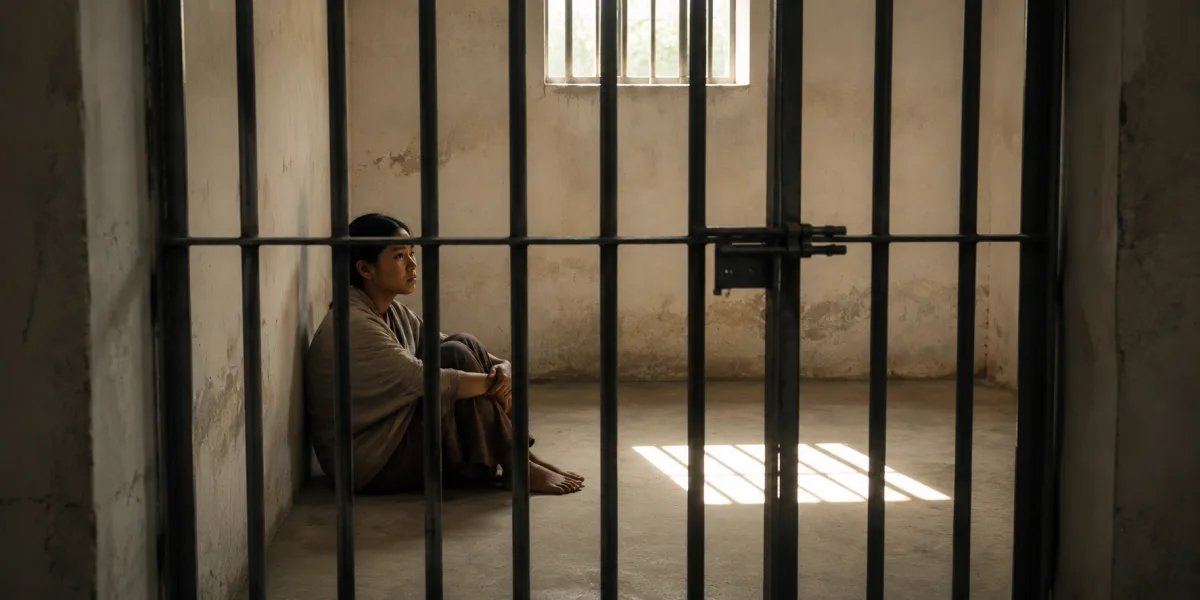
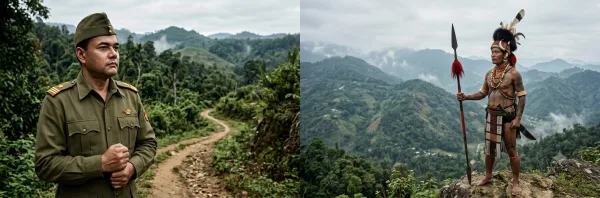
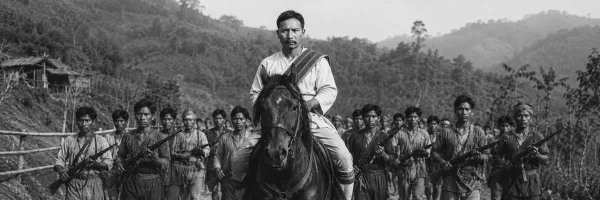
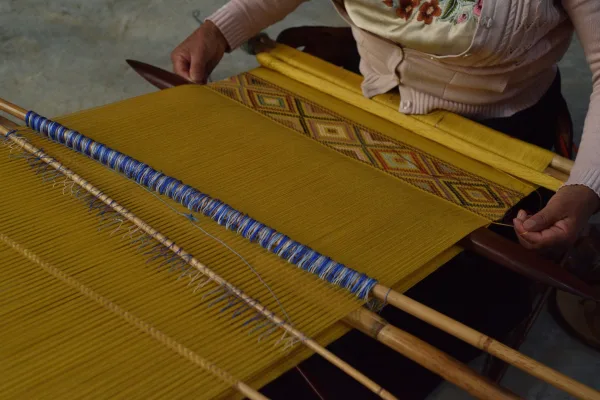
 Photo Courtesy: Representative Image
"The untold story of Rani Gaidinliu, the Naga teenager who led a spiritual and political rebellion against British rule, spent 15 years in prison, and built an underground government to protect her people's culture and rights."
"Story of the Naga girl at the center of Zeliangrong reform & rebellion"
In 1937, while touring the North East, Nehru repeatedly heard about a girl who had served about five years of her life imprisonment. He insisted on meeting her and travelled to Shillong Jail to meet the prisoner.
She was not a Congress worker. She had never addressed a political rally. She had never attended a university or written a manifesto. Until a few years earlier, she had scarcely stepped beyond the hills where she was born.
She was only twenty-two years old. She came from a remote Naga village that barely figured in the national story of the freedom movement. Yet the British Empire considered the young tribal woman dangerous enough to imprison for life.
Nehru left the prison carrying her story with him.
“India does not even know of this brave child of her hills,” he wrote afterwards. In the same essay, he called her Rani - a title that would remain with her long after both the prison and the empire had disappeared.
Her real name was Gaidinliu.
Today, outside the hills of Manipur, Nagaland and Assam, few remember Gaidinliu. Fewer still remember the prophet whose unfinished revolution she inherited.
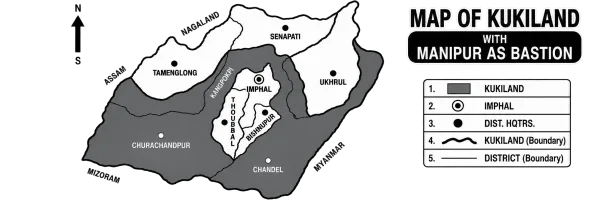
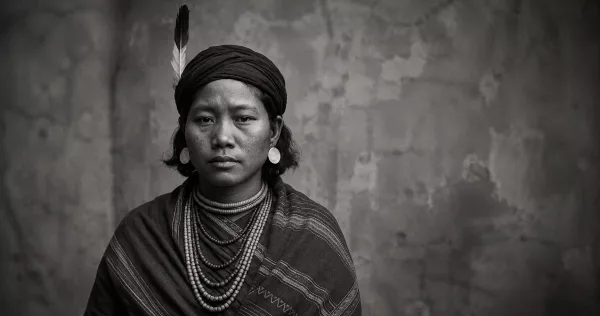
Across the forested hills in India’s North East and western Myanmar lived dozens of tribes - Angami, Ao, Konyak, Tangkhul, Sumi, Lotha, Mao, Maram, Rongmei, Liangmai, Zeme and many others. They spoke different languages, wore distinctive shawls and ornaments, celebrated different festivals, and preserved their own genealogies, songs and origin stories. Yet to an outsider, they also shared a recognizable world - villages perched on ridges, shifting cultivation carved into the hillsides, great communal feasts, richly carved log drums, and a cosmology in which forests, rivers, mountains and ancestors were all alive with unseen presence.
For centuries, allegiance had seldom extended beyond the village and the tribe. A man was first Rongmei or Angami, Tangkhul or Konyak, before he was anything else. Even neighbouring villages of the same tribe guarded their autonomy with remarkable jealousy. What later generations would call a Naga identity was still taking shape.
Somewhere between the tribe and this larger idea stood identities like ‘Zeliangrong’ and ‘Chakhesang’ - not new tribes, but unions of kindred ones occupying a space that was broader than a tribe but smaller than a cultural universe.
The Zeliangrong brought together the Zeme, Liangmai and Rongmei while the Chakhesang united the Chakru, Khezha and Sang. Three peoples whose languages belonged to the same family, whose sacred geography overlapped, and whose oral traditions often traced their beginnings to a common ancestral homeland. It allowed people to be Rongmei and Zeliangrong, or Chakru and Chakhesang, without surrendering either identity. These identities did not replace one another; they nested within each other like rings in a tree.
In this middle space a religious movement was born that brought together three kindred peoples without claiming to speak for all Nagas.
The Zeliangrong had no scripture to consult, no temple where the divine could be confined, and no single priesthood that mediated between heaven and earth. The sacred lived instead in caves and lakes, forests and village gates, household hearths and ancestral stones. Above them all was the supreme creator. But everyday life unfolded in the company of countless unseen presences - spirits of the hills, the forests, the rivers and the ancestors who were believed to watch over the living.
Religion was not separated from the ordinary business of life. Before sowing a field, setting out on a hunt or embarking on a journey, people looked for omens. Dreams were discussed with the seriousness of legal testimony. The flight of an animal, an unexpected storm or an unexplained illness were not dismissed. It was a world dense with symbols, where the visible and the invisible constantly overlapped.
The hills had long believed that the divine spoke through signs - but usually in whispers. It was simply a question of learning how to listen.
Such worlds have always made room for visionaries. The hills had known priests, healers and diviners before. What they had not yet seen was someone who would claim that the divine was speaking not merely about the next harvest or the next hunt, but about the destiny of an entire people.
Jadonang was born in 1905 in the village of Kambiron, in present-day Manipur. By all accounts, there was little in his circumstances to suggest that he would one day alter the course of his people’s history.
As a boy, Jadonang was said to spend long hours alone, slipping into trances that worried his family. He later claimed that he was not possessed but in conversation with the supreme creator. Whether these accounts belong to history or hagiography is impossible to know. What matters is that they became the foundation of his authority. People began to seek him out as a healer, a diviner and an interpreter of dreams.
His journeys took him to places that had been sacred long before his birth. He made repeated pilgrimages to the limestone cave at Bhuvan in the Cachar Hills, where generations of Zeliangrong believed the divine could be encountered. He prayed beside the sacred waters of Zeilad Lake, around which ancient taboos and legends had accumulated over centuries. Here, according to tradition, he received the revelations that would define his life.
Yet Jadonang was no iconoclast. He did not denounce the faith of his ancestors, nor did he proclaim a new god. If anything, he argued that the old religion had drifted too far from its source with too many rituals and sacrifices.
He did not found a new religion. He tried to purify an old one which over time evolved into Heraka, literally meaning – to purify.
The hills were changing at the time when Jadonang spoke of purifying an ancient faith.
British authority, once little more than an occasional presence beyond the valleys, was climbing steadily into the highlands. House taxes were imposed on villages that had never known an external sovereign. Men were compelled to carry the baggage of touring officials across mountain trails without payment. Missionaries arrived with schools, new scriptures and a faith that questioned the old order. A world that had long governed itself was being asked to submit - to a new administration, a new religion and a new idea of authority.
Jadonang’s response was not political in the conventional sense. He did not ask his people to build an army or draft a manifesto. He asked them to recover what they had begun to lose. Worship the supreme creator once more. Strip away rituals that had become burdensome. Pray together. Return to the sacred places. Purify the faith of the ancestors.
Then his visions changed.
The whispers that had once spoken of harvests and healing now spoke of history. A new kingdom was about to descend upon the hills. British rule would end. House taxes would vanish. Forced labour would cease.
Within a few years, villages across the hills had stopped paying taxes, refused government labour and begun preparing for a different future. Prayer houses appeared where none had stood before. A religious revival had become a political movement.
The kingdom he promised never arrived in the form his followers expected. But he altered history in ways neither he nor the British could have imagined.
Among those who began making the journey to Jadonang was a thirteen-year-old girl, Gaidinliu.
History tells us that she was Jadonang’s younger cousin who joined his growing movement around 1927. Tradition speaks of her having recurring dreams, visions that unsettled her, and a conviction that only the young prophet Jadonang could explain.
For the next four years, she became Jadonang’s closest disciple. She accompanied him on his journeys through the hills, watched him heal the sick and interpret dreams. She joined him on pilgrimages to sacred caves and lakes and listened as his message slowly evolved from religious reform into something much larger. She was still a child. But she was learning a faith in transition.
By this time, the healer had become far more dangerous than a mystic. He had become a rebel, the centre of a movement.
In August 1931, Jadonang was tried for the murder of four Manipuri traders in a case that many of his followers believed had been contrived to silence him. He was hanged in Imphal at the age of twenty-six.
The prophet was dead. The movement lost its leader.
But the movement he had set in motion did not stall. The apprentice standing quietly beside him would inherit a future she had never been preparing for.
There is no evidence that Jadonang formally named her his successor. Nor do we know whether either of them imagined that she would one day lead the movement. She appears in the historical record as a quiet presence at his side - a student absorbing lessons whose significance neither teacher nor disciple could yet fully grasp.
She was sixteen. An age when most children are still trying to understand the world they have inherited, Gaidinliu was asked to inherit a revolution.
Nothing in Gaidinliu’s childhood suggests she was being groomed for command. She had followed Jadonang to learn, to pray and perhaps to understand her own visions. Leadership was not her ambition but an obligation.
Within weeks of Jadonang’s execution, the quiet disciple who had spent four years at his side emerged as the movement’s unlikely leader. She did not claim to be another prophet. Nor did she alter the message she had inherited. The prayer meetings continued. The worships continued. Villages continued to resist house taxes and forced labour. What changed was not the vision, but the urgency with which it had to be defended.
Gaidinliu charted a more courageous path than her teacher.
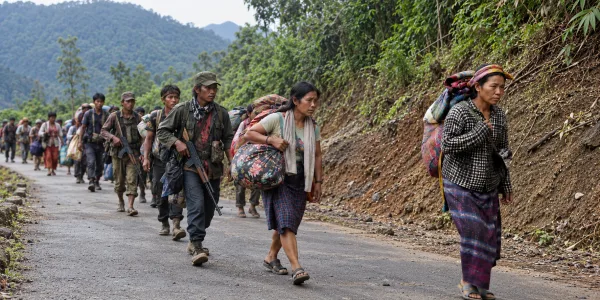
She abandoned the stillness of sacred caves for the uncertainty of mountain trails. Moving from village to village across the forests of present-day Manipur, Nagaland and Assam, she kept together a network that the British believed would disintegrate with Jadonang’s death. Young men and women rallied around her. Villages sheltered her. Rewards were announced for information leading to her capture. One proclamation even promised a remission of house taxes to any village that betrayed her whereabouts.
Jadonang had travelled the hills as a prophet. Gaidinliu travelled them as a fugitive. He had gathered people around prayer houses. She gathered them into mobile bands that could disappear into forests before the Assam Rifles arrived. He had spoken of a kingdom to come. She had to keep the movement alive long enough for anyone to believe it still could.
What had been centred on one prophet became a dispersed network. The rebellion became more disciplined, more elusive and, from the British point of view, more dangerous than before. Villages that sheltered her risked collective punishment. Yet followers continued to appear, convinced that Jadonang’s death had not ended the struggle but merely passed it into younger hands.
For little more than a year, the hills held their breath.
In October 1932, British forces surrounded the village where her followers had gathered. They captured the seventeen-year-old girl and sentenced her to life imprisonment. She would not walk free again for another fifteen years.
Gaidinliu had managed to keep the idea alive. That idea outlived both the prison that awaited her and the empire that built it.
Those fifteen years left few dramatic episodes for history to record. Moved from one prison to another across the Northeast, she watched the movement she had inherited continue without either its prophet or its young leader. For a while, it seemed as though both the rebellion and the religion they had tried to reshape would fade quietly into memory. It did not.
After their meeting in 1937, Nehru tried unsuccessfully to persuade the British to release her. They refused. Even after five years behind bars, they believed she remained capable of rekindling the movement that had unsettled their rule in the hills.
She finally walked free in October 1947, two months after India became independent.
But freedom came to her with an unexpected condition.
She was not allowed to return immediately to her native hills. She found herself living for several years in what was, in effect, a quieter form of exile. The empire had disappeared. The anxieties surrounding her had not.
The country she stepped into was no longer the one she had left. Jadonang was gone. The rebellion had ended. Even the British Empire that had imprisoned her had disappeared.
Christianity had spread rapidly across the Naga Hills. New political movements spoke in the language of nationalism rather than prophecy. The struggle that had begun with Jadonang had been overtaken by a very different age.
Those who expected Gaidinliu to retire quietly misunderstood her. She refused to disappear into history.
She returned to the forests once again, organising what came to be known as the ‘Rani Government’ - an underground network that occupied a curious space in the politics of the hills. It reportedly had around 1,000 followers, several hundred firearms, village-level organization, local administrative structures. It was an effort to protect the ancestral faith of Zeliangrong people.
It created a strange triangle. Instead of a simple binary, the hills now had three centres of power. Government of India, Naga movement insurgency and the Rani Government. Each disagreed with the others.
It was one of the most unusual episodes in independent India’s early history. A former prisoner of the British, now leading an underground movement that was neither a rebellion against India nor an ally of the mainstream Naga politics.
The struggle that would ultimately define her was not political or military. It was civilizational.
Over the following decades, she devoted herself to giving permanence to what Jadonang had left unfinished. Rituals that had once travelled only through memory were codified. Prayers were collected. Worship was organised. The faith that had begun as scattered revelations in villages, caves and forest clearings gradually acquired a durable institutional life.
If Jadonang had imagined Heraka, Gaidinliu made it possible for later generations to inherit it.
That may also explain one of the quieter paradoxes of the Zeliangrong today. Most have embraced Christianity. Many hold political views far removed from Gaidinliu’s own. Yet they continue to celebrate festivals such as Gaan-Ngai, remember the same ancestral landscapes, and recognise a shared Zeliangrong identity. Faith changed. Politics changed. Culture proved more enduring.
Perhaps that is Gaidinliu’s most lasting legacy. Not that she won a rebellion, or fulfilled a prophecy, but that she refused to let an entire cultural inheritance vanish in the turbulence of the twentieth century.
History remembers her as Rani Gaidinliu.
The hills remember something else. That a message once whispered in a sacred cave did not end on the gallows at Imphal or behind the walls of Shillong Jail. It endured because, for sixty years after the prophet fell silent, one woman refused to let it be forgotten.
This article by Zeyaur Rahman, author of 'A River Remembers' and writer of the weekly Substack series @zeyaurrahmanshah was originally published on Substack and is re-published on NEWire.in with due permission. This article draws on the scholarly research of Prof. Ajailiu Niumai, 'Rani Gaidinliu: The Iconic Woman of Northeast India,' Indian Journal of Gender Studies, SAGE Publications, 2018.

Comments