"The article by Sr. Prof. K. Yugindro Singh examines census data, population trends, legacy records, the India-Myanmar border, and the ongoing debate over immigration, demography, land, identity and the proposed implementation of NRC before Census 2027."
1. The National Register of Citizens (NRC), 1951 in the context of Manipur
The National Register of Citizens (NRC), 1951, is an official record created simultaneously with the 1951 Census. It was compiled across India. The NRC, 1951 listed all legal Indian citizens by name, age, occupation, village and household. The cut-off date for NRC, 1951 was 26th January 1950 as defined by Article 5 of the Constitution of India (Vaghaiwalla, 1954, pp.27). In Manipur, the NRC, 1951 was conducted along with 1951 Census during 1951-53. The NRC, 1951 data for Manipur was preserved in manuscript as permanent records in the custody of then Manipur District Office. During those days Manipur was a Part C State with a single district directly ruled by the Government of India through a Chief Commissioner.
In Manipur, the post 1951 illegal immigrants refers broadly to undocumented individuals and foreign nationals from neighbouring countries - primarily Myanmar, Bangladesh, and Nepal -who entered and settled in the state after the 1951 Census without valid legal documents or permits. All illegal immigrants taking settlement in Manipur, post the 1951 Census, may be detected and identified precisely by means of the NRC 1951, the 1951 Census Report, the 1951 Village directory, and the Electoral Rolls of 1948 in pursuance of the provisions under Article III of the Contract of Agreement dated 8th August 1994 signed between the Government of Manipur and the All Manipur Students’ Union (AMSU) when Manipur was under the President’s Rule (31.12.1993 – 13.12.1994).
Notably, on August 5, 2022, the Manipur Legislative Assembly took a resolution to introduce and enforce the National Register of Citizens. Again, on March 1, 2024, the same Assembly resolved to reaffirm its earlier resolution passed on August 5, 2022 and to urge the Government of India to implement the National Register of Citizens in Manipur in the interest of the State.
2. The dynamics of the influx of immigrants into Manipur
The dynamics of the influx of immigrants into Manipur since its merger with India on 15th October 1949, may be grasped, by taking into consideration the changes in the rules of administration dealing with entry of foreigners (Non-Manipuris) into the State. On 26 September 1950, the so-called Free Movement Regime (FMR) came into force through a notification issued by the Ministry of Home Affairs, whereby the “hill tribes, who is either a citizen of India or the Union of Burma and who is ordinarily a resident in any area within 40 km (25 miles) on either side of the India-Burma frontier” were exempted from the carrying passport or visa while entering into India (Das, 2024). Manipur was badly affected by FMR since it has 398 km long porous border with Burma (now called Myanmar). Further, the age-old Permit System of Manipur which was a very effective system of controlling the entry of foreigners (Non-Manipuris) into the State was abolished on 18th November 1950 by Himmat Singh, then Chief Commissioner of Manipur. Further, the Government of India notified, on 20 September 1951, the first Scheduled Tribes list of Manipur comprising of ‘Any Kuki Tribe’, ‘Any Lushai Tribe’ and ‘Any Naga Tribe’. Since the traditional hereditary chieftainship has been prevalent among the Kuki-Zo communities, all immigrants from Burma (now called Myanmar) and the Lushai Hills (now Mizoram) could easily seek settlement in the Hill Areas of Manipur under the patronage of Kuki-Zo chiefs and subsequently, obtain the tag of ‘Scheduled Tribe’ primarily by means of permanent resident certificates issued by the chiefs. After being recognized as Scheduled Tribes, all such Myanmar refugees/ illegal immigrants enjoy the various rights, privileges, safeguards, and protections under various provisions of the Constitution of India, various laws/acts and various welfare schemes of the Government of India. The Chin people in Myanmar are a part of a wider Kuki-Zo ethnic family with shared common ancestry, languages, and family networks. They have preference to live in India for better economic security, safety and easier living hood. Other factors for migration of the Chin people from Myanmar to Manipur are political instability, civil conflict, and military rule in Myanmar. For the Chins, moving to Manipur means joining their kin communities who can offer refuge.
3. Kuki-Zo communities inhabited in Manipur
Currently, the Scheduled Tribes list of Manipur comprises of 34 tribe names viz., 1. Aimol, 2. Anal, 3. Angami, 4. Chiru, 5. Chothe, 6. Gangte, 7. Hmar, 8. Kabui, Inpui, Rongmei, 9. Kacha Naga, Liangmai, Zeme, 10. Koirao, Thangal, 11. Koireng, 12. Kom, 13. Lamgang, 14. Mao, 15. Maram, 16. Maring, 17. Any Mizo (Lushai) tribes, 18. Monsang, 19. Moyon, 20. Paite, 21. Purum, 22. Ralte, 23. Sema, 24. Simte, 25. Suhte, 26. Tangkhul, 27. Thadou, 28. Vaiphei, 29. Zou, 30. Poumai Naga, 31. Tarao, 32. Kharam, 33. Any Kuki tribes, and 34. Mate.
In the above list of Scheduled Tribes, the names of the tribes belonging to the Kuki-Zo communities are: Gangte, Hmar, Any Mizo (Lushai) tribes, Paite, Ralte, Simte, Suhte, Thadou, Vaiphei, Zou, Any Kuki tribes and Mate.
4. Historical context for immigration of Kuki-Zo people to Manipur
Historically, a large number of Lushai (Mizo) people and related Kuki-Zo people poured into Manipur in the post-1951 Census, being primarily driven by the 1958–1960 Mautam (the flowering of bamboos) Famine. This famine was caused by an alarming population explosion of rats that devastated crops and food supplies in the Mizo Hills, thereby causing severe starvation and forcing many to migrate or seek relief elsewhere. Relief measures obtained from then Government of Assam were far from adequate. A group of young men came together to render relief and organized themselves to form the Mizo National Famine Front (MNFF) headed by Mr. Laldenga in 1961 (Siamkhum, 2013, pp.201). After the famine was over, this social service organization was converted into a political party, known as the ‘Mizo National Front (MNF)’. In February 1966, the MNF started a very aggressive insurgency movement demanding a sovereign Mizoram. To counter the insurgency, the Indian military implemented a harsh "village grouping" policy, forcibly relocating nearly 80% of the Mizo hill population into controlled camps while burning down uncooperative villages. This caused widespread displacement. The displaced people fled across porous borders into neighbouring States including Manipur and took refuge among the Kuki-Zo communities of Manipur who share deep ethnic, cultural, and linguistic affinities.
Again, major political crises in Burma (now Myanmar) pushed waves of people across the border into Indian Territory especially in Manipur. These included movements following the 1962 military coup, the 1967 military operations, the 1987–1988 pro-democracy uprisings and the subsequent military crackdowns, and the 2021 military takeover. The 2021 military coup in Myanmar has resulted in a new and intensified wave of migration into neighbouring Indian States like Manipur and Mizoram, pushing local administrative capacities to the brink. The 398 km long border between Manipur and Myanmar remained largely unmonitored and unguarded, making cross-border movement relatively easy. Similarity of ethnicity of Chin communities of Myanmar and the Kuki-Zo communities already settled in various parts of Manipur makes the cross-border movement easier for the Chin refugees. These repeated political upheavals in Myanmar have made the Indo-Myanmar border porous not only to fleeing civilians, but also, in some instances, unregulated activities including narcotics trafficking, arms smuggling, and undocumented settlements. The impact on Manipur has been particularly acute-stretching public resources, disrupting the social fabric, and posing a direct threat to indigenous identity and territorial integrity.
5. Pattern of Kuki-Zo immigrants in Manipur
The pattern of Chin-Kuki-Zo immigrants from the Chin Hills in Myanmar and the Lushai (Mizo) Hills to Manipur, since the British colonial days, may be inferred from the census figures and the associated Population Growth Rates. Table 1 displays the Census figures of Kuki-Zo people in Manipur from the 1881 Census to 2011 Census. This Table reveals that the population of Kuki-Zo people in Manipur increased from 17,204 in 1881 to 4,48,214 in 2011 corresponding to annual population growth rate of 19.3% for the period 1881-2011. Notably, the Census 2011 included a special category called “Generic Tribes” with population 20,806. There are eight Kuk-Zo tribes under Generic Tribes with a total population of 8962 with the distribution: Gangte-218, Hmar-227, Kuki-614, Lushai/Mizo-45, Paite-846, Thadou-5190, Vaiphei-336, Zou-1486. If the population of Kuki-Zo tribes under “Generic Tribes” is taken into account, the actual annual population growth rate of Kuki-Zo tribes during 1881-2011 would be 19.67%. Thus, the growth rate exhibited by Kuki-Zo people in Manipur far exceeds average annual population growth rate of Manipur (9.17%) for the same period 1881-2011.
Table 1: Pattern of population growth of Kuki-Zo in Manipur during 1881-2011
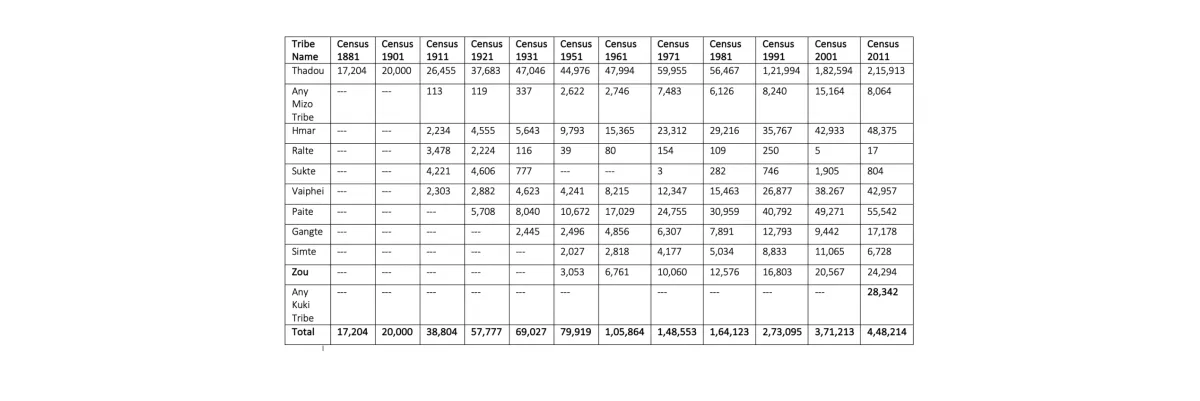
Census of India Reports published by Government of India
From Table 1 it is clear that the Thadou was the only tribe of the Kuki-Zo family who had settled in Manipur prior to the 1911 Census. Grierson reported that the Thadou tribe formerly lived in the Lushai and Chin Hills (Grierson, 1904, pp.59). Grierson also wrote: “The Lushai Chief Lallüli began, about the year 1810, to move northwards, and the Thados were gradually expelled from the Lushai Hills, and settled down in Cachar somewhere between 1840 and 1850. About the same time the Thados of the Chin Hills were conquered by the Soktes under their chief Kantum, and were driven towards the north into Manipur, where they settled down in the hills to the south. There are now only six Thado villages left in the Chin Hills.” (Grierson, 1904, pp.59).
From Table 1, it is evident that five new members of the Kuki-Zo family viz., Mizo, Mhar, Ralte, Sukte and Vaiphei migrated to Manipur during 1901-1911 taking advantage of the weak administration in the Manipur Hills, post the Anglo-Manipur war, 1891 in which Manipur faced defeat at the hands of the British. Again, during the period 1911 -1931 two more members of the Kuki-Zo family viz., Paite and Gangte took settlement in Manipur, that too by taking advantage of the weak administration in the Manipur Hills. All of these new immigrants formerly lived in the Lushai Hills (now Mizo Hills) and the Chin Hills in Burma (now Myanmar). Thus, according to Table 1, the members of the Kuki-Zo family who had migrated to Manipur, post 1901 and up to 1931 were Thadou, Mizo, Hmar, Ralte, Sukte, Vaiphei, Paite and Gangte. The 1951 Census data show the entry of two more new tribes viz., Simte and Zou, thereby hinting that they had entered into and taken settlement in Manipur during 1931-1951.
In the 2011 Census, an ambiguous tribe name ‘Any Kuki Tribes’ with a population of 28,342 appeared. The tribe name ‘Any Kuki Tribes’ was present in the first Scheduled Tribes list of Manipur vide the Constitution (Scheduled Tribes) (Part C States) Order, 1951 dated 20.09.1951. However, the said Order dated 20.09.1951was modified by the Scheduled Castes and Scheduled Tribes Lists (Modification) Order, 1956 dated 29.10.1956 whereby the tribe name ‘Any Kuki Tribes’ was deleted and replaced it by the particular names of the individual tribes such as Thadou, Paite, Hmar, Vaiphei, Gangte, Ralte, Simte, Suhte, Zou etc., in consonance with the recommendation of the Backward Classes Commission headed by Kaka Kalelkar. Again, the tribe name ‘Any Kuki Tribes’ was reintroduced in the Scheduled Tribes list of Manipur by the Scheduled Castes and Scheduled Tribes Orders (Amendment) Act, 2003 notified on 7 January 2003 consequent upon a recommendation of the State Government made in November 2002. Obviously, the entire population of 28,342 under the newly introduced tribe name ‘Any Kuki Tribes’ in the 2011 Census must be new comers to Manipur after the issuance of the ST list, 1956 dated 29.10.1956 since all the tribes covered by the earlier tribe name ‘Any Kuki Tribes’ in the ST list, 1951 had already been accommodated by the ST list, 1956.
The presence of illegal immigrants tribe-wise in the population data, post the 1951 Census, may be inferred from the decadal population growth rates manifested by the subsequent censuses i.e., from the 1961 Census onwards. The decadal population growth rates (DPGRs) for the census years 1961 to 2011 are displayed in Table 2. The numbers within the parenthesis in Table 2 indicate the population figures of the corresponding census years. The symbol ‘µ’ is the mathematical infinity symbol (meaning infinitely large) which occurs whenever the number zero appears in the denominator of the working formula for calculation of the growth rate.
Table 2: Decadal population growth rate (%) of Kuki-Zo in Manipur (1961-2011)
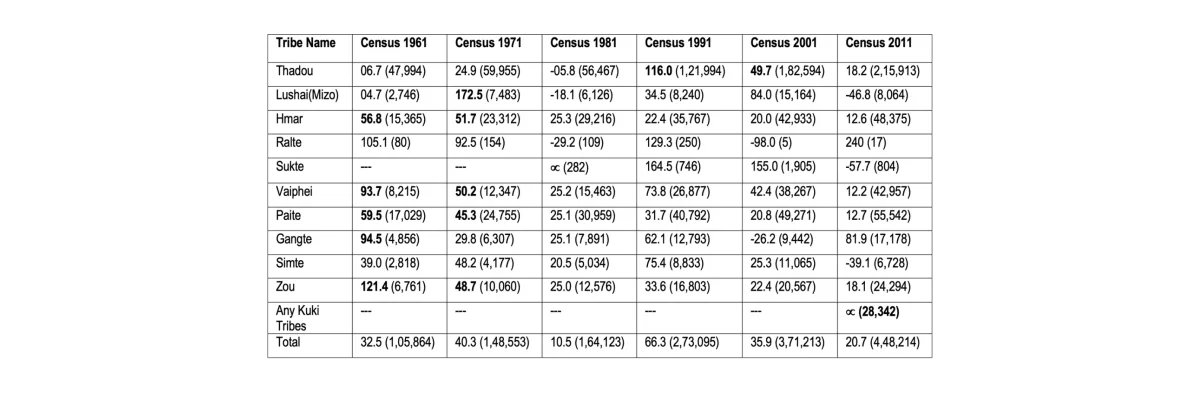
Prepared using the Census data shown in Table 1 above
Table 3 displays the decadal population growth rates of World, India, Manipur and Jiribam (then a Sub-Division of Manipur) for the census years from 1961 to 2011. Notably, Table 3 exhibits that Jiribam had extremely high decadal population high growth of 140.36% in the 1961 Census, thereby signifying that heavy migration and new settlements of Kuki-Zo people took place in that Sub-Division during the period 1951-1961. The presence of the huge number of Kuki-Zo immigrants in Jiribam led to transfer of 29 villages from Jiribam to Manipur South District (15 in 1969 and 14 in 1972) which was later bifurcated into Churachandpur District and Pherzawl District in December 2016.
Table-3: Decadal population growth rate (%) of World, India, Manipur & Jiribam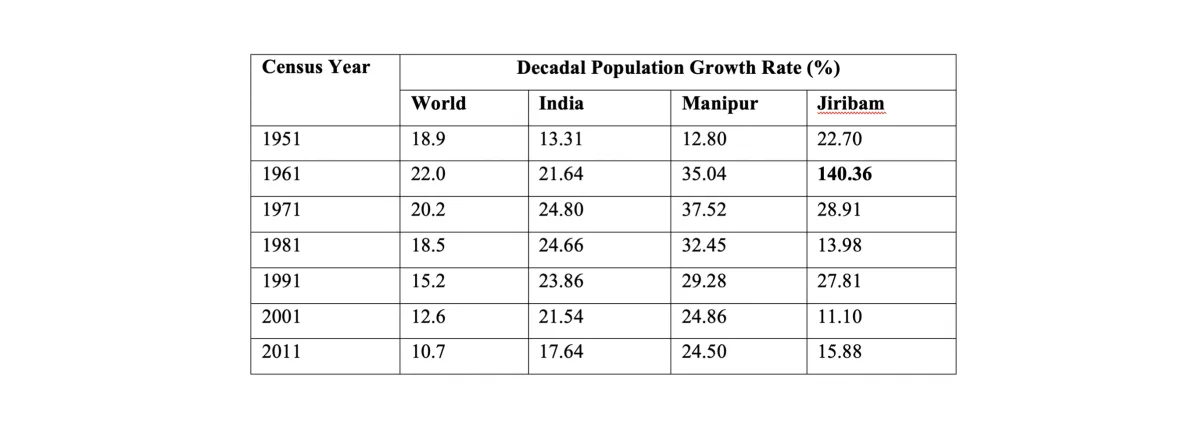
Narendra, 2025, pp.24
By comparing the decadal population growth rates (DPGRs) for the period 1961-2011 as shown in Table 2 with those shown in Table 3, it is observed that some tribes of Kuki-Zo communities had anomalously high population growth rates in the following census years:
(i) 1961 Census: In the 1961Census, Hmar exhibited DPGR 56.8%, Ralte 105.1%, Vaiphei 93.7%, Paite 59.5%, Gangte 94.5%, Zou 121.4%. These DPGRs are much higher than the average DPGR of World (22.0%,), India (21.64%) and Manipur (35.04%) for the census year 1961, thereby signifying that there was large influx of these tribes into Manipur, post the 1951 Census. The spurts in DPGRs in respect of Hmar (56.8%) and Gangte (94.5%) are due to migration of Hmar and Gangte families from Lushai Hills (Mizoram) to Churachandpur and Jiribam Sub-Divisions in Manipur. There also occurred migration of Ralte, Vaiphei, Paite and Zou communities from the Chin Hills (Myanmar) into Manipur primarily driven by prolonged political instability, civil conflict, and ethnic marginalization in Myanmar, thereby yielding high DPGR in respect of Ralte (105.1%), Vaiphei (93.7%), Paite (59.5%) and Zou (121.4%).
(ii) 1971 Census: In the 1971 Census, Mizo exhibited DPGR 172.5% and Hmar 51.7% which are much higher than the average DPGR of World (20.2%,), India (24.80%) and Manipur (37.52%). These high values of DPGR signify that there occurred migration of Mizos and Hmars from Mizoram to Manipur, primarily driven by the 1958–1960 Mautam Famine that caused severe starvation, forcing many to migrate from Mizoram and then, by the Indian military crackdowns against the secessionist movements of the Mizo National Front (MNF) during 1967-1969. In the same 1971 census, Vaiphei exhibited DPGR 50.2%, Paite 45.3%, Simte 48.2%, Zou 48.7% thereby indicating that a huge number people belonging to these Kuki-Zo communities migrated from Myanmar to Manipur during 1961-1971. This influx of a number of immigrants could be due to the 1962 military coup in Myanmar that forced many to flee across the border into Manipur and the subsequent military operations carried out in that country in December 1967. It is specifically mentioned in a letter dated 20 June 1973 written by P. Haokip, then Member of Parliament, Lok Sabha addressed to Shri K. C. Pant, then State Minister of Home Affairs, Government of India that the military operations in Myanmar in December 1967 led to fleeing of 1,500 families who were given refuge in Manipur and later rehabilitated with financial grant of Rs. 3,92,775/- obtained from the Government of India and the Government of Manipur (Haokip, 1973).
(iii) 1991 Census: In this census Thadou tribe exhibited DPGR 116.04% corresponding to the increase of its population from 56,467 in the 1981 Census to 1,21,994 in the 1991 Census. This DPGR of Thadous far exceeded the average decadal growth of the population of World (5.2%), India (23.86%) and Manipur (29.28%) for the same period 1981-1991. This fact reveals that there was huge increase of Thadous’ population in Manipur during 1981-1991 which is attributable to influx of Thadous from the Chin Hills in Myanmar primarily driven by the 1987–1988 pro-democracy uprisings in that country and the subsequent military crackdowns. The Kuki National Front (KNF) founded on 18 May 1986 under the chairmanship of (L) Nchlun Kipgen played key roles in the settlement and rehabilitation of the Thadou refugees in various parts of Manipur, especially in the erstwhile Sadar Hills which surrounds the Central (Imphal) valley in three directions viz. East, West and North. Historically, Sadar Hills was an integral part of SADAR which stands for “Selected Area Development Administrative Region”. The SADAR comprised of the Central (Imphal) Valley and the surrounding Hills. The term “Sadar Hills” was coined by J. C. Higgins in the 1930s to denote the Hills surrounding the Central (Imphal) valley. Sadar Hills became a full-fledged district but renaming it as Kangpokpi district in December 2016.
1. Relevance of NRC, 1951 for detection and identification of Illegal Immigrants
The presence of high Decadal Population Growth Rates (DPGRs) in respect of some Kuki-Zo tribes in the census years 1961, 1971 and 1991 as compared to the average decadal growth rates of the population of World, India and Manipur indicates that a huge number of non-bonafide citizens / illegal immigrants were recorded in those censuses. Since these new entrants were recorded in the censuses subsequent to the 1951 Census, they are obviously non-bonafide citizens of India as per the NRC, 1951. The entire population of 28,342 under the newly introduced tribe name ‘Any Kuki Tribes’ in the 2011 Census must be new comers to Manipur after the issuance of the ST list, 1956 dated 29.10.1956 since all the tribes under the earlier tribe name ‘Any Kuki Tribes’ in the ST list, 1951 had already been accommodated by the ST list, 1956. So, the entire population of 28,342 under ‘Any Kuki Tribes’ in the 2011 Census are not bonafide citizens of India in terms of the NRC, 1951. Likewise, the “Generic Tribes” showing a population of 20,806 including 8,962 Kuki-Zos in the Census 2011 must be illegal immigrants since the tribe name ‘Generic Tribe’ itself appeared for the first time in the 2011 Census.
Recently, after the eruption of the May 3, 2023 ethnic violence in Manipur, the Manipur Police reported the detention of 2,430 Myanmares illegal immigrants in five districts viz., Tengnoupal, Chandel, Churachandpur, Kamjong and Pherzawl vide a letter dated 6 June 2023 issued by Manipur Police. The Headquarters, 28 Sector Assam Rifles also reported the arrest of 718 illegal immigrants hailing from Myanmar, at New Lajang, Chandel vide their letter dated 23 July 2023. Since the cut-off date for bonafide Indian citizens is 26 January 1950 as per the NRC, 1951, all the illegal immigrants who have been taking settlement in Manipur subsequent to the publication of the 1951 Census (i.e. from the 1961 Census onwards), may be detected and identified primarily by means of the NRC, 1951 and other legacy data such as the 1951 Census Report, the 1951 Village directory, and the Electoral Rolls of 1948 etc.
2. Dangers posed by the presence of Kuki-Zo illegal immigrants in Manipur
The Kuki-Zo illegal immigrants from the Chin Hills (in Myanmar) and the Lushai Hills (Mizoram) have swept across many hill districts of Manipur causing abnormal rise in the number of unrecognized and new settlements. This abnormal rise in unrecognized and new settlements is discernible from the pattern of district-wise growth of villages shown in Table 4 which exhibits the district-wise distribution of villages in Manipur in the years 1969 and 2023. From this Table, it is readily evident that there occurred abnormal increase of villages in Churachandpur, Kangpokpi, Tengnoupal, Chandel and Pherzawl which are all Kuki-Zo dominated districts.
Table 4: District-wise growth of villages in Manipur during 1969-2023
(Source: Yugindro, 2025, Table 1 incorporated therein)

As such, many leading scholars of the Kuki-Zo communities have admitted openly that a huge number of Kuki-Zo people entering into Manipur after the 1951 Census have taken settlement in the State. For example, in their book ‘The Indigenous Zomi’, S. K. Ngaihte & K. Vungzamawi both belonging to the Kuki-Zo communities have categorically admitted that setting “1951 as base year to qualify as Manipur People” under Section 2(b) of ‘The Protection of Manipur People Bill, 2015’ would make “almost eighty percent of the Tribal population in the hill areas will be excluded from the purview of section 2(b) of the Act and will be treated as ‘Non-Manipur’ persons under section 2(c) of the Act with disastrous consequences.” (Ngaihte & Vungamawi, 2018, pp. 193-195).
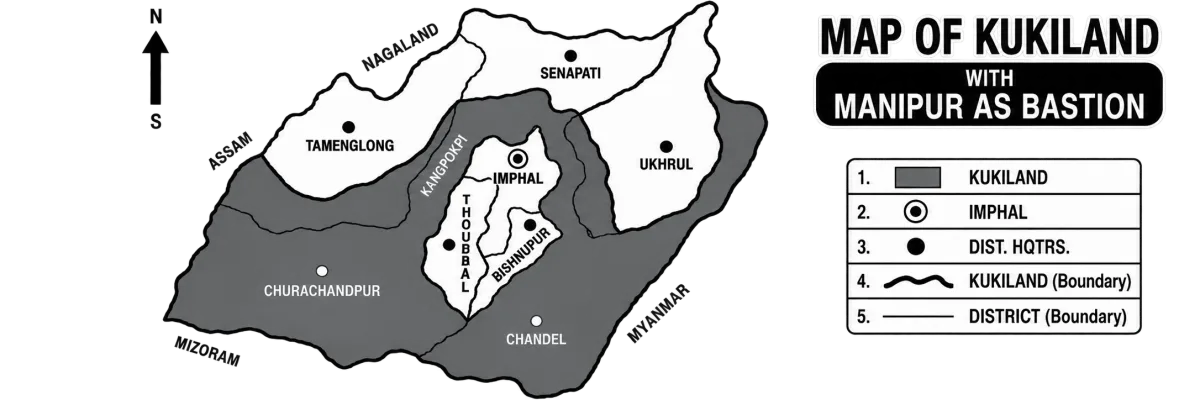
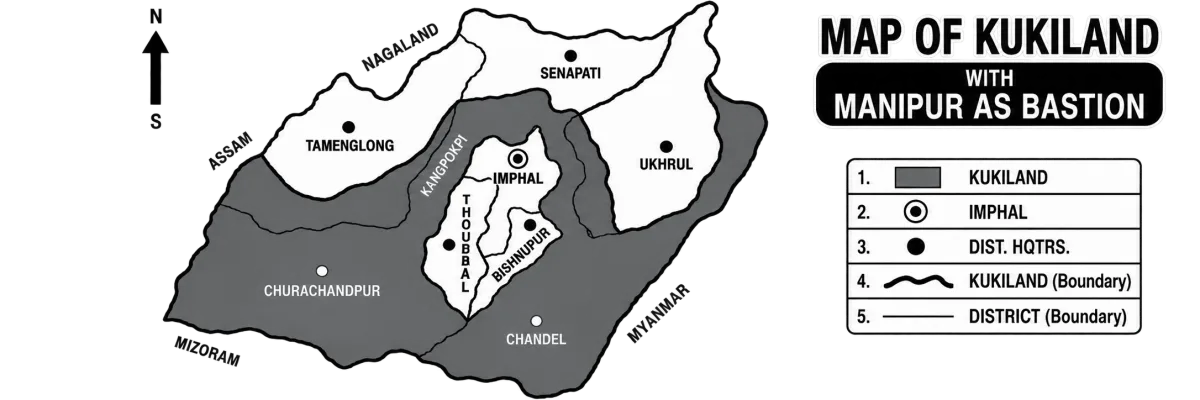
By misusing Scheduled Tribe (ST) tag, the Kuki-Zo illegal immigrants in Manipur have forfeited many legal rights and opportunities entitled to the genuine indigenous tribes of the State in terms of State job reservations, educational quotas, and financial funds etc. Their presence in Manipur not only strains local water, forest, and land resources, but also poses threat to the natural ecosystem due to deforestation for settlements and illicit activities, including opium poppy cultivation. They have also caused serious law and order problems to the State Government and have gone even to the extent of demanding a separate homeland for themselves by dismembering the integrity of Manipur. The North East Sun, a popular magazine covering regional politics, ethnic issues, insurgencies, local developments, and cultural affairs across the northeastern states of India, published in its edition, October 1-14, 2000 an article entitled ‘Question of Kukiland’ as cover story. The article began with the map of Kukiland (shown in Figure 1) encompassing a vast territory of Manipur with more than 70% of the total land area and then narrated the Interview that the North East Sun had with the General Secretary of the Kuki National Front (KNF), a militant organisation presently under Suspension of Operations (SoO). In that interview, the General Secretary of KNF categorically stated that the Kuki National Front (KNF) was formed on May 18. 1986 with the aim of carving out a separate state called ‘Kukiland’ by dismembering Manipur.
Figure 1: Map of Kukiland, the dreamland of KNF
(Source: North East Sun (October 1-14, 2000))
1. Why is there vehement demand for NRC, 1951 before the Census 2027 in Manipur?
The vehement demand in Manipur to implement the National Register of Citizens (NRC), 1951 before the Census 2027 stems from profound local anxieties regarding illegal immigration, shifting demographics, and future political representation. Groups like the Campaign for Just and Fair Delimitation (JFD) and various civil society organizations have adopted a "No NRC, No Census" stance, leading to widespread protests and the deferment of census training in multiple districts.
Key Reasons for the Demand:
- Fears of Demographic Distortion: Local indigenous groups worry that an unverified head count during the upcoming census will officially register undocumented illegal immigrants who entered via porous borders, effectively legalizing their presence in official data.
- Impact on Delimitation: Constituency redrawing (delimitation) relies directly on census figures. Indigenous bodies fear that counting unverified populations will permanently skew the allocation of assembly seats and political power away from native communities.
- Unresolved Post-Conflict Realities: Following the ethnic violence that began in May 2023, tens of thousands remain internally displaced. Protesters argue that conducting a census while populations are displaced and areas remain volatile will produce fundamentally flawed results.
- Protection of Land and Identity: Using the NRC, 1951 with January 26, 1950 as the cutoff baseline for bonafide Indian citizen, as per Article 5 of the Constitution of India, is viewed by indigenous natives and supporting groups as a necessary legal filter to separate out the illegal settlers from indigenous inhabitants before any permanent administrative data is locked in by the Census.
- The article is published with due permission from the Author, Sr. Prof. K. Yugindro Singh (Retd.), Former Acting Vice Chancellor, Manipur University
References:
1. Census Reports (From 1881 Census to 2011 Census) published by the Government of India.
2. Contract of Agreement signed on 5.8.1980 between the Government of Manipur and All Manipur Students’ Union (AMSU) & All Manipur Students’ Co-ordinating Committee (AMSCOC).
3. Contract of Agreement signed on 8.8.1994 between the Government of Manipur and All Manipur Students’ Union (AMSU).
4. Das, Pushpita, ‘Free Movement Regime: A Unique Feature of the India-Myanmar Border’, Manohar Parrikar Institute for Defence Studies and Analysis (January 17, 2024).
5. Grierson, G.R., ‘Linguistic Survey of India Volume III: Tibeto-Burman Family, Part III (Specimens of the Kuki-Chin and Burma Groups’ (1904).
6. Haokip, P., Member of Parliament, Lok Sabha: His letter dated 20th June 1973 addressed to K. C. Pant, State Minister of Home Affairs, Government of India.
7. Headquarters 28 Sector Assam Rifles’ letter No. 28008/10/General Staff (Operation)/2023/6049 dated July 23, 2023.
8. Manipur Police’s letter No. 15/19/2023-IGP(INT/NAB)/89 dated June 6, 2023.
9. Manipur Legislative Assembly’s Resolution No. 129 passed in its sitting held on August 5, 2022.
10. Manipur Legislative Assembly’s Resolution No. 5 passed in its 12th sitting held on March 1, 2024.
11. Ngaihte, S. K. and Vungzamawi, K., ‘The Indigenous Zomi’, Publisher: Zomi Human Rights Foundation, Hqtrs., Lamka (2018).
12. Narendra Singh, R.K., et. al., ‘Ideas of Manipur Series-1: Jiri Files’, Publisher: National Research Centre, Imphal (2005).
13. North East Sun, ‘Question of Kukiland’ (October 1-14, 2000).
14. Siamkhum, Th., ‘The Paites: A Study of the Changing Faces of the Community’, Notion Press, Chennai (2013).
15. Yugindro Singh, K., ‘The Side-Lining of the Manipur Hill Areas (Acquisition of Chiefs’ Rights) Act, 1967, and its Consequences’, Imphal Review of Arts and Politics (May 17, 2025).
16. Vaghaiwalla, R.B., Census of India, 1951, Volume XII, Assam, Manipur and Tripura, Administrative Report (1954).

I think there is a strong, defensible basis for saying that the article is framed through a preconceived and adversarial lens toward the Kuki-Zo community. The title itself establishes the conclusion before the analysis begins. That is significant. It does not ask whether the 1951 NRC could help identify post-1951 migration or whether an NRC could distinguish citizens from undocumented migrants. Instead, it grammatically links “Kuki-Zo” and “illegal immigrants” as though they are a single analytical category. That is a major methodological problem. The population-growth argument is particularly weak. The author/article confuses ethnicity with citizenship. This is arguably the central conceptual flaw. The language becomes openly threat-oriented. A scholarly article should be more careful,. The article seems to treat the 1951 NRC almost as though it were a comprehensive citizenship adjudication mechanism capable of determining the origins of every present-day ethnic population. The article undeniably adopts a highly one-sided framing in which “Kuki-Zo,” “immigrant,” “illegal immigrant,” demographic expansion, border insecurity and threats to indigenous identity are repeatedly brought together. Several of its most consequential conclusions are presented as self-evident when they actually require substantial additional evidence. That makes the article vulnerable to a well-founded criticism of ethnic bias and prejudicial framing.