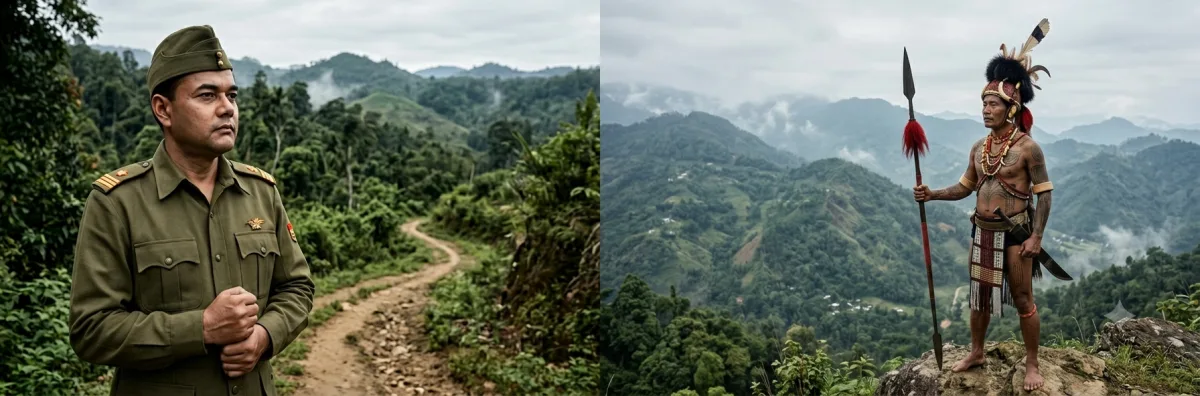
 Photo Courtesy: Representative Image
In the spring of 1944, a small hill station in the Naga Hills became the fulcrum on which the fate of the Indian subcontinent balanced. Kohima, a ridge town at 5,000 feet, sat astride the only road connecting the massive Allied supply depot at Dimapur to the British IV Corps base at Imphal, eighty miles south. When Lieutenant General Renya Mutaguchi's Japanese Fifteenth Army, 85,000 strong, crossed the Chindwin River on 8 March 1944 under Operation U-Go, they aimed to smash British power in Asia, trigger an anti-colonial uprising across India, and sever the air supply corridor to Chiang Kai-shek's China. What followed between 4 April and 22 June at Kohima, and simultaneously at Imphal from 8 March to 3 July, would shatter the myth of Japanese invincibility and open the road to the reconquest of Burma. It was, by the British military's own admission, the greatest battle in their entire history.
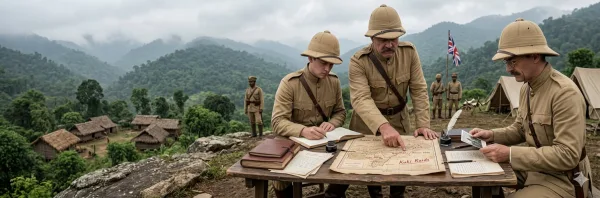
The strategic stakes were existential. By late 1942, Japan had seized Singapore, Hong Kong, Malaya, and Burma in a cascade of victories that began with the Pearl Harbor strike of 7 December 1941. Burma's fall placed the Japanese Fifteenth Army on India's northeastern frontier. For two years, General William Slim rebuilt the demoralized British Fourteenth Army in the Assam hills, training Indian, British, Gurkha, African, and Naga troops while stockpiling supplies at Dimapur and Imphal. Mutaguchi's plan was audacious: three divisions would converge on Imphal while the 31st Division under Lieutenant General Kotoku Sato seized Kohima, cut the Dimapur road, and push on to capture the railhead. Without Dimapur, Imphal would wither. With Imphal gone, Subhas Chandra Bose's Indian National Army could march into Bengal and ignite the revolution Mutaguchi believed was simmering.
The garrison at Kohima was laughably small. When Sato's 15,000 veterans reached the ridge on 4 April, they found 2,500 defenders huddled around the Deputy Commissioner's bungalow and a tennis court. The 4th Battalion, Queen's Own Royal West Kent Regiment, just 446 men airlifted that same morning, formed the core of the resistance. For thirteen days, the perimeter shrank. By 18 April, the British and Indian troops held a shell-shattered area barely 350 metres square. The front line ran through the tennis court. Men fought with bayonets, grenades, and bare hands. Of the 446 West Kents who landed on 4 April, 278 became casualties. Lieutenant Bruce Hayllar wrote that the stench of rotting flesh "sticks in your nose and mouth, as if death has partly claimed you."
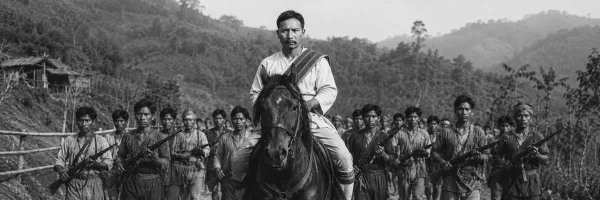
The Naga people saved the British position. The Naga Levies operated as scouts, porters, stretcher-bearers, and intelligence gatherers. Jemadar Unilhu Angami led five patrols deep behind Japanese lines, raised three thousand Naga villagers as porters, and earned a Military Cross. Sepoy Ziechao Angami slipped alone across the Zubza River to bring back intelligence that convinced the 2nd Division commander to move a brigade into Kohima Village. Jemadar Visai Angami earned the nickname "the bravest of all the scouts." Havildar Meibotha Angami allowed himself to be captured, worked four days as a forced porter, escaped, and pinpointed enemy ammunition dumps for RAF strikes. Captain Ralengnao Khathing organized Naga intelligence networks and led ambushes that killed an estimated 150 Japanese and captured 43 INA prisoners. Rhizotta Rino explained simply: "Why did we fight for the British? They were our protectors. They were here before the Japanese and they protected us." Major General John Grover admitted he had been taught to regard the Nagas as "savage head-hunters" but found them "extremely lovable" allies.
At Imphal, the Meitei people of Manipur found themselves trapped between two armies. The British followed a scorched earth policy, forcibly evacuating Meitei civilians within forty-eight hours and burning their homes. Survivors fled to floating islands on Loktak Lake, surviving on fish and seaweed. King Bodhachandra offered minimal assistance, and the majority remained neutral, caught between colonial repression and Japanese occupation. The Meitei experience was survival amid devastation: buildings destroyed, livestock seized, rice stocks requisitioned by both sides, and a homeland turned into a battlefield.
Subhas Chandra Bose saw Imphal and Kohima as the gateway to a free India. He had shifted the Provisional Government of Azad Hind to Rangoon on 7 January 1944, planning civilian administration and currency for liberated territory. Bose named INA regiments after Gandhi, Nehru, and Azad, and formed the elite Subhas Brigade under Colonel Shah Nawaz Khan. He told his troops: "I promise you nothing but hunger, thirst, suffering and death." Not one man stepped back. Bose rejected Japanese proposals to bomb Calcutta, arguing it would alienate the population he hoped to rally. He insisted that INA troops must be the spearhead, telling Field Marshal Terauchi that "any liberation of India secured through Japanese sacrifices is worse than slavery." The Gandhi and Azad Regiments fought alongside the Japanese at Imphal, but by 20 June, with the Japanese retreat underway, Shah Nawaz withdrew from Ukhrul. Bose's dream of a march on Delhi died in the mud of Manipur.
The Japanese collapse was total. Mutaguchi had gambled on capturing Allied supplies to sustain his advance. When the garrisons held and air supply kept them fed, his 85,000 men starved. The Fifteenth Army lost 53,000 dead, missing, and wounded, most from disease and starvation during the monsoon retreat. At Kohima alone, the Japanese left 7,000 dead. The British and Indian forces suffered approximately 16,500 casualties. On 31 May, Sato defied Mutaguchi's orders and began an unauthorized withdrawal, writing: "Our swords are broken and our arrows spent. Shedding bitter tears, I now leave Kohima." On 3 July, Operation U-Go was abandoned. The road between Kohima and Imphal reopened on 22 June.
What if the Japanese and INA had won? The scholarly literature suggests the dynamics of the entire subcontinent would have shifted. Metha, in the International Journal of Humanities and Social Science Invention (2018), documents that Mutaguchi's plan explicitly aimed to capture Dimapur to "enable Bose and the INA to penetrate into Bengal to initiate the long-awaited anti-British uprising." The political significance was so acute that even when the war situation turned against Japan, they "knowingly delayed the decision to terminate the war." LTG Kawabe admitted that "the reluctance to leave the grand plan of Bose to its own fate influenced the purely strategic judgment of the top leaders to a considerable extent." Pandit, in INA and Azad Hind Fauj, records that Bose "wanted to spread the campaign to the plains of Assam including Dimapur, because he was well aware that once he could reach there his unbounded popularity would automatically accelerate his progress." Pandit concludes: "Had this plan been implemented, the course of the Indian Freedom Struggle could have been different."
The British had never fully conquered the Naga Hills by force. Between 1839 and 1880, ten punitive expeditions failed to subdue the Angami Nagas. In 1879, Deputy Commissioner G.H. Damant marched into Khonoma with 86 men and was shot dead, his force annihilated. The British only took Khonoma after a siege of months, and even then the defenders retreated to the Chakka Forts at 8,500 feet, where the British refused to follow. Yet Bose's plan was not to conquer the hills. He aimed for Dimapur, the railhead and supply hub of the entire Northeast, where food, ammunition, and railway connections to the Brahmaputra Valley awaited. Field Marshal Slim himself admitted there was a chance for the Japanese to strike Dimapur in early April 1944.
The decisive importance of this battle for India becomes clear when examining what the INA achieved even in defeat. The Association for Asian Studies (2023) records that the INA court-martial of 1945-1946 "significantly helped hasten the British exit from India in 1947." Clement Attlee, British Prime Minister at independence, remarked in 1956 that "the INA, and not Gandhi's various civil disobedience campaigns, was the decisive factor forcing the British pullout." The USI Journal (2011) documents that Mountbatten was so fearful of Indian troops defecting to the INA that "Twenty four of its battalions had English, Nigerian and Burmese soldiers, because he feared that Indian soldiers would join the INA." Mero, writing in the International Journal of Creative Research Thoughts (2023), argues that "Britain quickened the pace of India's independence not so much because of Gandhi's Civil disobedience movement or other measures taken by Indian National Congress but because the impact of INA had on the psyche of British India's armed forces." If the INA could achieve this in defeat, a victory at Kohima would have multiplied the effect exponentially.
In 2013, the British National Army Museum conducted a public poll to identify Britain's greatest battle. The Battles of Imphal and Kohima won, ahead of D-Day, Waterloo, and Normandy. Historian Robert Lyman called them "one of the four great turning-point battles in the Second World War, when the tide of war changed irreversibly and dramatically." They are routinely called the "Stalingrad of the East." Yet outside military history circles and Northeast India, they remain curiously obscure. No Hollywood film has captured the tennis court. The names Unilhu Angami, Ziechao Angami, and Ralengnao Khathing do not appear in standard textbooks. The Meitei civilians who fled to Loktak Lake, the 53,000 Japanese dead, and the 16,500 Allied fallen are statistics without monuments in most of the world. This is perhaps the most telling measure of the battle's underrated status: a fight that decided the fate of an empire, that the British themselves crowned as their greatest battle ever fought, waged by Indian, British, Gurkha, African, and Naga soldiers in a corner of the world that the empire itself barely understood, now risks being remembered only by those whose grandfathers fought on the ridge.
- Angam Niumai | Independent Researcher
Sources Consulted
Metha, Kezhangulie. "The Japanese 15th Army And The INA Imphal Campaign Of 1944." International Journal of Humanities and Social Science Invention, vol. 7, no. 11, 2018, pp. 19-24. www.ijhssi.org.
Pandit, H.N. INA and Azad Hind Fauj. Cited in "Re-Reading Netaji Subhas in the Context of Imphal." Orissa Review, Aug. 2016, pp. 23-26.
"Battles - Rise and Fall of INA." Netaji Subhas Chandra Bose, www.netajisubhasbose.org.
"Trial at the Red Fort 1945-1946: The Indian National Army and the End of the British Raj in India." Association for Asian Studies, 2023. www.asianstudies.org.
"Impact of INA on India's Struggle for Independence." USI Journal, July-Sept. 2011. usiofindia.org.
Mero, Neipreu. "Battle of Kohima: Victory in Defeat." International Journal of Creative Research Thoughts, vol. 13, no. 1, 2023. ijcrt.org.
Walling, Talichuba. "The First Major Challenge Against the British Colonialism by the Nagas 1879-1880: A Critical Appraisal." Indian Journal of Applied Research, Jan. 2021.
Slim, Field Marshal William. Defeat into Victory. Cassell, 1956.
Lyman, Robert. Kohima 1944: The Battle That Saved India. Osprey Publishing, 2010.
Keane, Fergal. Road of Bones: The Siege of Kohima 1944. HarperPress, 2010.
Bannerji, Kalyan. Subhas Chandra Bose and the Indian National Army.
Majumdar, R.C. History of the Freedom Movement in India, vol. III. Firma KLM, 1996.
"The Battles of Imphal and Kohima." National Army Museum, www.nam.ac.uk.
"Imphal and Kohima: Britain's Greatest Battle." Kohima Educational Trust.

Comments