
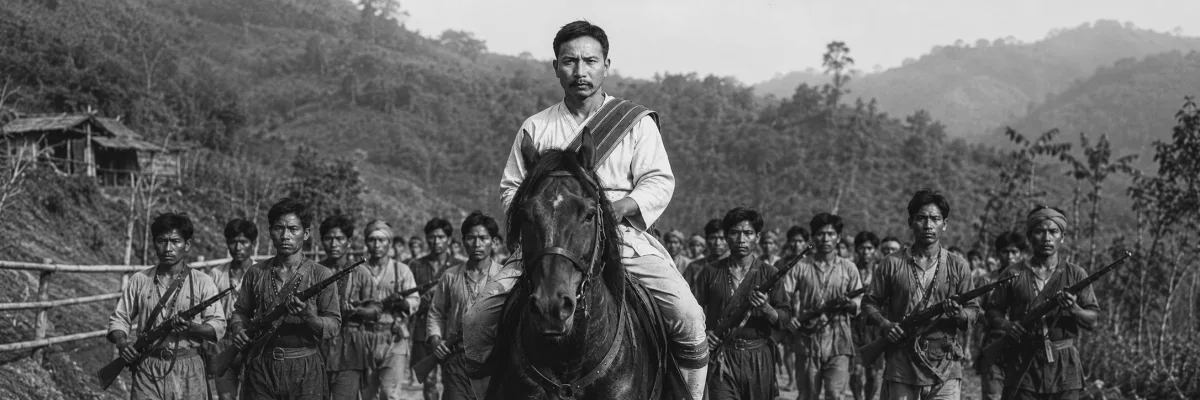
 Photo Courtesy: Representative Image
In a brief span, he built a religious reform movement, raised an army of 500, sent spears across Naga territory seeking alliances, and declared a Naga Raj. Historian John Thomas calls him the first to imagine a Naga nation transcending village, clan, and tribe. The Nagas did not fully answer his call. The British made sure he never got a second chance.
In the winter of 1927, a 22-year-old Jadonang from Kambiron village assembled a dance troupe of 200 boys and girls to welcome Mahatma Gandhi at Silchar. The British cancelled Gandhi's visit. The troupe never left. But Haipou Jadonang Malangmei kept walking. Four years later, the British hanged him at 26.
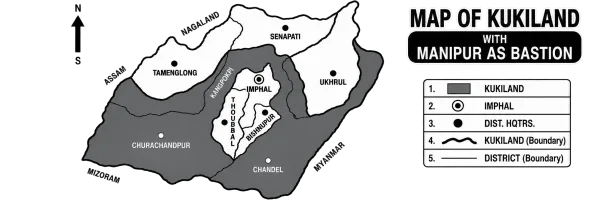
Jadonang was born around 1905 in Kambiron, present-day Tamenglong district, into the Malangmei clan of the Rongmei tribe. His father died when he was three. By age ten, he was already marked as a muh, a medicine man who healed the sick and interpreted divine signs. The Zeliangrong people, the collective of Rongmei, Zeme, Liangma and Inpui tribes spread across Assam, Manipur, and Nagaland, called him Haipou, the prophet.
What drove him was a convergence of grievances. The British imposed a house tax of Rs. 3 per year, forced labour called pothang, and new laws administered through lambus, local agents who translated colonial orders into the hills. The Kuki Rebellion of 1917-1919 had traumatised Zeliangrong villages, with the British failing to protect them. Christianity, carried by American Baptist missionaries working with the colonial administration, was making inroads. Many Zeliangrong families converted out of necessity, hoping baptism would ease their tax burden. Jadonang saw this as colonial strategy: the British used the church to break Naga identity. He would build a wall around what remained.
In 1925, Jadonang began the Heraka movement, from the Rongmei word for "pure." He elevated Tingkao Ragwang, a creator deity previously one among many gods, to a supreme being. He built temples called Kao Kai, introduced regular prayers and hymns, and abolished scores of gennas, the ritual taboos governing birth, death, and daily life. Gangmumei Kamei, the noted Naga historian, described this reform as "a synthesis of Christian monotheism and Hindu idolatry and temple culture, rationalized and simplified," aimed at reviving social solidarity among the Zeliangrong. John Thomas, in his 2012 article "Sending Out the Spears," argued that temples were not part of traditional belief but gained significance with the arrival of Vaishnavism and Christianity in neighbouring areas. Jadonang was not retreating into the past. He was borrowing from his enemies to build a fortress.
The Heraka movement attracted over 400 disciples. But it also attracted enemies. Christian converts reported Jadonang to the British. Traditional believers resisted the standardisation. In December 1928, SDO S.J. Duncan confronted Jadonang, ordered him to dismount his pony and remove his hat. Jadonang refused. He was jailed for a week. The arrest only raised his stature. A week later, the Angami-led Naga Club submitted its memorandum to the Simon Commission, demanding self-determination. The timing linked Jadonang's village-level defiance to a broader Naga awakening.
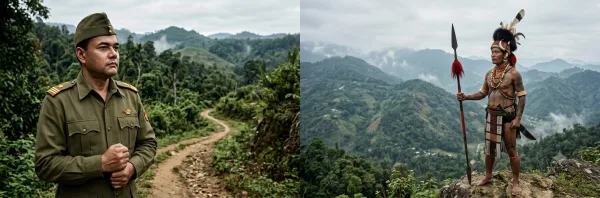
After his release, Jadonang built an army called the Riphen, 500 men and women strong, trained in military tactics and intelligence. They also farmed and grazed cattle, a civilian-military hybrid that kept the movement fed and hidden. He composed anti-colonial songs, taught by his disciple Gaidinliu, a 13-year-old girl from Nungkao who would become his spiritual heir. And then he did something no Naga leader had done before. He sent out the spears.
In Naga custom, a spear sent to another village was a request for military alliance. Acceptance meant allegiance; rejection meant enmity. Jadonang sent Riphen members carrying spears to Zeliangrong villages across the North Cachar Hills, Naga Hills, and Tamenglong Sub-Division. Villages that accepted sent mithuns as tribute. Some began paying taxes to Jadonang instead of the British. By 1930, he declared that no hill house tax would be paid to the Sarkar from 1931 onwards. The British were losing revenue.
Jadonang's ambition did not stop at the Zeliangrong. He reached out to the Angamis, Chakhesangs, Rengmas, Maos, and Marams. He travelled on horseback, dressed as a British official, seeking support for Makam Gwangdi, the Kingdom of the Nagas. The slogan was electric: Makameirui Gwangtupuni, the Nagas would rule one day. But here, he hit a wall. The council of Khonoma, the legendary Angami village, refused him. Their reason was blunt: he would only replace the British as their masters. The Angamis saw no reason to bow to a Rongmei prophet from Manipur. The Naga Club, formed by Angami veterans of the World War I labour corps, was pursuing a different path, petitioning for recognition within the colonial framework. Jadonang was asking for revolt. The two movements never merged.
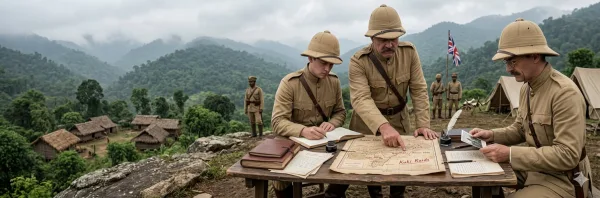
By January 1931, British intelligence had reports of secret meetings and gun collections. On 19 February 1931, while returning from the Bhuvan Cave with Gaidinliu and 600 followers, Jadonang was arrested at Lakhipur by Assam Police officer Imtiaz Ali, who had lured him under the pretext of a consultation. Political Agent J.C. Higgins, rather than taking the direct route to Imphal, marched Jadonang in chains through the Zeliangrong villages to prove the prophet had no divine power.
At Imphal jail, Higgins interrogated Jadonang about his religion and his proposed war. Jadonang denied everything. Higgins had no evidence for sedition. Then, a murder case from March 1930 surfaced: four Manipuri traders killed in Kambiron during a village genna that prohibited lighting fires. Jadonang was at Nungkao at the time. He had no role in the killings. But Jinlakpou, a Rongmei Christian convert and old enemy, implicated him. Higgins and Duncan pressured under-trial prisoners, promising release if they blamed Jadonang. Even his elder brother, Modunang, was made to testify against him. On 13 June 1931, Jadonang was declared guilty of abetment to murder. On 29 August 1931, at 6 a.m., he was hanged on the bank of the Nambul river behind Imphal jail. His last words, according to oral tradition recorded by Dr. Heera Marangmei Kabui: "I am not guilty. I am not the Makam Gwang. The Makam Gwang will come after me." He was 26.
Why did the Nagas not come forward? The Angamis had their own history of village-level resistance. Christian converts saw Heraka as a threat. The British had successfully divided the hills, pitting Kuki against Naga, Christian against traditionalist, village against village. Jadonang's vision of a Naga Raj required a leap that the fragmented, colonially administered hill society was not yet ready to make. He was ahead of his time.
Yet Jadonang was the first Naga to envision a national movement transcending tribe. The Angami resistance had been village-specific. The Naga Club was a petitioning body of educated elites. Jadonang built an army, sent spears across tribal boundaries, and declared a kingdom. As John Thomas argues in "Sending Out the Spears," both the Zeliangrong movement and the Naga Club "envisioned and anticipated a moment when Nagas would be united as a single political entity independent from the kingdoms of the plains." But where the Naga Club sought recognition within the colonial framework, Jadonang sought to overthrow it. He was the bridge between the village and the nation, between the spiritual and the political, between the Naga past and the Naga future.
After his death, Gaidinliu carried the torch until her arrest in 1932 and 14 years in British jails. Jawaharlal Nehru called her "Rani." But the movement she inherited had changed. The Naga National Council pursued a different vision of sovereignty, increasingly Christian and at odds with Heraka. Gaidinliu shifted her demand from a Naga Raj to a Zeliangrong homeland within the Indian Union. In 1980, she formed the Zeliangrong People's Convention, seeking a separate state. The demand was constitutional, not secessionist. She received the Padma Bhushan in 1982. But in Nagaland, where Christianity had become the dominant identity marker, her legacy remained contested.
The British hanged him for sedition against the Crown. The Indian state recognised his anti-colonial struggle as part of the broader freedom movement. But his vision of Makam Gwangdi was a Naga kingdom, free of external domination. He drew inspiration from Gandhi's non-cooperation and sought Naga rule. John Thomas, in his 2016 book Evangelising the Nation, places Jadonang at the centre of an alternative modernity, a Naga renaissance that challenged both colonialism and the missionary civilising mission. The Naga Club was privileged by later nationalists because it was secular, educated, and Christian. Jadonang was pushed to the margins because his movement was religious, tribal, and anti-Christian. But it was Jadonang who first sent out the spears. It was Jadonang who first imagined the Nagas as one people under one king.
The British knew what they were doing. Higgins did not just execute a young warrior. He executed a prophet who had built an alternative polity in the hills, one that threatened the colonial tax base, the missionary project, and the entire edifice of indirect rule. The trial was a sham. The witnesses were coerced. The verdict was predetermined. Jadonang died because he had become too dangerous to live. At 26, he had united religion, politics, and military organisation into a single movement aimed at the empire. The spears he sent out were never fully answered. But they were never forgotten either.
Sources Consulted
Thomas, John. "Sending Out the Spears: Zeliangrong Movement, Naga Club and a Nation in the Making." Indian Economic and Social History Review, vol. 49, no. 3, 2012, pp. 399-437. DOI: 10.1177/0019464612455274.
Thomas, John. Evangelising the Nation: Religion and the Formation of Naga Political Identity. Routledge, 2016.
Longkumer, Arkotong. Reform, Identity and Narratives of Belonging: The Heraka Movement in Northeast India. Continuum International, 2010.
Kamei, Gangmumei. The History of the Zeliangrong Nagas: From Makhel to Rani Gaidinliu. Spectrum Publications, 2004.
Kamei, Gangmumei. Jadonang: A Mystic Naga Rebel. Imphal, 2009.
Laishram, Dhanabir. Trust Deficit in the Largest Democratic Country. Ruby Press & Co., 2013.
Yonuo, Asoso. Nagas Struggle Against the British Rule Under Jadonang and Rani Gaidinliu 1925-1947. Kohima, 1982.
Kabui, Dr. Heera Marangmei. "Haipou Jadonang Marangmei — The Martyr." e-pao.net, 29 August 2011.
"Martyred at 26, This Naga Freedom Fighter Has a Story Every Indian Should Know." The Better India, 7 August 2018.
"Biography of Haipou Jadonang Malangmei (1905-1931)." Rongmei Encyclopedia, 29 August 2022.
"Freedom Struggle Under The Leadership Of Haipou Jadonang." Heritage Explorer.
"Commemorating Jadonang, A Forgotten Freedom Fighter From Manipur." Adivasi Lives Matter, 28 August 2022.
"Trial of Jadonang in the British Colonial Court." Indian Historical Review, 18 June 2022.
"The Nagas & the Baptists." Frontline, The Hindu, 24 April 2018.
"The Naga Raj of Haipou Jadonang in North East India." International Journal for Multidisciplinary Research, vol. 6, no. 1, 2024.
"Zeliangrong Religion in North East India." Serials Journals.
"Rani Gaidinliu: Naga Freedom Fighter." Scribd, 2025.
"The Zeliangrong Movement: Contribution of Rani Gaidinliu." e-pao.net, 21 October 2018.

Comments