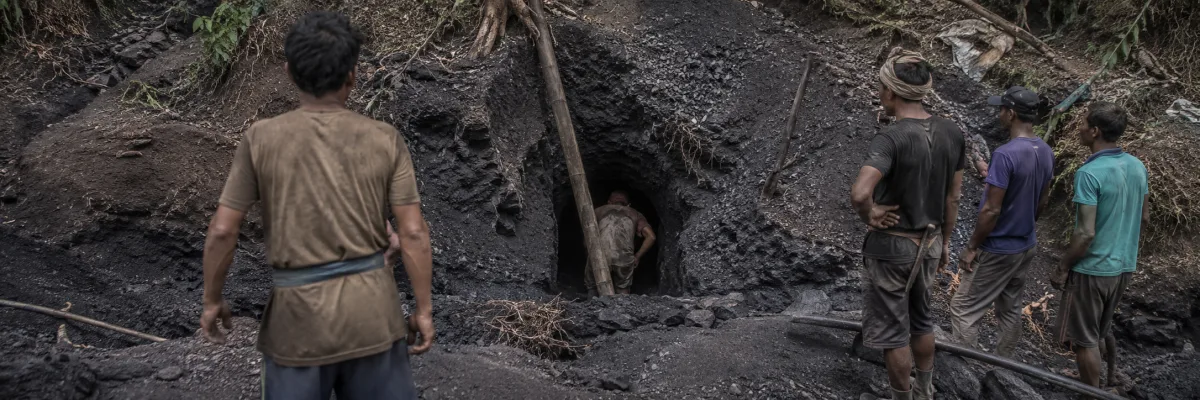
On 17 March 2025, Chief Minister Conrad K. Sangma inaugurated Meghalaya's first 'scientific' coal mining project at Byndihati in East Jaintia Hills, calling it a "historic and red-letter day" after an eleven-year ban. The ceremony came barely two months after a High Court-appointed panel reported that over 2,500 metric tonnes of illegally mined coal had been seized in South Garo Hills between November 2024 and January 2025 alone. This contradiction sits at the heart of Meghalaya's coal economy: a system where legal bans, judicial orders, and human tragedy have failed to dislodge an entrenched extraction network that feeds on migrant desperation, political patronage, and constitutional ambiguity.
The human cost is measured in bodies. In December 2018, fifteen miners drowned in a flooded rat-hole mine at Ksan village in East Jaintia Hills; rescue teams recovered only two decomposed bodies after a three-month operation involving the Indian Navy, Army, and NDRF. In January 2021, six miners died when a crane snapped at Sorkari. In January 2025, a dynamite blast at Thangsko killed six more. The miners, mostly poor migrants from Nepal, Bangladesh, Assam, and West Bengal, descend into shafts barely three feet wide, armed with pickaxes and torches, for wages ranging from Rs 800 to Rs 1,500 per day. For workers like Tara Munget, a 39-year-old from Nepal who survived the Thangsko blast, the arithmetic is brutal: "We don't know about legal or illegal. The money here is good." The wages far exceed manual labour rates in their home regions, yet the trade-off is silicosis, asphyxiation, and the ever-present risk of cave-ins or flooding. No compensation follows death; owners typically cover only funeral costs. The seasonal nature of the work forces workers to borrow during monsoon months when mines flood, trapping them in debt cycles.
The geology of greed is equally stark. Meghalaya holds an estimated 576.48 million tonnes of coal reserves, with 89 million tonnes in the 'proved' category and 470.93 million tonnes 'inferred', concentrated in East Jaintia Hills, West Khasi Hills, and Garo Hills. Before the 2014 ban, the state produced roughly 6 million tonnes annually. The 15th Finance Commission noted that the ban caused a Rs 255 crore revenue loss in 2014-15 alone, with the state government estimating total annual revenue losses at Rs 600 crore when forward and backward linkages are counted. The mining and quarrying sector's contribution to Gross State Value Added collapsed from Rs 1,394 crore in 2011-12 to Rs 224 crore in 2021-22, an 84 percent decline. Yet the illegal trade has filled the vacuum. Reports indicate that around 14 lakh tonnes of coal were exported annually to Bangladesh before the ban, earning Rs 254 crore. The Enforcement Directorate's 2025 raids seized Rs 1.58 crore in cash and uncovered financial trails running through shell companies and hawala networks. The Katakey Committee, appointed by the Meghalaya High Court in April 2022, has filed over 36 reports documenting rampant violations, including the interception of more than 1,000 trucks carrying illegally mined coal in 2024 alone.
The legal architecture is a maze of contradictions. The National Green Tribunal banned rat-hole mining on 17 April 2014 in OA No. 73 of 2014, citing environmental degradation and threats to life under Article 21. The Supreme Court upheld the ban in July 2019 but clarified that mining could resume if conducted under the Mines and Minerals (Development and Regulation) Act, 1957, with approved mining plans and environmental clearances. The Court rejected Meghalaya's plea for exemption under Paragraph 12A(b) of the Sixth Schedule, ruling that the MMDR Act applies even to privately owned tribal lands. The state has since registered 402 cases related to illegal coal transportation and 83 cases of unauthorized mining under Section 21 of the MMDR Act, with 65 transportation cases and 50 mining cases still pending investigation. Yet convictions remain rare. The Katakey Committee reported in January 2025 that the state had overstated pre-ban coal stocks by 13 lakh metric tonnes, suggesting systematic attempts to pass off freshly mined coal as old inventory. The Supreme Court's 2019 judgment noted that the state government itself admitted 308 violations across 11 districts and seized 605 trucks and 2,675.63 tonnes of coal, yet enforcement remained "inadequate" due to lack of manpower, corruption, and political interference.
The political economy of impunity runs deeper. Former Chief Minister Mukul Sangma, now Leader of the Opposition, has publicly demanded a probe into what he calls a "deep-rooted nexus" between politicians, bureaucrats, and coal mafias. The Enforcement Directorate's 2025 findings of shell companies and per-truck cash collections lend weight to allegations that the illegal trade is organized extraction backed by institutional protection. The Citizens' Report on Unregulated Coal Mining in Meghalaya, submitted to the Supreme Court in 2018, documented how "coal mine owners, transporters, politicians and administrators who have illegally benefitted out of this unregulated mining" filed appeals to rescind the NGT ban. The 2022 Katakey Committee identified over 30,000 abandoned mines across the state, yet sealing them has stalled due to funding and logistical failures. No documentary evidence was located to substantiate specific tender records linking named politicians directly to mining operations, though allegations of such connections circulate in local discourse and opposition statements.
The systemic failure is rooted in a constitutional fault-line. The Sixth Schedule grants Autonomous District Councils powers over land and resources, but the Supreme Court has ruled that this does not override the MMDR Act's requirement for mining leases and environmental clearances. The state government's 2015 resolution seeking exemption from the MMDR Act was rejected by the Centre. The result is a governance vacuum: tribal landowners claim customary rights to mine without leases, while the state lacks the institutional capacity or political will to enforce central laws. The Meghalaya Minerals and Mines Policy of 2012 has been criticized for strengthening big land and mine owners rather than regulating extraction. The "scientific mining" inaugurated in March 2025, with three approved blocks and 12 more applications under process, represents an attempt to bring the trade under formal regulation, but activists fear it will merely legitimize the same networks that profited from illegality.
The official position, articulated by the Meghalaya government in February 2025, rejects claims of collusion and asserts that enforcement measures like checkpoints and fines are in place. Chief Minister Sangma has stated that "illegal activities will not be allowed." Yet the evidence suggests otherwise: the Katakey Committee's repeated findings of illegal mining, the ED's exposure of financial networks, and the continuing stream of truck seizures all point to enforcement that is episodic rather than systemic. The government's own data shows that while cases are registered, investigations languish and convictions are scarce.
The rat-hole economy persists because it serves too many interests. It provides wages to migrant workers who have few alternatives, rents to landowners who resist regulation, profits to transporters operating outside tax nets, and political capital to those who broker between customary claims and central law. The environmental cost, measured in acid mine drainage that has turned the Lukha River blue and killed aquatic life, is borne by communities downstream. The human cost is borne by workers who die in darkness. The financial cost, in lost state revenue and uncollected royalties, is borne by the public exchequer. Until the structural incentives are dismantled, the bans will remain paper tigers, and the mafia will keep winning.
References
"15th Finance Commission holds meeting with Government of Meghalaya." Press Information Bureau, 4 June 2019, pib.gov.in/PressReleasePage.aspx?PRID=1573345.
"Coal Resources of Meghalaya." Press Information Bureau, 20 Oct. 2006, pib.gov.in/newsite/erelcontent.aspx?relid=21453.
"Decade after NGT ban, scientific coal mining block inaugurated in Meghalaya." The Hindu, 17 Mar. 2025, www.thehindu.com/news/national/meghalaya/decade-after-ngt-ban-scientific-coal-mining-block-inaugurated-in-meghalaya/article69340595.ece.
"Environmental activists oppose 'scientific' coal mining in Meghalaya." Down to Earth, 22 Mar. 2025, www.downtoearth.org.in/mining/environmental-activists-oppose-scientific-coal-mining-in-meghalaya.
"High Court panel finds illegal coal mining in Meghalaya." The Hindu, 29 Jan. 2025, www.thehindu.com/news/national/meghalaya/high-court-panel-finds-illegal-coal-mining-in-meghalaya/article69154979.ece.
Lamare, R.E. et al. "Seasonal Variation in Water Quality of Lukha River." Current World Environment, vol. 11, no. 1, 2016, pp. 101-113, cwejournal.org/pdf/vol11no1/Vol11_No1_p_101-113.pdf.
"Legal limits to tribal governance: coal mining in Meghalaya, India." CMI Brief, Chr. Michelsen Institute, Apr. 2016, www.cmi.no/publications/6185-legal-limits-to-tribal-governance.
Minerals of Meghalaya. Department of Mining and Geology, Government of Meghalaya, megdmg.gov.in/minerals.html.
Mukul Sangma demands probe after ED exposes illegal coal trade. Assam Tribune, 3 May 2025, assamtribune.com/north-east/mukul-sangma-demands-probe-into-political-bureaucratic-nexus-after-ed-exposes-illegal-coal-trade-1576161.
Nongrem, Wistful in Excelsis. "A Case Study of Jaintia Hills of Meghalaya." Mizoram University Institutional Repository, mzuir.inflibnet.ac.in:8080/jspui/bitstream/123456789/1321/1/WISTFUL%20IN%20EXCELSIS%20NONGREM%2C%20Eco.pdf.
"Rat-hole mining is banned and booming in Meghalaya." The Print, 14 Feb. 2026, theprint.in/ground-reports/rat-hole-mining-is-banned-and-booming-in-meghalaya-22000-mines-run-in-plain-sight/2854602/.
Reportable Judgment, Civil Appeal No. 10720 of 2018, Supreme Court of India, 3 July 2019, api.sci.gov.in/supremecourt/2018/39439/39439_2018_11_1501_14662_Judgement_03-Jul-2019.pdf.
Threat to Life Arising Out of Coal Mining in South Garo Hills District v. State of Meghalaya, OA No. 110(THC)/2012, National Green Tribunal, casemine.com/judgement/in/605c2ab69fca1948c27ff452.
"Unbridled illegal coal mining continues in Meghalaya despite court ban." Land Conflict Watch, 6 Nov. 2024, www.landconflictwatch.org/conflicts/unbridled-illegal-coal-mining-continues-in-meghalaya-despite-court-ban.


Comments