 Photo Courtesy: nenow
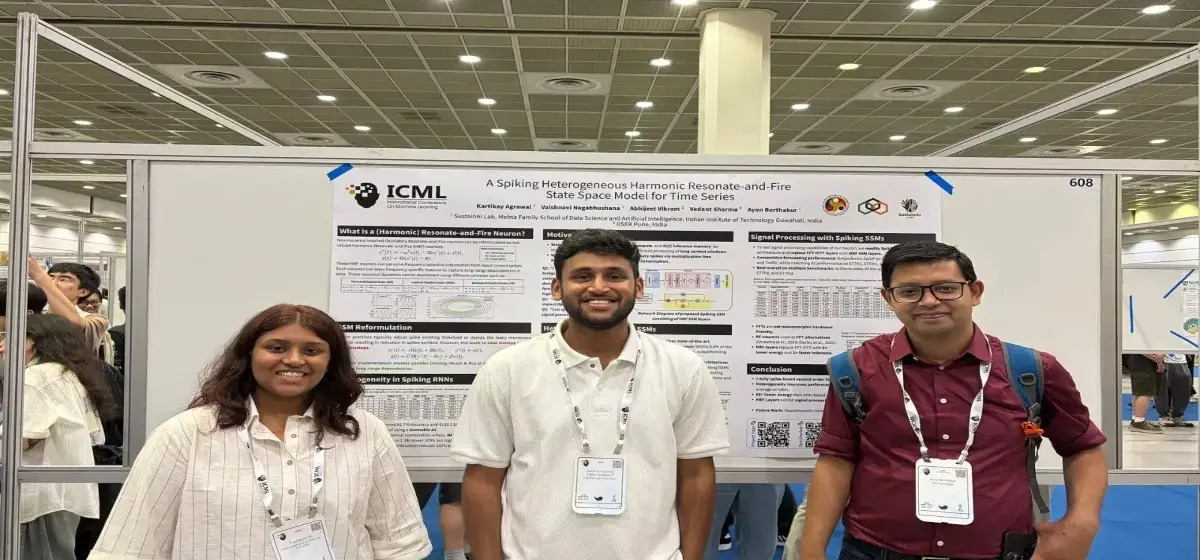
Guwahati: Researchers at IIT Guwahati have developed an AI model that mimics the human brain to process long data sequences while slashing energy consumption. The team from the SustainAI Lab at the Mehta Family School of Data Science and Artificial Intelligence presented the Spiking Heterogeneous Harmonic Resonate-and-Fire State Space Model, or SH2RFSSM, on July 7 at the ICML 2026 conference in Seoul. It debuted at the COEX Convention and Exhibition Centre.
Conventional AI systems burn through power by processing information continuously. This new model works differently. It uses spiking neural networks that only activate when significant events occur. By combining this with state-space modelling, the system manages long-range patterns without heavy computational loads. The model also features neuronal heterogeneity, ensuring artificial neurons act differently to better capture complex data patterns.
The researchers tested SH2RFSSM against 17 benchmark datasets. These included tasks like human activity recognition, regression, long-range sequence classification, and long-term forecasting. Results showed performance levels matching top models, but with far lower energy use.
Dr. Ayon Borthakur, an assistant professor at the Mehta Family School of Data Science and AI, noted the shift in industry needs. "Modern AI systems increasingly rely on analysing long streams of sequential data," Borthakur said. He explained that current high costs make these systems difficult to run on resource-constrained hardware.
PhD scholar Kartikay Agrawal co-authored the study alongside Vaishnavi Nagabhushana, Abhijeet Vikram, and Vedant Sharma. They believe the tech suits devices that must analyze data without constant cloud support. Potential uses range from wearable health monitors and IoT sensors to autonomous systems, smart manufacturing, and environmental tracking. The team plans to refine the model for real-world deployment on battery-powered tech.





Comments