
 Photo Courtesy: nenews
Guwahati: Researchers at the Indian Institute of Technology (IIT) Guwahati have pioneered a new composite coating technology designed to enhance the efficiency and durability of solar-driven water splitting systems. This development, recently published in the journal Small, offers a promising solution for the sustainable production of green hydrogen, a clean energy alternative to fossil fuels that avoids harmful greenhouse gas emissions.
The study was led by Professors Uttam Manna and Mohammad Qureshi alongside Dr. Hrisikesh Sarma and a team of research scholars including Alpana Sahu, Anshika Chaudhary, Sumanta Sarkar, Sourav Mandal, and Lingaraj Sahoo. The team focused on overcoming two primary obstacles in Photo-Assisted Electrochemical (PAEC) processes: the degradation of catalysts due to peeling from electrode surfaces and the drop in efficiency caused by gas bubbles that block active reaction sites.
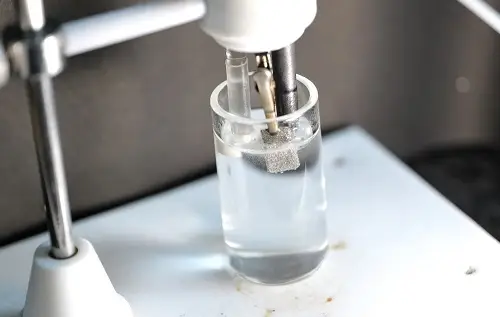
To mitigate these issues, the researchers created a durable coating by integrating graphitic carbon nitride into a bubble-repellent hydrogel layer on porous nickel foam. Unlike traditional methods where photocatalysts are simply applied as surface layers, this new design embeds the catalyst within the structure. This architecture prevents delamination while simultaneously increasing the electrochemically active surface area available for water-splitting reactions.
The experimental results demonstrated a substantial performance boost compared to conventional systems. The new composite coating achieved a 51 percent increase in hydrogen production and a 44 percent improvement in oxygen production. Professor Manna noted that by utilizing a bubble-repellent matrix to promote faster bubble departure, the team successfully enhanced the electrochemical performance of the system. This versatile strategy paves the way for further research into various catalysts, offering significant potential for large-scale solar-to-fuel conversion and advanced renewable energy storage solutions.






Comments