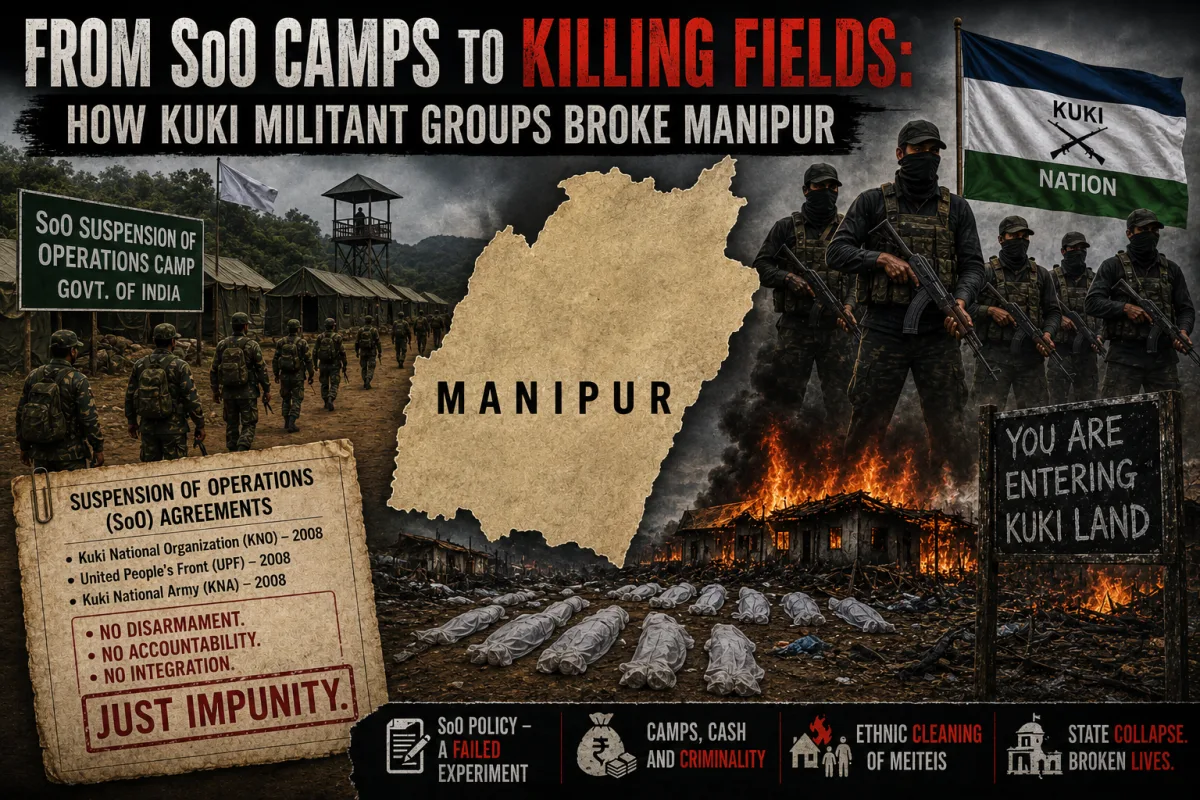
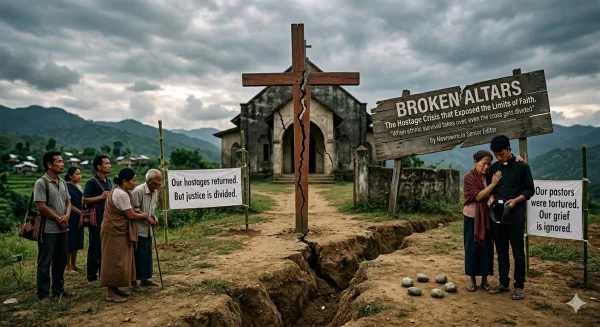
 Photo Courtesy: AI Generated
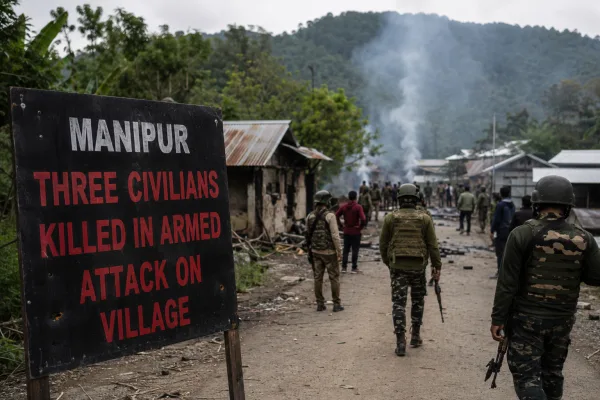
On the morning of 3 May 2023, tens of thousands of Kuki protesters marched through the hill districts of Manipur. The stated grievance was a court order recommending Scheduled Tribe status for the Meitei community. By afternoon, the kuki rebellion memorial at Leisang had been set ablaze. By evening, Torbung and Kangvai were burning. Within 48 hours, the state had split along ethnic lines. Two hundred and sixty people would die. Sixty thousand would flee their homes. The Indian Army would deploy nearly 67,000 troops to contain a conflict that has still not ended.
The standard narrative frames this as a clash between two communities, each with legitimate grievances, each driven to violence by fear and historical resentment. That framing is wrong. It is wrong because it treats Kuki militancy, the most organized, armed, and politically consequential force in the hills, as merely one side of a symmetrical dispute. It is not. The Kuki National Army, the Zomi Revolutionary Army, and their umbrella bodies, the Kuki National Organisation and the United People's Front, constitute a para-state apparatus that has operated inside Manipur for four decades with weapons, funding, cross-border supply lines, and a territorial ambition that directly threatens the state's integrity. Understanding Manipur's collapse requires understanding that apparatus, its origins, its methods, and the political shield it has enjoyed.
The Armed Project
The Kuki National Army was founded in 1988 by P. S. Haokip with a clear objective: the creation of Zale'n-gam, a Kuki homeland spanning parts of Manipur, Mizoram, Nagaland, Assam, and Myanmar's Chin Hills and Sagaing Region. This was not a cultural association. It was a secessionist armed project, trained initially by the Kachin Independence Army in Myanmar, funded through extortion, and equipped with AK-series rifles, G-series weapons, M-series assault rifles, and 60mm mortars. The KNA's Indian wing signed a Suspension of Operations agreement with New Delhi and the Manipur government in August 2008, confining its cadres to designated camps and placing weapons in monitored armouries. The agreement was renewed annually for fifteen years.
Here is what happened instead.
By 2012, the Integrated Check Post Joint Action Committee in Moreh was publicly alleging that the KNA, operating through the Hill Tribal Council, was extorting money from businessmen, kidnapping for ransom, and running a parallel taxation regime along National Highways 2 and 37, the lifelines connecting Manipur to the rest of India. In April 2012, two women from Moreh fled to Imphal after the KNA demanded a percentage cut from government land compensation meant for their families. In October of the same year, KNA cadres assaulted a Naga village chief in Senapati district for refusing to pay twenty thousand rupees for selling timberland. The same year, the United Committee on Manipur Integrity submitted a memorandum to the Governor blaming the SoO agreement for rising crime, unrestricted extortion, and abductions that had become routine. The Imphal-Moreh Sumo service had been suspended because the KNA's monetary demands on transporters made it unviable.
This was not peace. It was a protection racket with a political front.
The Narcotics Economy
The Manipur government's Narcotics and Affairs of Border unit reported that between 2017 and 2023, security forces destroyed more than 18,664 acres of poppy cultivation in the state. Roughly 85 per cent of that cultivation lay in Kuki-dominated districts. The connection between militant groups and the poppy economy is not speculative. In October 2023, security forces in Churachandpur arrested a commander of an SoO signatory group with 20 kilograms of heroin in his possession. The Vivekananda International Foundation, a Delhi-based security studies institute, has documented how KNA-affiliated cadres imposed "taxes" on poppy farmers and traffickers, using the proceeds to purchase weapons and sustain operations.
Kuki civil society organizations have countered that the "war on drugs" is a pretext for evicting tribal villagers from forest land. There is some truth to the claim that processing networks and wholesale traffickers operate across community lines. But the geographic concentration of cultivation, the documented arrests of SoO signatories with heroin, and the structural incentives created by a militant economy that funds itself through narcotics cannot be dismissed as mere political rhetoric. When the Manipur cabinet moved on 10 March 2023 to withdraw from the SoO agreement with the KNA and the Zomi Revolutionary Army, it cited precisely these two issues: poppy cultivation and the sheltering of undocumented migrants from Myanmar. The Manipur Assembly endorsed full abrogation in February 2024. The Centre declined to follow suit.
That refusal is the hinge on which much of the current violence turns.
The Cross-Border Pipeline
The Kuki National Army is not a domestic insurgency. It is a transnational armed network with its Burmese wing, the KNA-B, operating in Myanmar's Sagaing Region and Chin State. After the 2021 Myanmar coup, the KNA-B resumed armed operations against the Tatmadaw, fighting alongside the Kachin Independence Army and units of the People's Defence Force. From 2024, it clashed repeatedly with the NSCN-IM inside Myanmar. From January 2025, it engaged Manipur valley insurgent groups operating from Myanmar territory.
This cross-border architecture matters for Manipur in three concrete ways. First, it provides a weapons pipeline. Indian security officers have confirmed that Kuki groups procure sophisticated arms, including rocket launchers and foreign-made M16s and M4A1s, from Myanmar's semi-autonomous Wa state and through Kachin rebel networks. Second, it enables the movement of fighters. The 2023 violence escalated precisely when cadres trained and hardened in Myanmar's civil war began crossing back into Manipur. Third, it sustains a demographic and political project. The Free Movement Regime, which allowed visa-free cross-border movement within 16 kilometres of the boundary, was revoked by India in February 2024 because of concerns over illegal immigration, arms trafficking, and demographic change. The Kuki political demand for a Territorial Council includes a provision for visa-less movement across the Myanmar border, a demand that would effectively restore the very regime New Delhi dismantled for security reasons.
The KNA's ideology, articulated by P. S. Haokip in 1980, calls for the recognition of Kukis as an independent people and the restoration of Zale'n-gam through statehood: Western Zale'n-gam in India and Eastern Zale'n-gam in Burma. In peace talks with the Government of India, the KNO and UPF have shifted their demand from full statehood to a Territorial Council under Article 244A, modelled on the Bodoland Territorial Council, with separate educational boards, a regional office of the Ministry of External Affairs, and parliamentary representation. But the territorial claim has not shrunk. It still encompasses Kuki-inhabited tracts across multiple Indian states and Myanmar. It still imagines a polity that transcends the Indo-Myanmar border. And it still relies on armed cadres who operate outside any democratic accountability.
The SoO Trap
The Suspension of Operations agreement was conceived as a confidence-building measure. It has become an impunity machine. Under its cover, KNA cadres have been accused of attacks on security forces during the 2023-2026 conflict, including raids on the Border Security Force and Manipur Police in Moreh in late 2023 and early 2024. The National Investigation Agency has arrested several KNA cadres in connection with these incidents. Yet the agreement remains in place, renewed annually, because New Delhi treats it as a stabilization tool while the state government lacks the authority to terminate it unilaterally.
This is the central paradox of Manipur's crisis. They are armed, funded, and legitimized a militant network that now threatens the very territorial integrity the state claims to defend, as part of the SoO Agreement. The colonial British used Kuki levies against the Lushais and the Nagas. Post-independence India, in its counterinsurgency against Naga and Meitei militant groups, found in the Kukis a mercenary force willing to do what regular troops could not. The Kuki-Naga ethnic clash of 1991-1997 is not different. The SoO agreement, signed in 2008, institutionalized the arrangement. The result is a militant ecosystem that collects taxes, cultivates poppies, traffics narcotics, smuggles arms, recruits minors, and now fights an ethnic war inside India while maintaining operational bases in Myanmar.
What the Colonial Archive Reveals
The Sangai Express editorial that revisits Kuki massacres during British rule has been dismissed by some as communal historiography. That dismissal misses the point. The colonial archive, from Alexander Mackenzie's 1884 history to James Johnstone's personal accounts to the Annual Administration Reports of Manipur, documents a pattern of Kuki raids against Meitei, Naga, and other communities that stretches from 1844 to 1919. The Kachubari massacre of 1844. The Adumpore killings of 1862. The Chagulneyah raid that left 185 dead in Tipperah. The Chengri Valley attacks of 1889. The Swemi slaughter of 1893. The Aishan head-hunting campaigns. The 1918 raids on Tangkhul and Kabui (Zeliangrong) villages that killed nearly 300 in months.
These are not myths. They are recorded, investigated, and filed by British officers who had no incentive to fabricate them. The point is not that Kukis are collectively guilty for the crimes of their ancestors. The point is that the political project of Kuki militancy, then and now, has been organized around territorial expansion, subjugation of neighbouring communities, and the use of armed force to achieve political ends. The 1917-1919 Kuki Rebellion was an anti-colonial uprising and an ethnic campaign against Nagas and Meiteis. Gangmumei Kamei's history of the Kabui (Zeliangrong) Nagas documents how the rebellion opened a new front of Kuki violence against Zeliangrong communities, with hundreds killed and villages burned. The Zeliangrong Naga rebellion of 1930-32 was directed as much against Kuki encroachment as against British taxation.
The historical continuity is not genetic. It is political. The Kuki National Organisation's demand for Zale'n-gam, the KNA's armed operations across the Indo-Myanmar border, the extortion networks in Moreh and Churachandpur, the poppy-funded weapons pipeline, and the 2023 ethnic violence are nodes in the same network. They share a territorial ambition, a method of armed coercion, and a structural reliance on impunity.
The Counterarguments and Their Limits
Critics will say this analysis ignores Meitei violence. They are right that Meitei mobs burned Kuki homes in Imphal, that Meitei militant groups like Arambai Tenggol looted police armouries, and that the Biren Singh government's eviction drives and anti-tribal rhetoric created the conditions for the 2023 explosion. These are facts, and they matter.
But they do not establish symmetry. The Meitei community does not operate a transnational armed network with 2,000 cadres in Myanmar. It does not have a Suspension of Operations agreement that legitimizes armed groups inside Indian territory. It does not control a narcotics economy that funds weapons purchases from the Golden Triangle. It does not demand a territorial council with cross-border visa-free movement. The Meitei demand for Scheduled Tribe status, however misguided the High Court's handling of it may have been, is a constitutional petition, not an armed secessionist project.
The violence of May 2023 was triggered by a Kuki solidarity march that turned into an armed mob attack, by the desecration of a war memorial that Kuki nationalists had elevated to a sacred symbol, and by the activation of militant networks that had been waiting for a pretext. The Meitei response was brutal, disorganized, and criminal. But it was a response. Treating the two as equivalent forces, each equally responsible, each equally armed, each equally invested in a territorial breakup of the state, is analytically false and politically dangerous.
The Path Forward
Manipur cannot be stabilized until the Kuki militant ecosystem is dismantled. This requires four steps that New Delhi has so far refused to take.
First, abrogate the SoO agreement. The Centre's refusal to follow the Manipur Assembly's February 2024 resolution for full abrogation sends a signal of weakness that armed groups have correctly interpreted as license. Second, seal the Myanmar border. The fencing project announced in February 2024 is necessary but insufficient without dismantling the KNA-B's operational bases in Sagaing and Chin State. Third, disarm all militant groups, Kuki and Meitei, through a verified surrender-and-rehabilitation program backed by credible intelligence on weapons caches. Fourth, prosecute the narcotics-financing nexus. The 20-kilogram heroin seizure in Churachandpur and the documented poppy-taxation networks provide a legal foundation for money-laundering and narco-terrorism charges against KNA commanders.
The Indian state needs to un-create this monster. It needs to un-signed the SoO agreement to not buy temporary quiet, but bring in sustainable, lasting solution. It should un-permit a Free Movement Regime that became a conveyor belt for undocumented migrants and weapons. The state cannot now pretend that the explosion in Manipur is a spontaneous ethnic riot between two equally culpable communities.
References
Das, Pushpita. "The Unfolding Kuki–Meitei Conflict in Manipur." Institute for Defence Studies and Analyses, Issue Brief, 26 May 2023.
Guite, Jangkhomang, and Thongkholal Haokip, eds. The Anglo-Kuki War, 1917-1919: A Frontier Uprising against Imperialism during the First World War. New York: Routledge, 2019.
Johnstone, James. My Experiences in Manipur and the Naga Hills. London: Sampson Low, Marston and Company, 1896.
Kamei, Gangmumei. A History of the Zeliangrong Nagas: From Makhel to Rani Gaidinliu. Guwahati: Spectrum Publications, 2004.
Mackenzie, Alexander. History of the Relations of the Government with the Hill Tribes of the North-East Frontier of Bengal. Calcutta: Home Department Press, 1884.
Sharma, Amarjit. "Peace as the Modality of Power: Nationality, Para-State Politics and the Silencing of Women." Peace Prints: South Asian Journal of Peacebuilding, vol. 7, no. 1, Summer 2021.
Singh, Yumnam Joykumar. Interview with Reuters, December 2024. In "Fighters from Myanmar Civil War Aggravate Bitter Ethnic Conflict in India." The Straits Times, 20 December 2024.
South Asia Terrorism Portal. "Kuki National Army, Manipur." www.satp.org.
Vivekananda International Foundation. "Kuki National Army: Allegations of Criminal Activity." Research documentation, 2023.

Comments