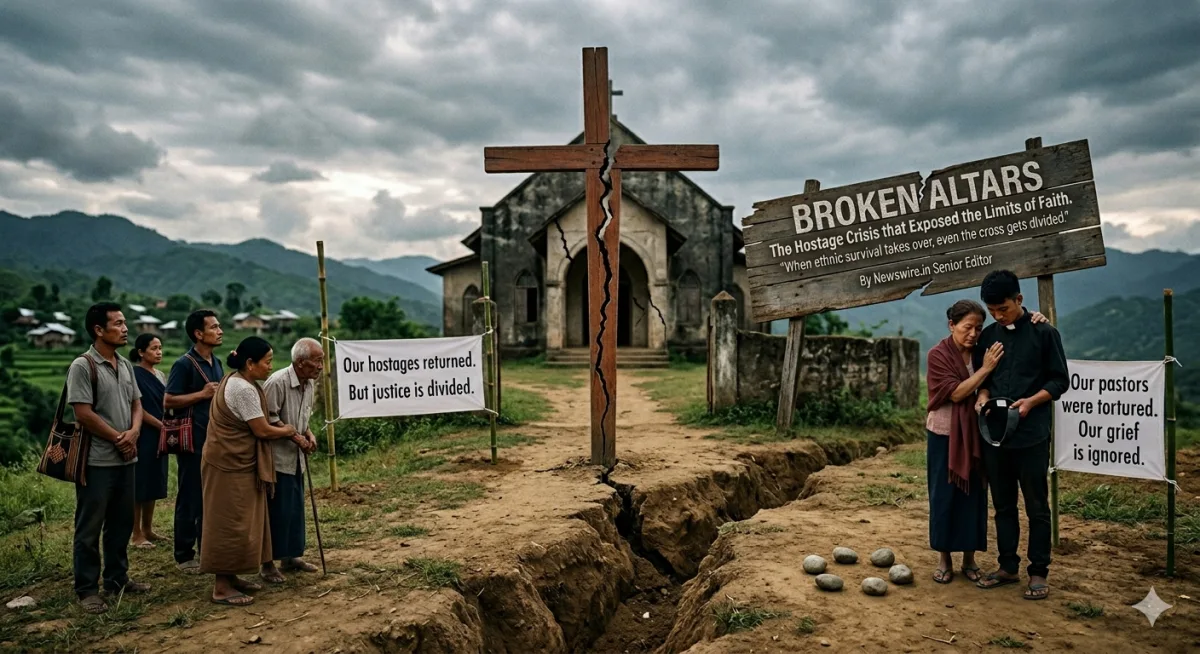
 Photo Courtesy: Representative Image
The hills of Manipur have a cruel habit of burying hope before it can take root.
On the morning of June 9, 2026, fourteen Kuki men held captive for twenty-seven days in the Naga-majority Senapati district finally saw their families again. They walked out alive, unharmed, and into the arms of waiting relatives at Taphou village. Church bells had rung for this moment. Politicians in Nagaland and Meghalaya had appealed for it. Even Union Home Minister Amit Shah had given his word that the government would trace the six Naga men who had vanished on the very same day these fourteen Kukis were taken.
Barely twenty-four hours later, the search ended. But not the way anyone had prayed for.
Security forces recovered the remains of all six missing Naga hostages on June 10 from a stretch between Kuki villages, Leilon Vaiphei and Kharam Vaiphei in Kangpokpi district. Among the dead were two pastors, Rev. Manu Thiumai and Pastor Kenpibou, along with four other civilians: Dilip Thiumai, Phenrilungbou, Kaliwangbou, and Phen-rongwibou. They had been abducted on May 13 while returning from a wedding reception, separated from the women and children who were later released, and simply never seen again. Until now.
The timing is what haunts people. For nearly a month, the government could not trace these six men. Their families filed a PIL in the Manipur High Court seeking state intervention (Ukhrul Times). The United Naga Council (UNC) set deadlines for their release, then cancelled the scheduled release of the fourteen Kuki hostages, citing what it called "prevailing sentiments of the Naga public" ("Release of 14 Abducted Kukis," The Hindu). It was only after the Kukis were freed, after the political pressure eased, that the six bodies surfaced. To the Naga community, this was not coincidence. It was confirmation of their worst fears: that the men had been dead all along, and that someone, somewhere, had known exactly where they were.
Into this firestorm of grief and suspicion stepped the Kuki Christian Leaders' Forum (KCLF).
In a statement issued on June 11, the KCLF expressed what it called "deep grief" over the killing of the six Naga hostages. As reported by India Today NE, the forum condemned the violence, called for peace, and extended solidarity to the bereaved families—then, in the very same statement, highlighted another attack, this one in Kultuh village, Kamjong district, where the Head Deacon and Youth Chairman of the local Baptist Church were shot dead in a pre-dawn raid. The forum also noted the killing of Haogin Lhouvum, a fifty-five-year-old Kuki farmer gunned down while working in his paddy field in Tamenglong district on June 9 (Borah). "The ongoing violence has witnessed many brutal and barbaric acts of killings," the forum said, urging communities to reject revenge. It spoke of compassion, of forgiveness, of the late Rev. V. Sitlhou's peace missions to Nagaland. It thanked Naga civil society organisations for releasing the fourteen Kuki hostages.
But here is where the story fractures.
Neutral observers and Naga community members have watched this "dual-condemnation" playbook before. Throughout the nearly month-long standoff, Naga civil society organisations made no secret of the fact that they were holding the fourteen Kuki villagers as leverage, explicitly demanding the safe return of the six missing Naga men. The Kuki side, meanwhile, maintained through its civil and religious bodies that it had no knowledge of where the six men were. "Honest responses should not be mistaken for irresponsibility," the Kuki CSO Working Committee later stated, suggesting their denials were simply truth, not evasion (Borah). When the bodies were recovered from Kuki-dominated territory by a joint security team, that narrative of collective ignorance collapsed in the eyes of the Naga community.
In highly polarized ethnic conflicts, public statements are parsed with surgical precision. It is precisely why neutral observers and the Naga community have pointed out a glaring, deeply unsettling asymmetry in how the KCLF and associated Kuki apex bodies managed this crisis.
From the beginning, the structural bias was evident. Early statements and rallies by Kuki groups focused almost exclusively on the catalyst of the crisis, the tragic May 13 ambush that killed three Thadou church leaders, and the safety of their own fourteen detained kinsmen. Critics argue that by hyper-focusing on their own grievances, these religious forums treated the six Naga lives as a secondary concern, a footnote to be dealt with only when the clock ran out.
But the true moral failure occurred after the bodies were found.
When the KCLF finally issued its statement, it offered an expression of grief for the slain Nagas. Yet, in the exact same press release, the forum immediately pivoted, highlighting and condemning fresh Kuki casualties. To objective observers, this is the great, recurring tragedy of modern Manipur: the immediate, almost involuntary reflex to "balance the ledger" of grief. It was an exercise in narrative damage control. But this calculated attempt at political neutrality does something far more insidious than just dilute accountability, it creates a false moral equivalence that sanitises the nature of the crime.
There is a profound ethical, legal, and human chasm between a sudden ambush shooting, as horrific as it is, and a month-long hostage ordeal that ends in the condition in which these bodies were discovered. The Hindu, citing forensic and eyewitness details from Kangpokpi, reported that the remains were "so badly brutalized that heartbroken families had to identify their fathers and brothers primarily by their clothes and shoes" ("Bodies of Two Naga Hostages"). This was not a standard crossfire casualty. The distinct markers, prolonged captivity, the separation of women and children who were later released, and the reported condition of the remains, have led observers familiar with the region's conflict patterns to characterize the incident as bearing the terrifying markers of an atrocity rather than an active skirmish.
By "flattening" these two vastly different realities into a singular, generic narrative of an "ongoing cycle of violence," the KCLF effectively erased the exceptional barbarism of what those six men endured. When an organization instantly tries to balance the scales, it provides an immediate escape hatch from internal accountability. It shifts a painful, necessary internal reckoning, how did armed elements operate a shadow execution camp in our backyard without our knowledge, or our intervention, into a comfortable shield of mutual victimhood: see, we are both suffering.
Under international humanitarian law, the targeted execution and torture of hostages carries a completely different ethical and legal weight than active skirmishes. Critics of this approach argue that when public relations statements treat a prolonged atrocity as just another interchangeable piece of ethnic violence, they are weaponizing grief to maintain political symmetry rather than pursuing moral truth. The KCLF's response was seen not as a noble, universal call for peace; it was, rather, seen by observers across communities as a tactical maneuver designed to drown out an uncomfortable anomaly of torture in the broader noise of the conflict.
When religious leadership prioritizes narrative protection over unvarnished moral truth, the damage is catastrophic. It doesn't just alienate the aggrieved community; it breaks the very foundation of moral authority required to ever broker peace.
This is where faith hits a brutal geopolitical wall. For decades, the church was the ultimate arbiter of peace in the Northeast, a rare, resilient institution that could transcend tribal lines. The KCLF's June 11 statement, as reported, thanked Naga civil society organisations for releasing the fourteen Kuki hostages and recalled the peace missions of the late Rev. V. Sitlhou, while simultaneously pivoting to Kuki victimhood within the same breath (Borah). The result, as seen by observers across communities, was not a universal call for peace but a calibrated maneuver designed to maintain political symmetry. If pastors can be targeted, and if religious forums can no longer speak without checking their tribal alignment, then who is left to step into the breach? Manipur is rapidly running out of neutral voices. When the language of faith is reduced to just another tool for wartime public relations, the path back to shared coexistence becomes a question one can only ponder.
The hills of Manipur have seen this script before. The question is whether anyone will rewrite it before the next coffin is carried down the road.
- By A. Newmai | Indepedent Researcher
Works Cited
"The Hindu." The Hindu, 12 June 2026, www.thehindu.com/news/national/manipur/bodies-of-two-naga-hostages-identified-amid-rising-demand-to-scrap-peace-deal-with-kuki-outfits/article71094275.ece.
Borah, Nandita, editor. "Kuki Christian Leaders Mourn Six Hostages' Deaths, Condemn Fresh Violence in Manipur." India Today NE, 11 June 2026, www.indiatodayne.in/manipur/story/kuki-christian-leaders-mourn-six-hostages-deaths-condemn-fresh-violence-in-manipur-1406658-2026-06-11.
Grimm, William J. "Christian Tensions Ease after Hostages Released in India's Manipur." UCA News, 10 June 2026, www.ucanews.com/news/christian-tensions-ease-after-release-of-kuki-hostages-in-indias-manipur/113712.
"PIL Filed in Manipur High Court Seeking Intervention in Abduction of Six Naga Hostages." Ukhrul Times, 4 June 2026, ukhrultimes.com/pil-filed-in-manipur-high-court-six-naga-hostages/.
"Release of 14 Abducted Kukis 'Cancelled' after Protests in Manipur." The Hindu, 1 June 2026, www.thehindu.com/news/national/manipur/release-of-14-abducted-kukis-cancelled-after-protests-in-manipur/article71049477.ece.
"UNC Calls Off Release of 14 Kuki Detainees Hours After Announcement." Ukhrul Times, 1 June 2026, ukhrultimes.com/unc-calls-off-release-of-14-kuki-detainees-hours-after-announcement/.
"Manipur: Naga Groups Release Remaining 14 Kuki Hostages; Fate of Six Missing Nagas Unclear." The Wire, 9 June 2026, m.thewire.in/article/security/manipur-nagas-release-14-kuki-hostages-fate-of-six-missing-nagas-unclear.
"ASIA/INDIA – Instability, Roadblocks, and Protests in Manipur: High Tensions and Hostage Crisis Continues." Fides News Agency, 26 May 2026, www.fides.org/en/news/77730-ASIA_INDIA_Instability_roadblocks_and_protests_in_Manipur_high_tensions_and_hostage_crisis_continues.




Comments