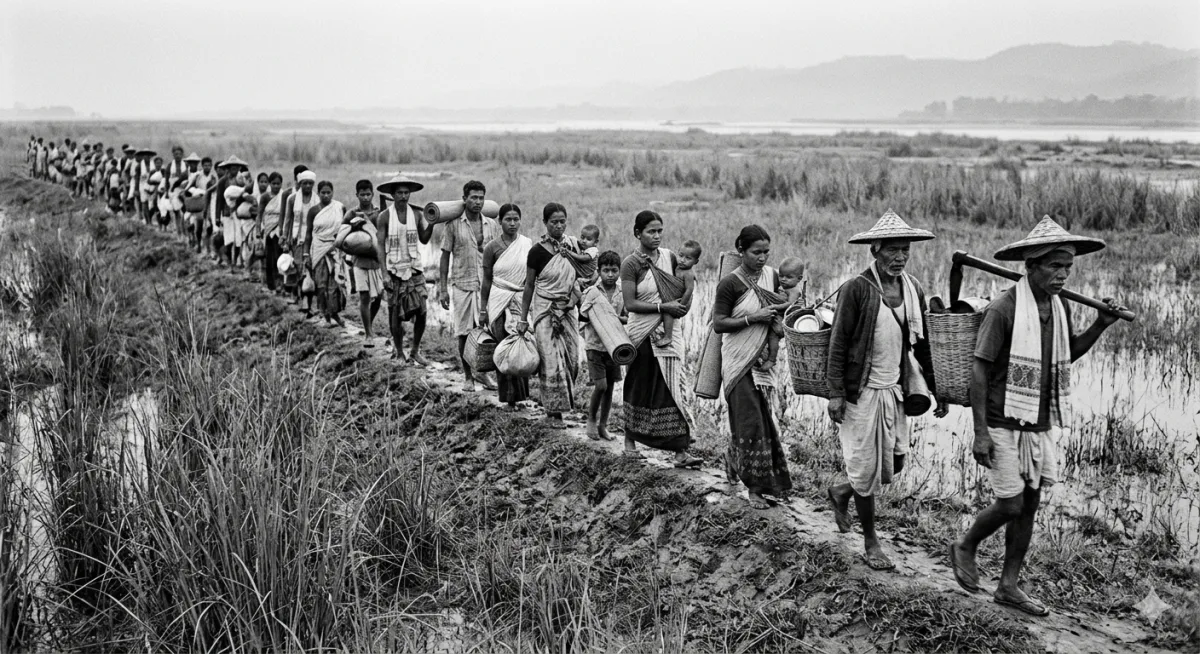
In the winter of 2017, Abdul Rashid, a 62-year-old farmer from the char areas of Darrang district, stopped sleeping in his own house. For three months, he spent his days tending to his plot and his nights hiding in neighbors' homes, terrified that the knock on his door would come from police, not visitors. He had been declared a foreigner by a tribunal. The thought of detention gave him, as he told researchers, "shivers down the spine." His family had lived on that land since the 1930s. His father had paid revenue to British tax collectors. None of it mattered.
Rashid's story is one thread in a much larger, more troubling fabric. For decades, Assam has been ground zero for a debate that reduces human beings to census figures and political talking points: the influx of migrants from Bangladesh. The conversation, amplified by nationalist rhetoric and election cycles, fixates on religious identity and national security. Lost in the noise is a quieter, more devastating reality. Assam's indigenous tribal communities, the Bodo, Mising, Karbi, Dimasa, and numerous smaller groups, are watching their ancestral lands, languages, and political futures erode. Not always from migration itself, but from a state that has consistently failed to protect them while weaponizing their fears.
The numbers are stark, and they fuel the anxiety. According to Census 2011, Muslims constituted 34.22% of Assam's population, up from 30.92% in 2001. In nine districts, including Dhubri, Barpeta, and Goalpara, Muslims now form the majority. Chief Minister Himanta Biswa Sarma claimed in late 2025 that the figure had reached 39.5%, backing the Centre's new "detect, delete, deport" demography mission. The Hindu population, meanwhile, has slipped to roughly 61%, and in several sub-districts, the decline has been precipitous. For indigenous communities, this is not abstract arithmetic. It is the arithmetic of extinction.
The "nut graph" is this: Assam's indigenous tribes face an existential squeeze from two directions. From one side, decades of migration, both documented and undocumented, have altered the demographic and electoral map of the state, particularly in the fertile riverine belts and char areas where land is scarce and livelihoods are fragile. From the other side, the Indian state, in its zeal to manage this migration through tools like the National Register of Citizens (NRC) and the Citizenship Amendment Act (CAA), has enacted policies that often bypass, ignore, or actively undermine the constitutional safeguards meant for tribal communities. The result is not security. It is a deepening crisis of displacement, land alienation, and cultural precarity for those who were here first.
Consider the Bodo people. The Bodoland Territorial Region (BTR) Accord of 2020 was signed with fanfare, promising legislative protection for tribal land rights, accelerated development, and rehabilitation for former militants. Five years later, in November 2025, Bodo organizations were protesting at Jantar Mantar in Delhi, accusing the government of slow-walking implementation. A study published in the South Asian Law Review Journal noted that while the accord expanded the council's powers on paper, "tribal people in Assam, particularly in the Bodoland region, are again confused" by land policies that conflate "Indigenous Backward Classes" with Scheduled Tribes, diluting protections. Around 3 lakh bighas of land in the Bodoland region alone remain under threat of encroachment. The accord's promise to protect khas land and grazing reserves from illegal encroachment remains largely unfulfilled.
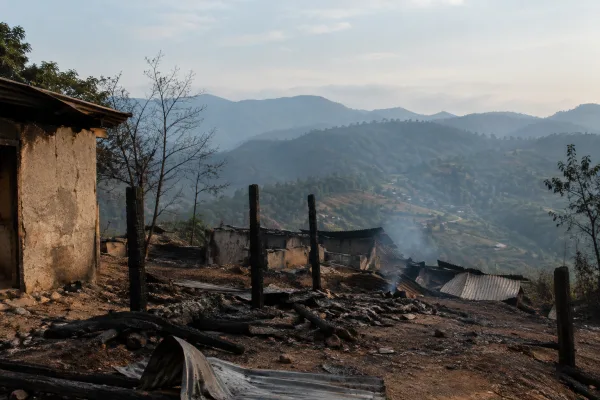
The Bodo are not alone. The Mising, Karbi, and Dimasa tribes have faced repeated cycles of displacement, not merely from migrants moving onto their lands, but from state-led development projects, dams, and industrial complexes that acquire tribal territory without comprehensive rehabilitation. A status report by the Mahanirban Calcutta Research Group documented how ethnic violence between Karbi and Dimasa militant groups in 2005 displaced over 60,000 tribal people, forcing them into relief camps where they remained for months. The government's response was piecemeal. Schools were converted into shelters. Food and medicine ran short. When the violence subsided, many did not return home. They had no homes to return to.
This is the part of the story that gets buried under the headline-grabbing rhetoric about "infiltrators" and "vote banks." The indigenous communities of Assam are not simply afraid of being outnumbered. They are afraid of being rendered politically irrelevant in a state where political power follows demographic weight. The Assam Accord of 1985, which ended the six-year anti-foreigner agitation, promised Clause 6 safeguards for the "Assamese people," including land and language protections. In 2024, the state government accepted a 1951 cut-off date for some recommendations and promised to implement 52 clauses by April 2025. But the definition of "Assamese people" remains contested, and the autonomous councils under the Sixth Schedule, which govern tribal areas, have been given discretion over whether to adopt these safeguards at all. For tribes outside these councils, the protection is even thinner.
The NRC process, touted as a solution, has compounded the problem. When the final list was published in August 2019, 1.9 million people were excluded. Among them were tens of thousands of indigenous tribal people. The Commonwealth Human Rights Initiative reported that approximately 25,000 Bodos, 12,000 Reangs, and 8,000 Hajongs were left off the register. Many Reang women, identified as a particularly vulnerable tribal group with extremely low literacy, were excluded simply because they could not prove 1971 legacy documents, a requirement that ignores the patrilineal customs of tribal record-keeping. The NRC, designed to filter out foreigners, instead filtered out some of Assam's most vulnerable original inhabitants.
The Counterargument, and Its Limits
It would be intellectually dishonest to ignore the other side of this ledger. Migration into Assam did not begin in 1971. The British colonial administration actively encouraged Bengali Muslim peasants to settle in the riverine char areas to boost agricultural revenue. These migrants introduced multi-cropping, transformed wasteland into fertile farms, and built economies in regions the indigenous population largely avoided. Many of today's so-called "illegal Bangladeshis" are descendants of those colonial-era settlers, or refugees from the 1971 war, or erosion-displaced citizens who have lived in Assam for generations. To treat them all as a monolithic threat is to commit the same erasure that indigenous communities rightly decry.
Moreover, the char dwellers, predominantly Bengali-origin Muslims, live in crushing poverty. The Human Development Report of Assam, 2016, found that 44.59% of char residents live in multidimensional poverty, compared to 30.10% for the state as a whole. They face floods, erosion, and state violence. Their lives are precarious. Branding them uniformly as infiltrators ignores this reality and serves a political purpose: it diverts attention from the state's failure to manage resources, enforce land laws, or provide rehabilitation to all displaced people, regardless of ethnicity.
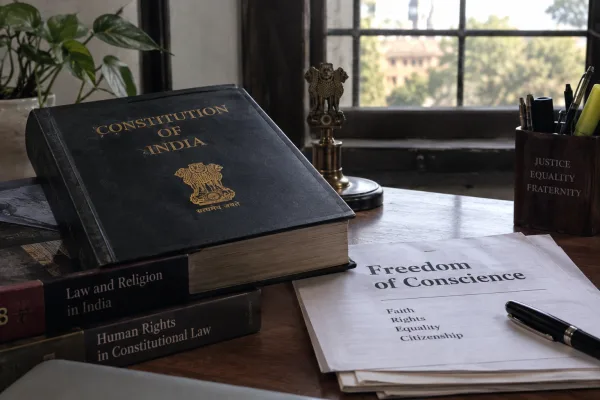
But here is where I part ways with the purely humanitarian framing. The suffering of migrant communities, however real, cannot be used to invalidate the legitimate fears of indigenous tribes. The two are not mutually exclusive. Assam is not a blank slate. It is a territory with existing inhabitants who possess constitutional rights to their land and culture under the Sixth Schedule and other protections. When the state fails to distinguish between a colonial-era migrant and a recent undocumented arrival, or when it refuses to implement tribal land safeguards while conducting eviction drives that disproportionately target one community, it abdicates its primary duty: to protect its most vulnerable citizens, starting with those who were there first.
What the State Owes Its First Peoples
The solution is not more rhetoric about deportation, which Bangladesh refuses to acknowledge at scale and which India lacks the infrastructure to enforce. It is not the CAA, which offers citizenship to non-Muslim migrants while leaving Muslim migrants in limbo, a religious test that violates the constitutional principle of secularism and does nothing for indigenous rights. It is certainly not the current approach to the NRC, which has created a class of stateless people while excluding genuine citizens.
The solution begins with land. The Assam government must implement the BTR Accord's land protection clauses in full, not just for the Bodo but as a model for all tribal areas. It must enforce the Tribal Belts and Blocks Regulations, which prohibit the transfer of tribal land to non-tribals, and it must do so retroactively where encroachment is provably recent. The Brahma Committee, which reviewed these regulations, recommended harsher penalties for illegal land transfers and prosecution of officials who facilitate them. These recommendations have gathered dust.
The solution continues with data. The 2021 Census, delayed for years, must be conducted transparently, and its data on tribal populations must be disaggregated and protected. The current political discourse conflates "indigenous Muslim" growth, which is modest, with migration-driven growth in border districts. This conflation serves only to inflame communal tensions while obscuring the specific needs of tribal communities.
Finally, the solution requires political will. The 125th Constitutional Amendment Bill, which would strengthen the fiscal and administrative powers of Sixth Schedule councils, has been pending since 2019. Bodo groups protested in Delhi in late 2025 demanding its passage. The Centre's response has been silence. This is not governance. It is negligence dressed in nationalist clothing.
Assam's indigenous tribes are not asking for supremacy. They are asking for survival. The Bodo farmer watching his grazing land shrink, the Mising woman unable to prove her citizenship, the Karbi family displaced by ethnic violence and left in a relief camp, these are not entries in a demographic ledger. They are people whose ancestors shaped the hills and river valleys of Assam long before the drawing of borders.
The state owes them more than eviction drives and empty accords. It owes them a future in which they are not strangers in their own homeland. Until that debt is paid, all talk of national security and demographic integrity rings hollow. The threat to Assam's native tribes is real. It has just never come primarily from across the border. It has come from the failure of those in power to see them at all.
- By Angam Niumai | Independent Researcher
References
Barman, Barsha. "A Case Study on Bangladeshi Illegal Migration to Assam." India Policy Review Research, IMPRI, vol. 3, no. 2, July-Dec. 2024, pp. 1-15.
Boro, Dipen, et al. "Assam Organisations Protest in Delhi for Bodo Accord Implementation." The Hindu, 21 Nov. 2025, www.thehindu.com/news/national/assam-organisations-protest-in-delhi-for-bodo-accord-implementation/article70307627.ece.
Chakma, Suhas. "Media Factsheet on Issues of Citizenship in the Northeast." Commonwealth Human Rights Initiative, 2020, mcrg.ac.in/RLS_Migration_2020/NRC_Factsheet_2020.pdf.
James, K. S. Luckyson. "The Bodoland Territorial Council (BTC) in Assam." South Asian Law Review Journal, vol. 9, 2023, pp. 45-62.
Saikia, Arunabh. "In Assam, Many Women, Children Fail to Make NRC Even as Their Family Members Are Counted as Citizens." Scroll.in, 31 Aug. 2019, scroll.in/article/931012.
Sarma, Himanta Biswa. "Assam CM Sarma Claims Muslim Population in State Has Risen to 39.5%." ANI News, 12 Oct. 2025, www.aninews.in/news/national/politics/assam-cm-sarma-claims-muslim-population-in-state-has-risen-to-395-backs-centres-detect-delete-deport-demography-mission20251012172410.
Sharma, Chandan Kumar. "Questioning the 'Infiltrator' Narrative and Migration in Assam." Economic and Political Weekly, 20 Feb. 2020, www.epw.in/engage/article/questioning-infiltrator-narrative-migration.
Sinha, S. K. "Illegal Migration into Assam." Report submitted to the President of India, 1998, satp.org/satporgtp/countries/india/states/assam/documents/papers/illegal_migration_in_assam.htm.
Vajiram & Ravi. "Implementation of Clause 6 of Assam Accord." Current Affairs, 26 Sept. 2024, vajiramandravi.com/current-affairs/implementation-of-clause-6-of-assam-accord/.


Comments