
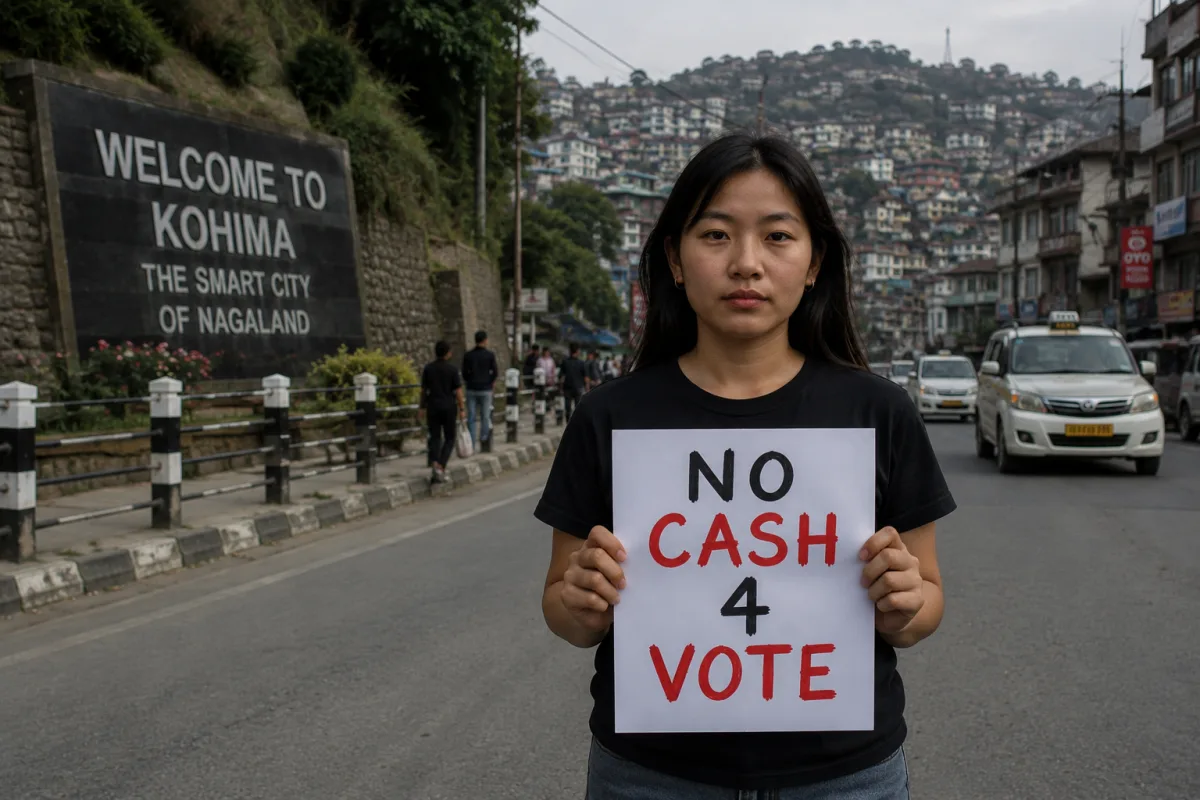
 Photo Courtesy: Representative Image
In February 2023, the Mizoram People’s Forum (MPF) deployed over 2,000 volunteers across polling booths to monitor elections for the state assembly, operating under a strict moral code backed by the Presbyterian Church Synod. Two months earlier, in Nagaland, candidates for the same election reportedly distributed cash, liquor, and promises of government jobs to voters in villages where the Baptist Church Council remained publicly silent on electoral malpractice. The contrast is stark. Both states are Christian-majority, tribal, mountainous, and dependent on central funds. Yet one has built an institutional firewall against vote-buying while the other has normalised it. The question is not whether Nagaland is more corrupt. It is why the same religious fabric produced such divergent civic outcomes, and whether Nagaland can still alter its trajectory.
The Mizoram Synod is financially self-sustaining, with an annual income of approximately Rs 243 crore drawn almost entirely from member tithes and the Buhfaitham rice offering system. It operates 18 boards and committees, runs schools, hospitals, and vocational centres, and audits its accounts through chartered accountants. This is not a charity dependent on foreign missions. It is a parallel governance structure with revenue streams, personnel systems, and disciplinary mechanisms that rival the state in reach. When the MPF was formalised in 2006, it drew on this existing church infrastructure: local pastors as moral guarantors, church halls as meeting venues, and the Synod’s communication networks to disseminate candidate ratings. The YMA, founded in 1935, adds a secular layer of social audit that inspects government works and publishes findings. The church and the YMA together create a dual-track accountability system that the state government cannot ignore. In 2022, Governor Hari Babu Kambhampati publicly acknowledged the Presbyterian Church’s role in ensuring free and fair elections and monitoring development programmes. This is not informal influence. It is structured, recognised, and funded from internal resources.
Nagaland’s church architecture is different. The Nagaland Baptist Church Council (NBCC) is influential in moral discourse, particularly on issues like alcohol prohibition and social justice, but it lacks the Synod’s centralised financial autonomy and administrative density. The Baptist churches in Nagaland operate with more decentralised governance, and the NBCC has not built an equivalent to the MPF’s election monitoring apparatus. Academic research on church governance in Nagaland points to the NBCC’s focus on spiritual and social welfare rather than systematic political oversight. Where the Mizoram Synod can discipline members, withhold endorsements, and mobilise volunteers through a hierarchical structure, the NBCC’s engagement with elections has been more episodic and less institutionally embedded.
The zero-corruption norm in Mizoram did not emerge spontaneously. It was built through decades of church-led social discipline. The Presbyterian Church’s self-financing model, established by missionary D.E. Jones in the 1890s, required members to tithe from the first converts onward. This created a culture of fiscal transparency at the village level that extended to expectations of government conduct. The MPF’s election monitoring, which began in earnest in the 2000s, formalised a pre-existing social expectation: that public office is a form of service, not a business investment. The YMA’s village-level inspections of government works, published and discussed in public forums, add a layer of technical accountability that makes corruption harder to hide. In Nagaland, by contrast, the church condemned individual sins but did not systematically monitor public expenditure or electoral conduct.
The structural dependency on central funds makes both states vulnerable, but Mizoram has leveraged this differently. The 15th Finance Commission found that Mizoram’s own tax revenue hovered around 10% of total receipts, with central devolution providing the rest. Yet Mizoram has maintained revenue surpluses in most years and kept its fiscal deficit below 3% of GSDP. Nagaland, according to the SKOCH State of Governance 2024 report, ranks in the lower tier nationally on fiscal prudence, with weak own-revenue mobilisation and limited capital expenditure capacity. The difference is not the size of central grants but how they are administered. Mizoram’s IFMIS computerisation of treasuries, completed by 2015, and its public expenditure reforms under the ADB-funded MPRMP created digital trails that reduce leakage. Nagaland’s e-governance infrastructure ranks among the bottom five states, with poor internet penetration and limited service digitisation. When funds pass through opaque manual systems, the incentive to capture them increases.
Cash-for-votes may work in Nagaland because the transaction is rational for both sides. Voters in a state with high unemployment, weak public services, and limited private-sector opportunities may treat election cash as a direct welfare transfer. Candidates, in return may treat it as a necessary investment with calculable returns through government contracts and patronage appointments. According to the Association for Democratic Reforms analysis of the 2023 Nagaland Assembly elections, 63% of the 184 candidates were crorepatis with average declared assets of Rs 5.13 crore. The Election Commission of India reported that enforcement agencies seized cash, liquor, drugs, and freebies worth Rs 36.99 crore during the 2023 Nagaland election period, with the ECI noting that seizures in the three northeastern poll-bound states (Tripura, Nagaland, Meghalaya) were 20 times higher than in the 2018 elections.
Academic research published in the Mizoram University journal documented that “proxy voting and voting in return for bribes becomes a big problem in the Nagaland election,” with former Chief Minister Dr. Shurhozelie Liezietsu quoted as stating that “the election in Nagaland has been reduced to a game of money.” The church’s moral authority, where it is exercised, operates on individual conscience rather than institutional blocking. In Mizoram, the MPF’s presence at polling stations, its public rating of candidates on integrity, and the church’s capacity to socially sanction violators raise the cost of vote-buying. A candidate who buys votes risks not just legal penalties but loss of social standing in a community where church membership is nearly universal and church discipline is real.
Performance indices reflect this divergence. Mizoram’s literacy rate stands at 91.3%, the second highest among Indian states, and its human development indicators consistently outrank Nagaland’s. On the Good Governance Index 2020-21, Nagaland topped the judiciary and public security category, but Mizoram scored competitively across multiple sectors. The SKOCH report notes Nagaland’s strengths in forest governance and district administration but flags its weak fiscal position and digital infrastructure. These indices are not causes of clean elections; they are symptoms of the same underlying institutional capacity that produces clean elections. Mizoram invested in education, built church-financed social infrastructure, and created accountability mechanisms that reduced the premium on state patronage. Nagaland’s lower literacy, weaker private sector, and dependence on government employment made state resources the primary route to economic advancement, intensifying the scramble for electoral capture.
Nagaland has attempted reform. Civil society groups have periodically campaigned against corruption, and the state has adopted some e-governance initiatives. But these efforts lack the structural depth of Mizoram’s church-YMA partnership. The NBCC’s occasional statements against electoral malpractice do not translate into booth-level monitoring or systematic candidate vetting. The state’s contractor-politician nexus, where individuals move seamlessly between government contracts and elected office, has proven resilient. As documented in the Economic and Political Weekly, this nexus of politicians, bureaucrats, contractors and underground leaders operates by exploiting the Naga issue rather than solving it, while sustaining and reproducing systemic corruption. Without an institution with the financial autonomy, membership density, and disciplinary capacity of the Mizoram Synod, reform remains episodic.
Replication would require radical measures, not symbolic gestures. First, the Nagaland church councils would need to centralise financial management and build independent revenue streams, reducing dependence on foreign mission funding and sporadic donations. Second, civil society would need to create a permanent election monitoring body with village-level presence, not ad hoc campaigns. Third, the state would need to accelerate e-governance and treasury computerisation to create audit trails for public funds. Fourth, and most difficult, the political economy of contractor-politician overlap would need to be disrupted through transparent tendering and conflict-of-interest disclosure. These are structural changes, not moral exhortations.
The official position in both states acknowledges corruption as a problem while pointing to central dependency as a root cause. Mizoram’s government has cited limited own-revenue capacity and the need for central transfers as fiscal constraints. Nagaland’s officials have similarly referenced geography and insurgency as barriers to development. Both are partially true. But Mizoram has demonstrated that central dependency does not preclude clean administration when parallel accountability structures exist. The church in Mizoram did not wait for state capacity to improve. It built its own capacity and used it to discipline the state. Nagaland’s church, for reasons of history, theology, and organisation, did not do the same. The result is visible at every polling booth.
The structural trap in Nagaland is real: politics, civil society, the church, and the public are locked in a cycle where cash-for-votes is alleged to be the equilibrium because no single actor can defect without cost. Breaking this requires an institution with the credibility, resources, and reach to change the payoff structure for everyone. Mizoram found that institution in the Synod. Nagaland has not. Until it does, the cash may keep flowing, and the ballots may keep selling.
References
"Governor Hari Babu interacts with leaders of Mizoram Presbyterian Church." Directorate of Information and Public Relations, Government of Mizoram, 21 Feb. 2022, dipr.mizoram.gov.in/post/governor-hari-babu-interacts-with-leaders-of-mizoram-presbyterian-church.
"Mizoram Presbyterian Church." Mizoram Synod, www.mizoramsynod.org/page/1231.
"Mizoram Presbyterian Church." Mizoram Synod, www.mizoramsynod.org/page/1792.
"Nagaland - States of Viksit Bharat: Annual Report 2024." SKOCH Group, 2024, skoch.org/reports/states-of-viksit-bharat-2024/nagaland.
"Centre Releases 'Good Governance Index 2020-21.'" Northeast Today, 27 Dec. 2021, northeasttoday.in/northeast/centre-releases-good-governance-index-2020-21-check-out-ranks-of-northeastern-states/.
"Evaluation of State Finance Mizoram." Fifteenth Finance Commission, Government of India, fincomindia.nic.in/asset/doc/commission-reports/15th-FC/reports/studies/evaluation/EVALUATION%20OF%20STATE%20FINANCE%20MIZORAM.pdf.
Royte, Ronald Lalunmawia, and K. Lalromawia. "A Study of Baptist Church of Mizoram." Mizoram University, 2024, mzu.edu.in/NAAC_DVV_2024/3.4.4/Management/409%20managing%20church%20finance.pdf.
"Mizoram Budget Analysis 2024-25." PRS Legislative Research, 28 Mar. 2024, prsindia.org/files/budget/budget_state/mizoram/2024/Mizoram_Budget_Analysis_2024-25.pdf.
"Nagaland Assembly Elections 2023: Analysis of Criminal, Financial and other Details of Candidates." Association for Democratic Reforms (ADR India), 2023, adrindia.org/sites/default/files/Analysis_of_Criminal_Financial_and_other_Details_of_Candidates_Nagaland_Assembly_Elections_2023_Finalver_English.pdf.
"Nagaland election 2023: Cash, liquor and freebies worth Rs 36 crore seized." India Today NE, 13 Feb. 2023, www.indiatodayne.in/elections/nagaland-assembly-elections-2023/story/nagaland-election-2023-cash-liquor-and-freebies-worth-rs-36-crore-seized-512077-2023-02-13.
Guite, V. "Nagaland Legislative Assembly Election – 2023." Mizoram University Journal of Humanities and Social Sciences, vol. 9, no. 1, 2023, mzuhssjournal.in/images/resources/v9n1/guite.pdf.
"North-East polls: EC makes record seizure in Tripura, Nagaland and Meghalaya." The New Indian Express, 16 Feb. 2023, www.newindianexpress.com/india/northeast/2023/Feb/16/north-east-polls-ecmakes-recordseizure-intripura-nagaland-and-meghalaya-2548026.html.
"The Naga Homeland Movement." Economic and Political Weekly, 2026, www.epw.in/tags/nagaland.


Comments