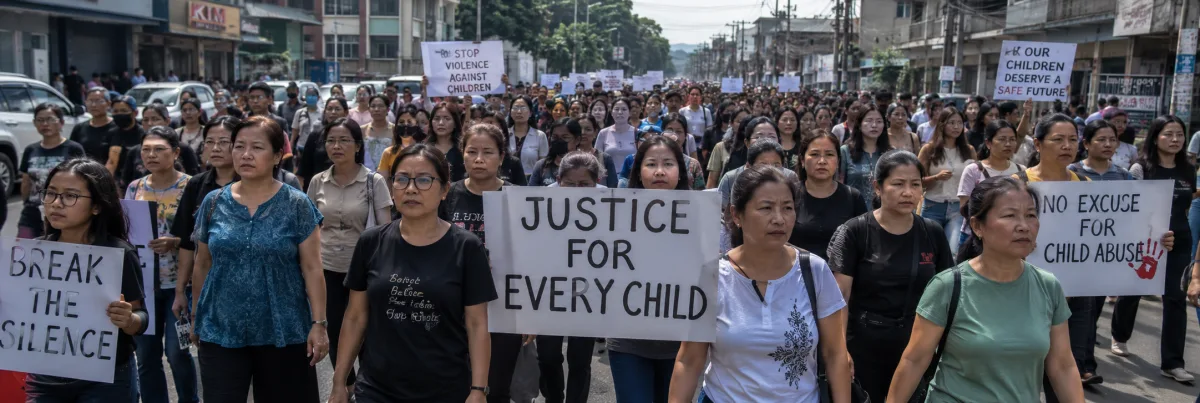
On 25 May 2026, an FIR was registered at the Dimapur Women Police Station against three men accused of aggravated penetrative sexual assault of a minor girl. A Special Investigation Team was constituted within days. The accused are in custody, and the law has begun its course. Yet the facts that surround this prosecution that the child had allegedly been placed in the primary accused's residence for nearly two years for educational purposes, that she came from outside Dimapur, and that allegations by the Dimapur Eastern Naga Students' Union (DENSU) suggest her disclosure reached the police through school counsellors who had noticed academic decline and behavioural change suggest that this is not merely a criminal case. It is a reflection of a structural vulnerability that Nagaland's child protection institutions have documented for years and addressed for none.
In June 2017, the Morung Express published an investigative report on what it called the "invisible child labour" of Dimapur. Hundreds of children from Eastern Nagaland and neighbouring regions, it found, were sent annually to urban households under informal "student guardianship" arrangements that frequently devolved into domestic servitude, physical labour, and abuse. One twelve-year-old girl from Myanmar, given the pseudonym Taying, described her daily routine: "My main task was to look after the well-being of four pigs, I foraged for their fodder, cooked for them and then fed them every day, this job took me the whole day." The report warned that these children had little contact with their parents and no institutional oversight. Nine years later, the Eastern Naga Women Organization has issued an explicit caution to parents: under no circumstances should children be sent away to work as domestic helpers. The pipeline has persisted. The safeguards have not.
This is not the first time Dimapur has forced Nagaland to confront what happens when the protection of young females is left to informal arrangements rather than institutional accountability. On 5 March 2015, Syed Sharif Uddin Khan, accused of raping a twenty-year-old student, was dragged from Dimapur Central Jail by a mob estimated in the thousands, stripped, tied to a motorcycle, dragged seven kilometres, and killed. A one-man judicial commission headed by retired Gauhati High Court judge B.D. Agarwal found that the police and security forces "appear to have surrendered before the small crowd for no valid reason." The Gauhati High Court directed the CBI to investigate. More than a decade later, the outcome of that investigation remains unavailable in the public record. The opacity is itself a governance failure.
The connection between 2015 and 2026 is not criminal equivalence. It is institutional recurrence. The same city. The same vulnerability of young females placed beyond the reach of effective protection. The same institutional actors; police, judiciary, child welfare machinery, whose performance is now being tested again. Where a mob once substituted for perceived institutional failure, the question today is whether the formal system can deliver what the mob could not: sustained, transparent, accountable protection for children in custodial arrangements that the state has never bothered to regulate.
The documentary record raises a further question about whether the state even sees the problem clearly. The National Crime Records Bureau's Crime in India 2023 reported zero POCSO cases in Nagaland for the years 2021 through 2023, noting that the data was "provisional." Yet the Commissioner of Police, Dimapur, has publicly confirmed that POCSO cases in the state rose from seven in 2022 to fifteen in 2025. When the official crime statistics of the republic record zero during years when prosecutions were actively underway, the failure is not merely statistical. It is a collapse of data integrity that conceals ground reality and distorts public understanding. Nagaland is frequently designated India's "safest state for women" based on precisely these NCRB rates. The designation is built on absence of recording, not absence of crime.
If the state cannot count the offences, it is reasonable to ask how it proposes to prevent them. The Lengrijan case illuminates what institutional invisibility means in human terms. Allegations have been made by student organisations that the child's disclosure emerged not through family or a direct call to a statutory protection line, but through teachers who noticed that she was no longer the student she had been. If this account is accurate, it suggests that for children in informal guardianship, the classroom may be the only space where an adult notices something is wrong. Schools are bearing a protection burden that formal institutions have not adequately assumed. The child, relocated for an education, found herself in a situation where the very arrangement designed to advance her future allegedly became the instrument of its destruction.
Under the Constitution, this is not a neutral fact. Articles 15(3), 21, and 39(e) and (f) impose affirmative duties upon the state to protect children from exploitation and to ensure that childhood is not forced by economic necessity into vocations unsuited to age or strength. The migration of children from Eastern Nagaland to Dimapur for education is driven by real disparities in educational infrastructure and parental aspiration. Those aspirations deserve respect. But the state's constitutional obligation does not end at permitting migration. It extends to ensuring that such arrangements do not become unregulated pipelines into abuse. The Protection of Children from Sexual Offences Act and the Juvenile Justice Act mandate specific procedures CWC intimation, medical examination, woman officer recording of statements. The public record contains no confirmation that these protocols were followed in the Lengrijan case. The absence of such confirmation, in a matter of intense public interest, is itself an institutional silence that demands correction.
What is required is not merely post-abuse prosecution, which the Dimapur Police have initiated with commendable speed, but proactive systemic oversight. The Social Welfare Department must establish mandatory registration and periodic welfare monitoring for all children placed in informal guardianship outside their home districts, with the District Child Protection Units and Child Welfare Committees legally empowered to conduct unannounced welfare checks. The Nagaland Government must publicly reconcile NCRB data with ground-level prosecution records and explain why POCSO cases were recorded as zero during years when they were known to exist. The CBI must disclose the current status and outcome of its 2015 lynching investigation, as directed by the Gauhati High Court in September 2015. Public funds were expended on the probe; the public is entitled to know its outcome. Transparency in that case is not historical curiosity; it is a measure of whether institutional accountability in Dimapur has improved at all.
The mirror that the Lengrijan case holds up is unsparing. It shows a child protection architecture that has not institutionalised the lessons of its own documented history. It shows a migration pipeline that operates in darkness, a crime recording system that obscures rather than reveals, and a city where the vulnerability of young females has recurred across a decade with no systemic response. The question is no longer whether this case is shocking. It is whether anything has actually changed since 2015, since 2017, since the last time a child was sent away for an education that no one bothered to supervise. Until the state chooses to see what Dimapur keeps showing it, every case will be called an anomaly, and every child in those invisible households will remain exactly that: invisible.
— The Editorial Team, NEWire.in
Editor’s Note (July 16, 2026): This editorial has been updated to reflect the filing of the SIT's chargesheet/adjournment of proceedings as of this date, ensuring the documentary record remains accurate for readers. The core institutional analysis remains unchanged.



Comments