
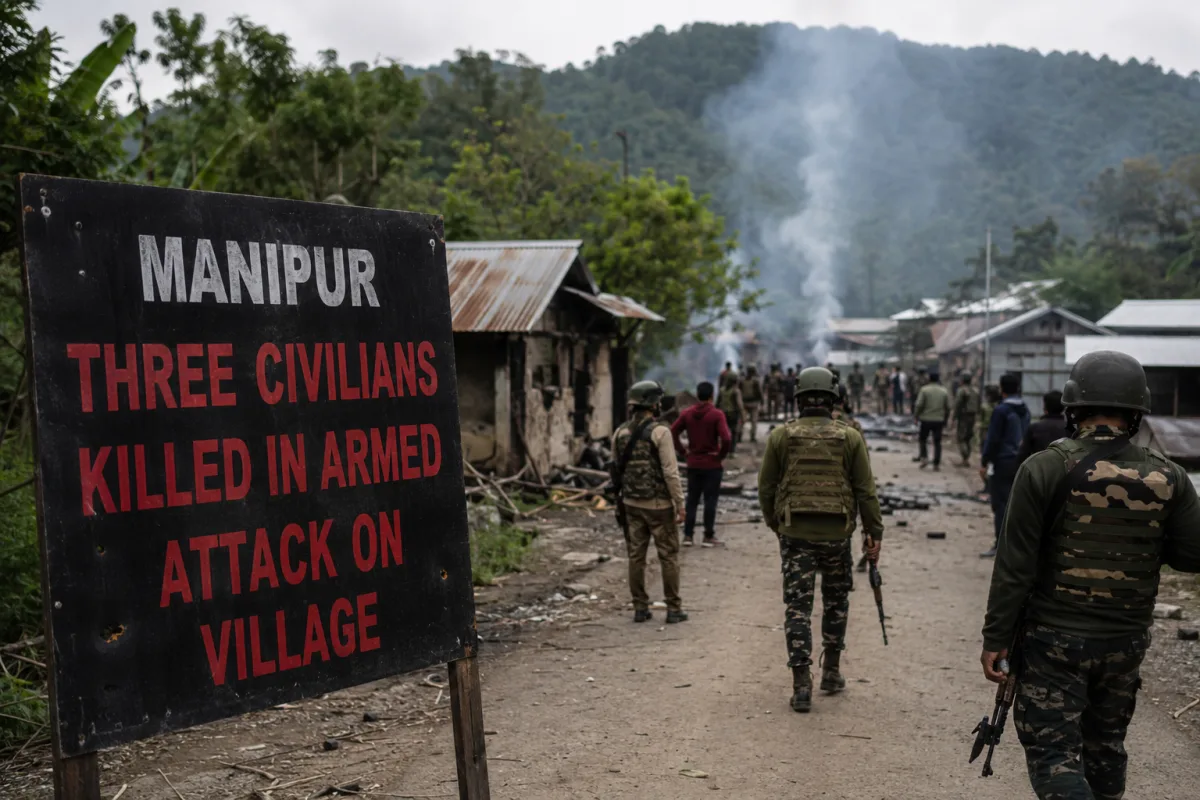
It was still dark when the shooting started. Around 3:30 AM on June 5, 2026, the hills between Loibol Khullen, a Kuki village and Pongringlong, also called Charoipandongba Part-1, a Rongmei Naga settlement in Kangpokpi district erupted in gunfire. By the time the sun came up, three civilians were dead. Seven houses had burned to the ground. And before anyone could even figure out who pulled the trigger, two communities were already at each other's throats, trading accusations that said more about Manipur's broken information landscape than about what actually happened in those hills.
The dead were Letkhongam Haokip, Tinmary, and Jangminlal Haokip.
But who killed them? Ask the Naga organizations, and you'll get one story. The Rongmei Naga Council Manipur and the Naga Co-ordinating Committee both insist this was an unprovoked attack by Kuki militants operating under the Suspension of Operations, or SoO, agreement. They describe "indiscriminate firing" that put villagers in "extreme danger" and "grave danger." The RNCM goes even further, claiming these militants were carrying sophisticated weapons and operating near "illegally farmed poppy plantations" in Pongringlong a clear nod to the narco-terrorism talking points that have dominated Naga political discourse lately.
Then flip the page to the Kuki Inpi Manipur's statement, and the story turns completely upside down. According to them, the attackers were "heavily armed cadres of NSCN-IM and its proxy ZUF (K)" Naga insurgent groups, not Kuki. They name the victims. They count the houses reduced to ashes. And they frame the whole thing as a deliberate strike on Kuki civilians. Then comes the line that reads less like a condolence and more like a warning: "Kuki Inpi Manipur shall not be held responsible for any consequences arising from this heinous crime against our people."
But there's another angle that is picking up serious traction right now, and it has nothing to do with Kuki versus Naga. Some local observers are pointing to a much messier possibility: an intra-Kuki turf war between the Kuki Liberation Army (KLA) and the Kuki National Army-Progressive, or KNA-P.
Shortly after 4:00 AM that same morning, a raw, unedited video started spreading like wildfire across local WhatsApp groups and X. The footage shows men in full combat gear, armed to the teeth, firing advanced weapons while houses burn around them. But here's the detail that matters: the voices shouting commands in the video are speaking fluent Kuki. Orders like "Shoot this side, now that side!" and shouts of "Well done!" to the gunmen, in Kuki dialect. If the men doing the shooting are shouting in Kuki, the simple Kuki-versus-Naga narrative starts to fall apart.
And that wouldn't be surprising. Out in the peripheral hills of Kangpokpi, various SoO groups have been operating under a fragile, paper-thin peace for years. But beneath that surface, old sub-tribal rivalries and territorial grudges run deep. These groups aren't exactly one big happy family. When money, territory, or factional pride is on the line, the guns come out fast.
History backs this up. The KLA and KNA have been fighting their own internal battles for decades, with fault lines that have nothing to do with the Naga community next door. Yet every time shots ring out in these remote hill pockets, the mainstream media's first instinct is to slap a "Kuki vs Naga" headline on it. That might be easier to digest, but it's often textually wrong. Sometimes the enemy is wearing the same uniform, speaking the same language, and claiming the same flag. And in Manipur's hills, that's the story that rarely makes it to the front page.
Newire.in is committed to ground-truth reporting in Northeast India. If you have verified information about this incident, contact our editorial desk.

Comments