
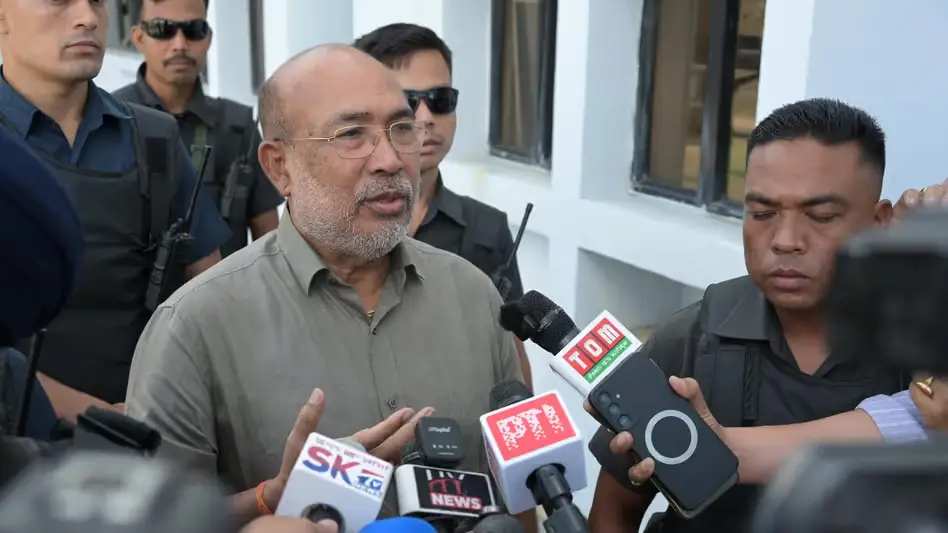
 Photo Courtesy: India Today Group
Imphal: N. Biren Singh flew to New Delhi on Monday, August 24. He needs to talk. The former Manipur Chief Minister is meeting with central leaders to address the state's ongoing violence and instability. A BJP official confirmed the party leadership requested his presence to hash out urgent issues.
Pressure is mounting over demographic concerns and the National Register of Citizens. Activists from the Campaign for Just and Fair Delimitation want an NRC update before the Census begins. They insist on using 1951 as the base year to track down illegal immigrants. Singh already discussed these specific demands with Union Home Minister Amit Shah.
The region remains a powder keg. Political sensitivity runs high regarding delimitation and the registration process. Singh stepped down from his post in February 2025 during the height of the ethnic fighting. His trip comes as state groups push their agenda. "Singh had been called by central leaders to discuss various issues concerning Manipur," said a BJP functionary.
Updated at 24th August 2026 at 10:00pm
This trip marks Singh's second visit to the capital in under a week. His previous two-day stint included a sit-down with Home Minister Amit Shah, where Singh claimed the Minister responded positively to the NRC demand. The repeat journey adds heat to rumors of potential shifts in the Khemchand Singh government, including a possible cabinet expansion.
Governor Ajay Kumar Bhalla and various BJP legislators also recently scrambled to Delhi as protests and shutdowns grip the state. While official channels remain tight-lipped, the frantic movement suggests the Centre is weighing a formal stance on the NRC-before-Census standoff. These developments keep the pressure on the Khemchand Singh administration to manage the state's ongoing volatility.
Updated at 25th August 2026 at 5:49pm
A separate delegation of 14 civil society organizations, representing both Meitei and Naga interests, hit the capital on August 24 to lobby the Ministry of Home Affairs and Union Minister Kiren Rijiju. The groups are demanding a full halt to Census and delimitation work until the NRC identifies legitimate Indian citizens. Shanta Nahakpam, the coalition's convenor, stated, "We discussed the deferment of Census and how to go about the process of National Register of Citizens (NRC) before the delimitation exercise." The coalition plans to keep the heat on by meeting with BJP president Nitin Nabin.
NPP legislator Mayanglambam Rameshwar Singh has added his voice to the fray, pointing to a sharp, unexplained rise in villages and voter rolls within Kuki-Zo dominated districts. Drawing on Panchayati Raj data, the MLA claims village counts surged between 1969 and 2023, while electoral rolls in certain pockets jumped 75 percent over a decade. He is pushing for the abolition of local kinship laws he links to undocumented migration. Rameshwar argued that Section 3 of the Census Act, 1948, allows for delays, citing the COVID-19 pandemic as a precedent for stalling the count until the security situation stabilizes.
Updated at 26th August 2026 at 1:50am
Tensions hit the ground in Tengnoupal on August 25. Indigenous groups, including the Maring Uparup and Aimol Tribe Union, swarmed St. Joseph’s Higher Secondary School in Kuraopokpi to shut down a government census training session. Protesters forced staff to vacate the site, claiming the ongoing displacement of people makes an accurate count impossible until the NRC is settled. Local leadership from groups like the United Naga Council confirmed they are pushing back against any data collection until the government addresses the status of alleged foreigners.
Meanwhile, the delegation of 14 CSOs, including Kangleipak, met with Union Minister Kiren Rijiju in Delhi on Monday. Manipur government spokesperson Thokchom Radheshyam accompanied the group. Rijiju promised to relay the demands to Home Minister Amit Shah before the Centre makes a final call on stalling the census and delimitation. The coalition wrapped up the day with a scheduled meeting with BJP president Nitin Nabin.
Updated at 26th August 2026 at 9:49pm
A broad coalition including the Kabui Union Manipur, Kom Union Manipur, Rongmei Naga Manipur, Meitei Pangal Manipur, and representatives of internally displaced persons has petitioned the Prime Minister, the Home Minister, and the Registrar General of India. The group traces the state's administrative history back to the pre-merger Manipur Constitution Act, pointing to the 1951 Census as the historical baseline for identifying citizens. They claim the state's entry and exit pass system, scrapped in 1950, functioned as the only real wall against foreign influx.
Official records cited by the coalition show the number of recognized villages exploded from 1,866 in the 1961 Census to 2,540 by 2011. The group highlighted sharp increases in Churachandpur and Chandel, while numbers actually dropped in districts like Bishnupur and Imphal East. They also flagged a 2011 incident where a state IAS officer was suspended for allegedly greenlighting 96 unauthorized villages in the hill districts.
The Scheduled Tribe Demand Committee Manipur has officially backed the push to halt the Census until the NRC is updated. They argue that mass displacement from the ongoing violence makes any current attempt at counting citizens a statistical farce. The committee, which is also pushing for Meitei inclusion in the Scheduled Tribe list, has scheduled its annual general meeting for August 30 at the Youth Hostel in Khuman Lampak.
Anti-Census agitation moved into the neighborhoods of Imphal as local clubs and the Singjamei Kendra Apunba Clubs launched a poster campaign. Protesters at Pishum Keithel labeled the current headcount a risk that could legitimize undocumented settlers if verification is skipped.
Updated at 27th August 2026 at 1:49am
Chief Minister Yumnam Khemchand Singh met with Union Home Minister Amit Shah on Wednesday at his New Delhi residence. The pair reached a deal for Shah to visit Manipur in the first week of October. The primary objective of the trip is for the Home Minister to lay the foundation stone for a proposed medical college in Senapati district, a project aimed at boosting healthcare in the hill region. Shah also gave the state government a nod of approval for getting the Imphal-Dimapur-Guwahati bus service back on the road and keeping traffic flowing on National Highway 2.
Khemchand Singh kept his momentum going by meeting with Union Minority Affairs Minister Kiren Rijiju. The Chief Minister pressed for federal aid to assist minority communities and discussed development projects. With state assembly elections looming in early 2027, the two leaders also talked shop regarding preparations for the upcoming vote. Rijiju promised the ministry would back the state with whatever help it could provide.
Updated at 28th August 2026 at 9:47am
The pressure moved to the streets on August 27. Hundreds of Meira Paibi activists held a massive torch rally through Imphal, moving from Koirengei village along National Highway 2 toward Liberal College. Organized by the North Imphal Meira and Clubs Coordinating Committee under the JFD banner, the march signaled a broadening of the grassroots agitation.
This protest follows a string of similar torchlit marches that hit Tiddim Road on August 23 and other points across the city starting August 16. Activists have been crowding Deputy Commissioners offices to force a hold on census preparations. While the CM secured a vague promise from Amit Shah in Delhi, these protesters are showing no signs of backing down until they see actual policy changes.
Updated at 28th August 2026 at 10:05pm
The Campaign for Just and Fair Delimitation has issued a hard ultimatum to the central government. Convenor Jeetendra Ningomba declared that if New Delhi fails to issue an official order deferring the census by midnight on August 31, a 24-hour statewide general strike will hit the streets starting September 1.
The group is looking to the state legislature to back their play. They are demanding the Manipur Legislative Assembly adopt a resolution during its upcoming session, set for September 2, 3, and 7, to formally reject the census until the NRC is updated using 1951 as the base year. If the House fails to deliver, the JFD plans to march on the Assembly on September 7 and trigger an indefinite shutdown that night. If a resolution passes but the government stalls on implementation, a separate indefinite strike kicks in on September 10.
Despite the high-stakes lobbying, a delegation of 14 CSOs that recently returned from Delhi reported no concrete written guarantees. While spokesperson Shanta Nahakpam said the group is optimistic that the Centre will announce a deferment within days, he admitted the delegation has no official assurance. The coalition is now pushing for a tripartite meeting between the Centre, the state government, and local stakeholders to iron out how to verify citizens and deport those deemed ineligible.
Updated at 29th August 2026 at 9:50pm
JFD leadership laid out the protest roadmap at the Citizens Club in Soibam Leikai. They confirmed that if the Assembly passes the resolution, they will grant the state 48 hours to secure a written order from the Centre. If that window closes without a formal deferment, they will launch an indefinite strike on September 10.
Academic analysis suggests the demographic friction has roots in 20th-century administrative failures. Experts note that the abolition of the state's traditional Permit System on November 18, 1950, and the implementation of the Free Movement Regime in 1950 effectively dismantled border controls. This allowed for significant migration from neighboring regions, particularly during the 1958-1960 Mautam famine and subsequent political upheavals in Myanmar.
Observers point out that the 1951 NRC was originally preserved as a manuscript in the Manipur District Office. The push to use it now stems from the belief that these records, combined with the 1948 electoral rolls, remain the only viable tools to distinguish indigenous residents from those who settled under the patronage of Kuki-Zo chiefs following mass displacement events, including the 1966 village grouping policy in the Mizo Hills.
Updated at 30th August 2026 at 9:50pm
Legal scholars are pointing to specific bureaucratic failures that fueled the current crisis. Records show that the 1951 NRC was originally a manuscript held by the Manipur District Office when the region functioned as a Part C state. Experts argue that Article III of the 1994 agreement between the state government and the All Manipur Students Union provides a clear framework for using the 1951 Census, the 1951 village directory, and 1948 electoral rolls to flush out post-1951 arrivals who lack legal status.
The Meitei Tribe Union has ramped up its rhetoric, flagging data from the United Nations High Commissioner for Refugees which estimates roughly 64,300 people fled from Myanmar into Manipur between 2021 and 2025. The group claims that current statutes like the Foreigners Act of 1946 and the 2025 Immigration and Foreigners Act have done nothing to stop the flow. They are now pushing for the Manipur State Population Commission to lead the verification efforts, arguing that the existing legislative resolutions from 2022 and 2024 must be backed by a transparent database to stop the expansion of unrecognized hill villages.
Updated at 31st August 2026 at 9:47am
Tensions boiled over in Kakching on August 30 when police fired tear gas to break up a torch rally. Officers detained seven protesters, including four women, who were pushing for the No NRC, No Census agenda and the resettlement of displaced families. The marchers had attempted to hit the district headquarters before authorities intervened.
Chief Minister Yumnam Khemchand Singh is playing a delicate hand. Before heading to New Delhi, he publicly urged groups to drop the threat of bandhs, claiming shutdowns punish street vendors and students rather than the state. He warned that lawbreakers would face a crackdown, even as he acknowledged the government is still pushing the Centre for the NRC update.
Sunil Karam, finance secretary for the JFD, dismissed the CM's plea. The group maintains that without a formal deferment from New Delhi by midnight on August 31, the September 1 statewide strike will move forward as planned. The JFD has now explicitly named seven local organizations, including NEMYODA and the Sagolband Nepra Menjor Meira Paibi, as the backbone of the joint protest movement.
Behind the political noise, the historical friction over migration has reached an academic boiling point. Observers point to the 1950 abolition of the state's traditional Permit System and the introduction of the Free Movement Regime as the primary catalysts for the current demographic scramble. Critics argue that the 1951 NRC data, currently locked in manuscript form at the district office, remains the only concrete weapon to identify residents who settled under the patronage of Kuki-Zo chiefs after the region's merger with India.
Updated at 31st August 2026 at 9:52pm
Manipur Home Minister Govindas Konthoujam broke the silence on August 31, confirming that the Centre officially decided to defer the Census in the state. Speaking at a press conference at Thambal Shanglen, Konthoujam credited the breakthrough to a high-level meeting in New Delhi involving Union Home Minister Amit Shah, Governor Ajay Kumar Bhalla, and Chief Minister Yumnam Khemchand Singh. He dismissed claims that a court order forced the move, insisting the decision stemmed from the Centre weighing the sentiments of the people.
Chief Minister Khemchand Singh threw his support behind the decision, thanking Prime Minister Narendra Modi and Amit Shah. He pointed to the behind-the-scenes legwork by BJP president Nitin Nabin and a delegation of BJP legislators who spent days lobbying in the capital. While the administration cheered the move, JFD executive member Longjam Ratan hit back, arguing the group never received the formal, written government order they demanded by their midnight deadline. Despite the government's victory lap, the JFD maintained its call for a strike, urging residents to block census enumerators until the Centre provides a ironclad guarantee on the NRC.
Updated at 31st August 2026 at 10:01pm
Beyond the JFD-led protests, a massive show of cross-community solidarity hit the streets on Monday. The People’s Voice March, or Meeyamgi Khollao-Puba Khongchat, drew Meetei, Naga, and Meitei Pangal participants to the historic battlefield of Khongjom. Organized by a coalition including the Thoubal and Kakching District Apunba Lup, the All Manipur Ulama Council, and various Naga women's unions, the rally brought together displaced families from Moreh relief camps to demand an end to the ongoing conflict.
Speakers at the Khongjom gathering hammered elected officials for their silence on the crisis. The coalition’s organizers questioned the state's legitimacy, asking if Manipur has truly functioned as a full-fledged state since its 1972 reorganization. They explicitly called for the abrogation of the Suspension of Operations agreement with Kuki militant groups and demanded an immediate halt to what they termed a proxy war, warning that the state's future hangs on the unity of its diverse indigenous communities.
Updated at 31st August 2026 at 10:19pm
The legal standoff ended abruptly on August 31. A special bench of the Manipur High Court, led by Chief Justice M Sundar and Justice A Guneswar Sharma, stayed the census and house-listing operations just hours before the September 1 start date. The court acted on a batch of petitions from the Kangleipak Students Association and other civil society groups demanding an NRC update before any population count. The bench set the next hearing for October 12, 2026.
Despite the government's announcement of a deferment, the Campaign for Just and Fair Delimitation refused to back down. Executive member Longjam Ratan labeled the state's move a hollow victory, noting that the central government failed to provide the ironclad written guarantee demanded by the midnight deadline. The JFD is sticking to its plan for a statewide general strike starting September 1, urging local clubs and Meira Paibis to block any enumerators attempting to work.
Home Minister Govindas Konthoujam spent his final August hours scrambling to neutralize the fallout. He held a press conference at Thambal Shanglen, publicly pleading with the JFD to call off the strike. Konthoujam argued that since the Centre already decided to pause the count, the shutdown would only serve to punish the public and grind essential services to a halt. The Kuki-Zo Council continues to watch the fallout from the sidelines, having maintained that a verified demographic count is the only way to settle the state's underlying identity disputes.
Updated at 1st September 2026 at 1:50am
Union Home Secretary Govind Mohan joined the high-level meeting in New Delhi on August 31, where officials formally reviewed the impact of the demographic push on state stability. While the administration frames the delay as a gesture of goodwill toward local sentiments, the Manipur High Court solidified the pause by staying house-listing operations pending further notification from the Registrar General of India.
Shanta Nahakpam, representing the coalition of 14 civil society groups, confirmed that legal representatives for both the state and central governments signaled their compliance with the deferment during Monday's special hearing. The court has set October 12 as the next date to review the petitions challenging the census timeline.
Chief Minister Yumnam Khemchand Singh took to social media to publicly credit Prime Minister Narendra Modi and party leadership for the decision, while doubling down on his plea for activists to drop the planned bandhs. He warned that such disruptions only invite further hardship for the public, urging groups to keep their fight within the channels of government consultation.
The JFD remains unmoved by the official promises. Longjam Ratan told reporters that because the Centre failed to provide a written guarantee by the midnight deadline, the protest movement is still active. Local clubs and activist networks are continuing their coordination to block enumerators, signaling that the administrative delay has not yet extinguished the grassroots fire.
Updated at 1st September 2026 at 9:48am
The Kuki People’s Alliance (KPA) has thrown its support behind the NRC in principle, provided the exercise remains strictly under federal control. The group rejected the push for state-specific 1951 or 1961 cut-off dates, insisting that any verification must stick to the 1955 Citizenship Act and the 2003 rules. The KPA voiced deep distrust in state agencies, arguing that only a centrally-led process by the Registrar General of India can guarantee impartiality in a region splintered by ethnic conflict.
Despite the High Court order halting the house-listing, the Campaign for Just and Fair Delimitation (JFD) pushed forward with its 24-hour general strike starting September 1. JFD member Longjam Ratan confirmed the move after the midnight deadline for a formal, written government guarantee came and went without a response. The group continues to press its demand for a clear, documented promise from the Centre to keep census enumerators out of the field until the citizenship register is finalized.
Updated at 1st September 2026 at 1:48pm
Manipur BJP president A. Sharda Devi, also the state’s lone Rajya Sabha MP, confirmed the party is taking a step-by-step approach to the NRC issue. She emphasized that the state government relayed local demands to Delhi to prevent demographic shifts, pinning the contention on ongoing migration fears linked to the conflict in neighboring Myanmar.
The strike hit hardest in the valley districts of Imphal East, Imphal West, Thoubal, Bishnupur, and Kakching, where businesses and schools shuttered. Protesters in Yairipok blocked roads with bamboo poles, while women vendors at the historic Khwairamband Keithel declared an indefinite work stoppage. The JFD remains defiant, stating that because the Centre provided no written guarantee by their deadline, the protest continues.
Tensions expanded into the hill districts where the United Naga Council ordered tribes to bar census officials from the field. Simultaneously, the Committee on Tribal Unity launched its own 24-hour shutdown of National Highway 2 following a violent attack at Teikhang village, which left three civilians dead and four wounded. The group blames rival militants for the strike-triggering violence and is demanding neutral deployment of security forces.
Updated at 1st September 2026 at 5:49pm
Chief Minister Yumnam Khemchand Singh took to social media to broadcast his thanks, specifically crediting the advocacy work of 14 civil society organizations and a delegation of BJP MLAs for the policy reversal. Singh framed the win as a direct result of the central leaderships awareness of local anxieties, pointing to the earlier implementation of the Inner Line Permit system as proof that New Delhi hears the states specific grievances.
Speaking at a reception at Thambal Sanglen, Singh pushed back against the ongoing wave of strikes. He warned that the protests are hitting the most vulnerable residents, specifically citing the toll taken on students and daily wage earners. He urged local groups to abandon the picket lines and return to the negotiating table, maintaining that long-term stability depends on cooperation with the administration rather than crippling the state with repetitive shutdowns.
Updated at 1st September 2026 at 9:51pm
Despite the official deferment, the state is reeling from a fresh wave of disruptions. Commercial hubs like Khwairamband Keithel have been emptied by indefinite work stoppages led by women vendors, while roads in valley districts are choked with bamboo barricades. The United Naga Council has declared an economic blockade in Naga-inhabited regions, halting the flow of food, fuel, and medical supplies to areas like Kangpokpi. Meanwhile, the Committee on Tribal Unity launched its own 24-hour shutdown of National Highway 2, citing a lethal attack at Teikhang village where three civilians were killed and four others injured.
A brush with detention escalated tensions in Imphal when police commandos intercepted JFD convenor Jitendra Ningombam near Konung Mamang. The standoff, which saw the leader briefly cornered in a bulletproof vehicle before being released following intervention by Meira Paibis, added fuel to the growing unrest. Police claimed the stop was for a missing registration plate, but the move drew sharp accusations of intimidation.
As the protests continue, the 14-CSO delegation has expanded its lobbying efforts, meeting Union Minister of State Ramdas Athawale to push for amnesty and rehabilitation programs for youths who took up arms during the conflict. Meanwhile, market leaders like Thingujam Rani have made their position clear: until the RGI issues an official gazette notification formalizing the NRC-before-census policy, the street protests will not cease.
Updated at 2nd September 2026 at 9:48am
The shutdown hit a chaotic peak on September 1 as various groups ignored the Centre's decision to pause the Census. While the JFD strike shuttered the valley, the United Naga Council enforced an economic blockade in Naga-inhabited areas, choking off food, fuel, and medical supplies to Kangpokpi and other regions. This movement of goods into Kuki-Zo areas now faces tight scrutiny and roadblocks.
The Committee on Tribal Unity launched its own 24-hour shutdown of National Highway 2 following the deadly attack at Teikhang village, which left three dead and four wounded. The committee blamed rival armed factions, including the NSCN-IM and ZUF, for the violence and demanded the deployment of neutral security forces to the area.
Police commandos nearly sparked a riot at Konung Mamang while attempting to detain JFD leader Jitendra Ningombam. Officers claimed the stop was for a missing license plate on his vehicle, but the move triggered an immediate standoff. Local women intervened to prevent the arrest, allowing Ningombam to drive away. The incident remains raw, as an earlier FIR against the leader for his protest activities hangs over the movement.
The Kuki-Zo Council has officially broken with the current administration, issuing a public demand for the reimposition of President's Rule. The group claimed that decision-making in New Delhi regarding the Census deferral was illegitimate because it excluded Kuki-Zo representatives. The Council stated they no longer feel secure under the state government and are now openly pursuing a separate political arrangement to protect their land and people.
Updated at 2nd September 2026 at 5:48pm
Women vendors at Ima Market are keeping up an overnight vigil, vowing to stay put until the Ministry of Home Affairs puts the NRC update in writing. Asem Nirmala, secretary of Lukmai Selup, clarified that the vendors are not anti-census, but they view a verified NRC as the only firewall for indigenous rights. They insist the government's current deferment misses the mark because it lacks a concrete commitment to the registry process.
The administrative freeze did nothing to clear the roads. Shutdowns by the JFD, economic blockades by the United Naga Council, and a separate highway closure by the Committee on Tribal Unity have created a logistical dead zone. Essential supplies are trapped as groups turn the state into a grid of bamboo barricades and pickets.
Police commandos nearly ignited a riot at Konung Mamang while trying to pull over JFD convenor Jitendra Ningombam. Officers claimed it was a routine stop for a missing license plate, but the intervention of local women prevented a detention that likely would have sparked mass violence. The incident remains a flashpoint as lingering FIRs against protest leaders hang over the movement.
The Kuki-Zo Council has officially walked away from the state government, demanding a return to President's Rule. They slammed the recent Delhi meetings as a backroom deal, arguing that any decision on the census or NRC made without their representatives is illegitimate. The Council is now signaling that they are finished with the current state framework and are looking for a separate political path to survive.
BJP North-East in-charge Sambit Patra landed in Imphal on September 2, trying to sell the census pause as a major victory. He told reporters that the NRC issue would be dealt with in due time, effectively asking the streets to cool down while the Ministry of Home Affairs sorts out the details.
Chief Minister Khemchand Singh told the Assembly that the push for the NRC has been an open secret for years. He confirmed the government has been filing resolutions and letters to Delhi since 2022, framing the recent deferment as the natural result of those persistent requests.
A delegation led by the 14 CSOs took their list of demands directly to Union Minister of State Ramdas Athawale. Beyond the NRC, the group asked for blanket amnesty for youths pressured into taking up arms during the conflict and floated the idea of creating Village Guard Forces as a way to transition these fighters back into society.

Comments