 Photo Courtesy: nenews
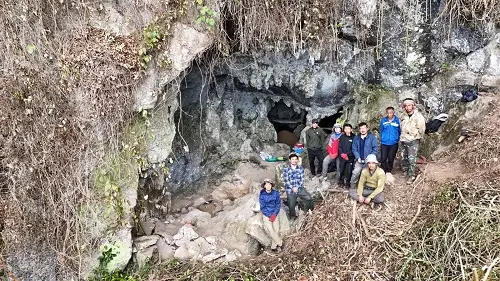
Kohima: Archaeologists have uncovered evidence of prehistoric human life hidden deep within the Naga Hills Ophiolite Belt. A joint expedition in March explored limestone caves near Chiphur village in Nagaland’s Noklak district. They found five caves and four rockshelters.
The research team included Professor Tiatoshi Jamir, Dr. Heme Lamthaiu, Dr. Limasanen Longkumer, Archaeological Research Officer Khumeng T., Robinson Huidrom, and Victoria Leyri from Delhi University. They worked alongside the Chiphur Village Council to survey the rugged terrain.
Excavations produced a haul of ancient artifacts. The team recovered cord-marked pottery, ground stone tools, and hearth remains. They also identified carbonized grains of foxtail millet (Setaria italica) and Job’s tears (Coix sp.), alongside wild animal bones. These findings suggest early inhabitants relied on a mix of hunting and farming.
Tests at the Beta Analytic Laboratory in Florida used Accelerator Mass Spectrometry to pin down dates. The Leilo Kaa rockshelter dates back roughly 3,500 years. The Kathso Kaa cave shows signs of occupation from around 1,000 years ago. These dates confirm that the sites were used continuously from prehistoric eras into historical times.
Researchers believe these findings support the theory that Northeast India functioned as a major corridor for ancient human migration. The area holds deep potential for understanding early burial practices, ceramic technology, and agricultural development. The site provides a rare look at how ancient communities survived along the Indo-Myanmar ranges.
Public Relations Officer Peter Ki stated: "The findings offer significant insights into the early history of agriculture and human habitation in Nagaland, and add to scientific understanding of Northeast India as a corridor of human migration."
Nagaland University and the state’s Department of Art and Culture plan to put the artifacts on public display. An exhibition is scheduled for October at the State Museum. It will showcase the tools and lifestyle of some of the earliest people to inhabit the Naga Hills.




Comments