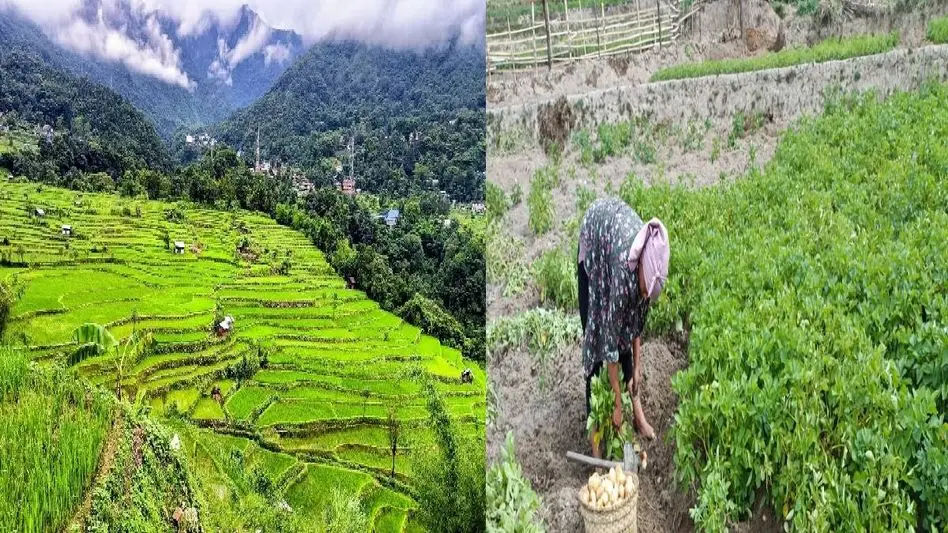
 Photo Courtesy: India Today Group
Kohima: A recent study from Nagaland University underscores how indigenous knowledge remains vital to the success of terrace farming among the Angami Naga community. While shifting cultivation is common across the hilly terrain of Nagaland, the Angami people have maintained a long-standing tradition of permanent terrace cultivation that prioritizes soil conservation, water efficiency, and organic farming methods.
The research, published in a SAGE journal, was led by scholar Ketekhoto Neihu under the supervision of Dr. Srikanth Yamsani from the university's Tribal Research Centre. The findings suggest that these agricultural systems are sustained by more than just farming techniques. Instead, they rely on a complex blend of ecological understanding, social cooperation, and cultural heritage.
Farmers in the region continue to rely on natural environmental cues to guide their seasonal work. Activities like planting and harvesting are dictated by observations of bird behavior, insect activity, and local flowering patterns. Dr. Yamsani emphasized the significance of this connection, stating, "Our study shows that Angami farmers continue to practise agriculture in close association with natural cycles and environmental indicators."
Nagaland University Vice-Chancellor Prof. Jagadish Kumar Patnaik noted that these traditional systems offer important lessons for modern agriculture, particularly as global demand for climate-resilient models grows. He stated, "The sustainability of Angami terrace cultivation rests on the harmonious integration of ecological practices, social cooperation, and cultural traditions."
Despite the long-term success of these traditions, the study highlights that farmers are increasingly confronting difficulties due to shifting rainfall patterns and broader climate variability. Researchers believe that the adaptive capacity inherent in indigenous knowledge will be essential for navigating these future environmental challenges. The team concluded that development policies should aim to integrate these traditional systems with scientific approaches to help strengthen regional food security without disrupting local cultural practices.



Comments