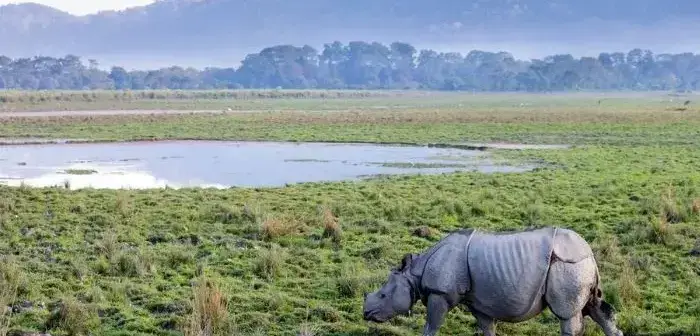
 Photo Courtesy: nenow
Guwahati: The International Union for Conservation of Nature (IUCN) issued a stern warning regarding the long-term ecological health of Kaziranga National Park. Experts flagged land-use shifts as a primary threat to the site. This arrives as the Assam government pushes to shrink the current 10-kilometer Eco-Sensitive Zone down to a range of just 1 to 3 kilometers. Conservationists are sounding the alarm. They argue this move invites industrial expansion and excessive tourism construction near the Karbi Anglong hills.
These hills remain vital for animal survival. During monsoon floods, wildlife retreats to this higher ground, which sits beyond NH-37. The IUCN 2025 Conservation Outlook, finalized on October 11, 2025, rates the park as Good with Some Concerns. While the report highlights stable rhino populations and successful anti-poaching measures, it identifies growing threats like invasive species Mikania micrantha and Eichhornia crassipes.
Industrial activity risks damaging essential animal corridors. Past efforts by the Supreme Court successfully curtailed stone mining and quarrying, but fears persist that current protections may vanish. Unplanned infrastructure, livestock grazing, illegal fishing, and riverbank erosion continue to plague the area. The report also cited the proposed expansion of the Kaziranga elevated highway as a significant risk factor.
Climate change promises to worsen these conditions. Rising temperatures and altered weather patterns will likely intensify monsoon floods, endangering both the park and its infrastructure. Addressing these issues requires immediate action. The report stated that "conservation measures that can respond to changing conditions, greater cooperation with local communities and planning that considers the wider landscape around Kaziranga" are now vital. Officials must weigh the economic desires of developers against the biological reality of the region.





Comments