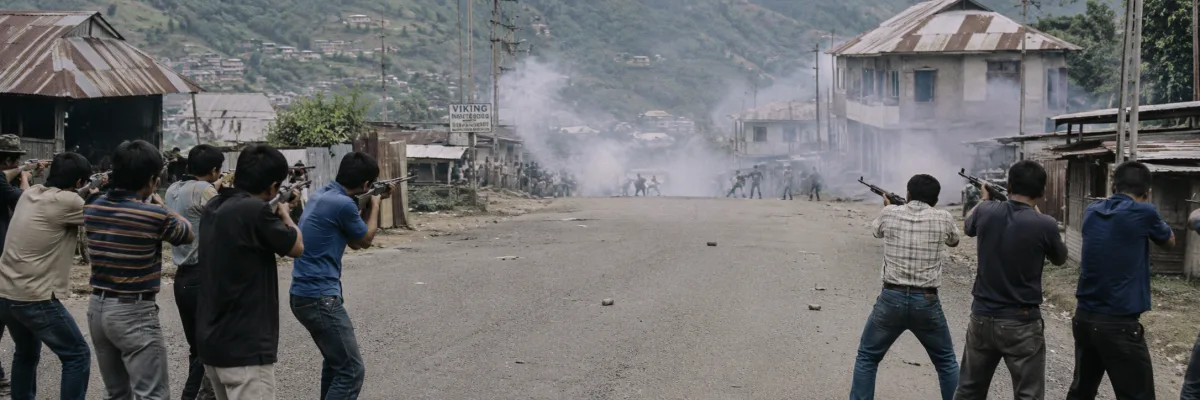
 Photo Courtesy: Representative Image
Imphal: It was a Tuesday, the kind of evening when children in Saikul would gather at church for fellowship. Dusk had settled over the village when armed men arrived from the direction of Khotaw. Some villagers welcomed them. C. Pumthang, whose house sits near the church compound, offered tea with sugar and refreshments to more than a hundred visitors who had gathered in his courtyard.
Not everyone accepted. Some of the armed men took the refreshments; others refused. Then, quietly, they began separating people into groups.
Pumzasiam and Thangchin sensed what was coming and ran. They escaped.
The children's fellowship ended around 7:30 PM. Shortly after, one of the leaders of the armed group arrived and ordered his men to force the gathered villagers toward Khotaw. They were marched to a canal and questioned.
The demand was specific and repeated: hand over members of the Zomi Revolutionary Army (ZRA) and the NSCN-IM, the Naga armed group. But according to multiple accounts from that night, no such members were present in Saikul. There was no one to hand over.
More armed men arrived. They rounded up additional elderly men and young men from the village. Pa Kampi, an elderly villager who had not been summoned, collapsed from fear and suffered a heart attack.
Near the church, terrified villagers tried to understand what was happening. But the village was already surrounded.
In total, about fifteen men were assembled and lined up in an open area. The gunmen stood roughly seven meters away. Before firing, they shone flashlights on their targets.
The first bullet struck T. Pumkhanjam, an elder. Then they opened fire for approximately five seconds.
When the shooting stopped, ten men were dead. Five others were seriously wounded, some so badly that they were nearly unrecognizable. The cries of the wounded, the screams, and the sounds of terror echoed through the village.
That night, rain began to fall, as if in mourning. Tarpaulins were hastily erected. Villagers sat beside the dying and the wounded through an endless night, listening to voices that still echo in memory: "Mother, I want water."
No funeral drums were beaten until daylight. No one had the strength.
With only painkillers and bandages, villagers did what they could for the injured. A police report was filed that same night. Officers arrived for inquiries around 7:30 AM on 25 June.
The bodies were taken for post-mortem examinations. Women and children remained in the village.
After the post-mortems, burying all ten victims in Saikul proved impractical. The YPA Headquarters was contacted for assistance. The original plan was to return the bodies to Saikul's Community Hall for mourning. Instead, they were taken to Zenhang, Lamka, where they were kept in the Community Hall before all ten were buried together in a single grave at the local cemetery. The support of the Zenhang YPA was noted with gratitude by the families.
After the burial, families returned home to chaos. There was no time to clean or rest. They were told to gather essential belongings and prepare to move.
Security concerns mounted. Many villagers were relocated to Zo Colony, Lamka, where they were sheltered at the home of Pa Khamkhanpau before being moved to the EBCC Sunday School in Lamka Tung. Food and assistance were provided.
The bloodshed in Saikul is widely regarded within the Zomi community as the trigger for what became known as the Zomi–Kuki conflict. Every year since, the people of Saikul have observed Sampas Kutt, a name derived from the phrase "Sa ikul Mi PA sal S awm KU ki T en T hat" ("Ten men from Saikul were killed by Kukis"), to commemorate those who died.
The killed victims were:
- Chinkhanlian (17), son of Nekzachin
- Tualkapthang (19), son of Pausianthang
- Nangson (16), son of the late Zelzakham
- Lamzahau (24), son of the late Vungzalian
- Lianzachin (19), son of Pauzanang
- Ginsuanlal (18), son of the late Kaizadam
- Kaizadam (50), son of the late Dongjam
- Kamkhopau (45), son of the late Lianzakham
- Khamthansang (17), son of the late Kamkhopau
- Pauminthang (31), son of the late Lianzakham
Injured:
- Pum No-a, son of Upa Ngaitunpum
- Paukhenmang, son of the late Thuampau
- Tualkhanthang, son of the late Thuampau
- Pausuanmung, son of Lalsuanthang
- Upa Jamkithang, son of the late Tongkhojam
This account was compiled from testimony recorded by C. Pumthang, a survivor present that night, who wrote it so that future generations would know what happened.
Twenty-seven years later, the rain still falls on 24 June.


Comments