
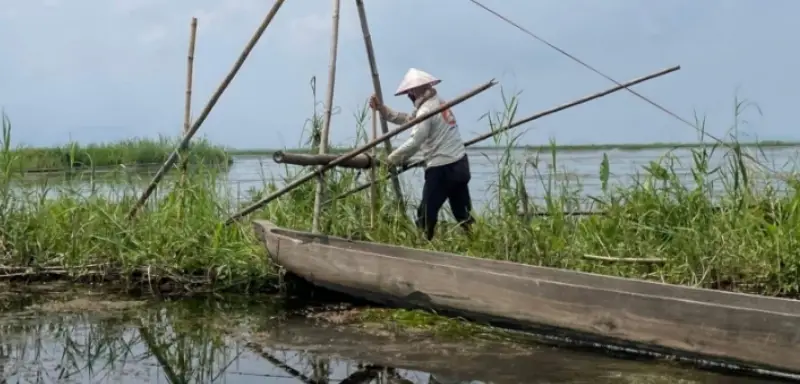
 Photo Courtesy: nenow
Imphal: Manipur’s Loktak Lake faces a brutal future. Rising temperatures and erratic monsoons are shrinking vital habitats for the rohu, a staple indigenous carp. New research in Ecological Indicators warns that the lake’s ability to sustain its fish population is rapidly failing.
Researchers used the rohu as a bellwether for the lake's overall health. Currently, only 9 square kilometers of the 287-square-kilometer wetland remain highly suitable for the fish. Projections under a high-emission scenario show this prime territory contracting by 30 square kilometers by the 2050s. The lake already suffers from pollution and disrupted water flow caused by the Ithai Barrage. This structure killed the natural cycle of flooding and nutrient distribution.
Lead study author Vicky Anand emphasized the gravity of the situation. "Fish are considered the most sensitive indicator of a water body’s health," he said. The study found that delayed monsoons extend warming periods, causing water stratification that chokes off oxygen and triggers toxic algal blooms.
Local fish populations are already in freefall. Native species like the state fish, pengba, have nearly vanished from markets. Much of what is sold as local catch now comes from hatcheries rather than the wild. Co-author Bakimchandra Oinam noted the decline, stating, "In my lifetime, I have seen Loktak transform from a largely natural wetland into a heavily regulated system."
The state government is fighting back against years of degradation. They are intercepting urban wastewater through the Nambul River conservation project. While the Manipur High Court previously froze all development around the lake, it recently granted the Loktak Development Authority permission to launch parts of a new management plan. Officials now face the task of balancing these restoration efforts against an accelerating climate crisis.




Comments