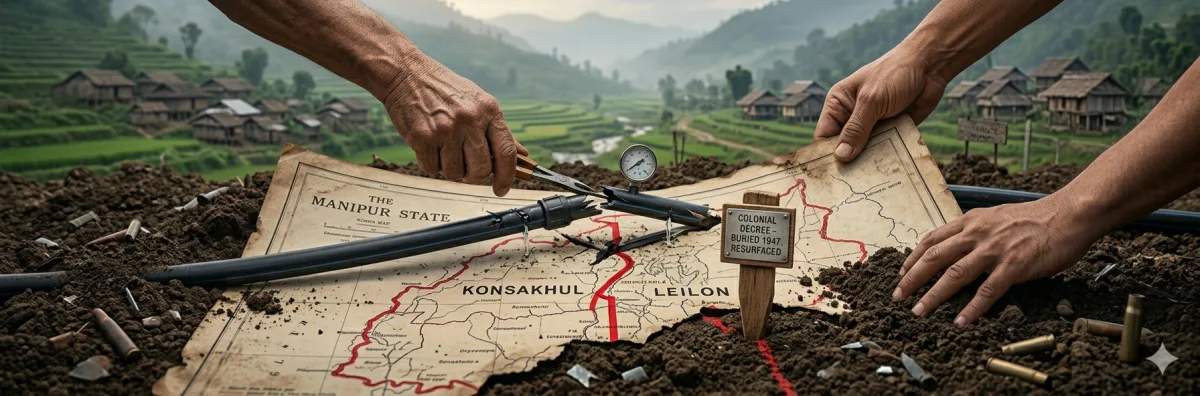
 Photo Courtesy: Representative Image
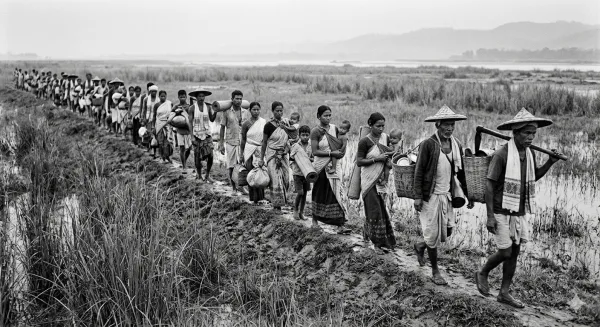
The eviction notice arrived on January 8, 2025. It gave the residents of Leilon village all 694 of them fifteen days to leave land their families had farmed for generations. The document, issued by the Konsakhul Village Authority in Manipur's Kangpokpi district, carried a chilling warning: "If there is any bloodshed spilt in the process of eviction, you will be held responsible for that."
Fifteen days. That is all the time given to a community to abandon their homes, their fields.
But to understand why this notice was issued and why it represents something far more dangerous than a village dispute we must look back. Not to January 7, 2025, when a Naga woman was allegedly assaulted by Kuki volunteers from Leilon. Not even to the broader Meitei-Kuki war that has killed over 260 people and displaced 60,000 since May 2023. We must go back much further. We must go back to the British colonial period, when the seeds of this conflict were deliberately sown.
The Colonial Origins of a Modern Tragedy
The United Naga Council (UNC), the apex body representing 20 Naga tribes, has been unequivocal in its historical narrative: "The name of their community [Kuki] was first heard when the British 'planted' them on the Naga hills between 1830 and 1840." The British found the Kukis useful as a "mercenary tribe" and utilized their "total lack of attachment to any land and landscape" to crush indigenous communities.
This is not mere rhetoric. The historical record supports it. In 1856, British Commissioner Francis Jenkins wrote to Captain Henry Bivar about the Kukis: "I have constantly heard of the bravery of some of these tribes... if they succeed in establishing flourishing villages in the fine and fertile country we are now abandoning, there would be nothing to prevent our assisting them with small guards of Sepoys... or siding them with gifts of fire arms and ammunition." The British explicitly settled Kukis as a buffer between the "timid subjects" of the plains and the "savage" Angami Nagas who raided British outposts.
In Manipur, Political Agent McCulloch played a crucial role in facilitating Kuki settlement along vulnerable frontiers. Scholar Pum Khan Pau documents that McCulloch, appointed in 1844, undertook the settlement of Kukis, allocating them lands for cultivation and recruiting them as irregular forces to man villages on exposed frontiers. James Johnstone, a later Political Agent (1877–1886), recorded in My Experiences in Manipur and the Naga Hills (1896) that "new immigrants" of Khongjai Kukis "poured into the hill tracts of Manipur in such numbers, as to drive away many of the older inhabitants."
The consequences were devastating for indigenous Naga communities. In what Naga historians call the Tingtongreh or Haokiplal, Kuki settlers went on a rampage across western Manipur, destroying over 34 indigenous Naga villages and killing over 1,000 Kabuis. In 1892, Kukis attacked Chingjaroi village, massacring 286 people mostly women and children. The village was so devastated that neighboring Naga communities had to provide marriageable women to repopulate it. This is not ancient history. This is living memory, passed down through generations.
From Buffer to Burden: The Kuki Settlement Pattern
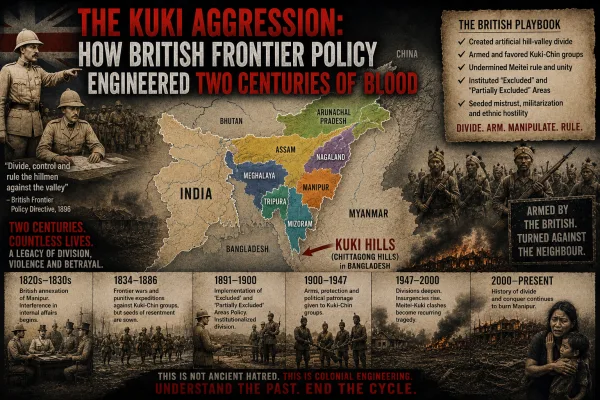
The British policy was systematic and deliberate. In 1856-57, lands were assigned rent-free for 10 years (later extended to 25 years) to any Kukis who would settle east of North Cachar beyond the Langting River. Firearms and ammunition were provided by the government. By 1860, the colony contained 1,356 inhabitants in seven villages. When the Naga Hills district was formed in 1866, these Kuki colonies were transferred with their land and amalgamated into Naga territory without the consent of the indigenous inhabitants.
The pattern repeated across Manipur. After World War II, retired Gorkha soldiers and Kuki porters for Allied forces were resettled in areas like Shepmanai (now corrupted to Saparmaina), 15 km north of Motbung, on land that originally belonged to the Lengmai Naga village without seeking permission. In 1974, during a period of President's Rule, 2,500 Kuki refugees were settled between Yaingangpokpi and Sanakeithei on land belonging to Hongman and Thawai villages. The villagers were never consulted.
This is the context in which we must understand the Konsakhul-Leilon dispute. The Konsakhul Naga community claims that the Leilon Vaiphei were allowed to settle on their ancestral land as tenants, paying taxes for years before stopping. The Konsakhul memorandum states explicitly: "Leilon Vaiphei village has been living under Konsakhul (Konsaram) ancestral land for ages paying taxes, but the Leilon village stopped paying taxes." The lease, they say, has expired. The hospitality has been abused.
The Reversal: When Tenants Claim Ownership
Here is where the contemporary crisis intersects with the historical one. The Konsakhul Naga community accuses the Leilon Vaiphei of not merely failing to pay taxes, but of something far more threatening: claiming the land as their own ancestral territory and harassing the original landowners.
This is not an isolated accusation. It reflects a broader pattern that has Naga communities across Manipur deeply alarmed. The United Naga Council has explicitly warned that the Kuki-Zo community is engaged in "blatant lies, lopsided history and fabricated information" to legitimize "imagined Kuki homeland within Naga ancestral homeland." The UNC points to the Kuki rebellion of 1917-1919, which Kuki groups have rebranded as the "Anglo-Kuki War" to suggest an independent Kuki nation existed. The Naga body calls this "one of the classic examples of their habitual lies."
The fear is straightforward and existential: communities that were settled as tenants, refugees, and buffers are now asserting themselves as indigenous landowners with ancestral rights. The Kuki National Assembly (KNA) submitted a memorandum to Prime Minister Jawaharlal Nehru in 1960 seeking a separate Kuki State. In 1989, the KNA wrote to Home Minister Buta Singh requesting training and arms for Kuki youths, vowing to "subdue the Naga Independence Movement in 5 years which the Indian army failed to execute in 40 years."
This is the immigrant dilemma that threatens indigenous communities not just in Manipur, but across the Northeast. When settled populations grow, when they acquire political organization and armed capacity, when they begin to rewrite history to claim indigenous status, the original inhabitants find themselves not merely displaced demographically but erased from their own narrative.
The January 2025 Flashpoint
The immediate trigger for the Konsakhul eviction notice was the alleged assault on a Naga woman on January 7, 2025, at K. Lungwiram in Kangchup Geljang Sub-Division. The Konsakhul Village Authority described it as a "gross violation of trust and respect" that "crossed all limits." The Leilon Village Authority denied the assault entirely, stating that "no such assault or mishandling took place at the site and time mentioned."
Regardless of the truth of this specific incident, the response reveals the depth of the rupture. The Liangmai Naga Council Eastern Zone demanded a formal apology from the Kuki community within 24 hours. The Koubru Range Liangmai Women Union imposed an indefinite bandh on SP Road, the only direct route between Kangpokpi and Churachandpur districts. The Konsakhul memorandum, addressed to the Chief Secretariat of the Manipur government, warned of "forceful eviction" and potential bloodshed.
The Committee on Tribal Unity, a Kuki-Zo body, responded with a statement that reveals how the Kuki-Zo perceive their own position: "The Liangmei Nagas of Manipur should not misunderstand our meekness in response to every of their press releases against the Kuki-Zo community, who are victims of religious and ethnic persecution from the majoritarian Meitei community... we have been defending our rights against oppression and tyranny on our culture and values; and to protect and defend our land from aggression for the past nearly 2 years alone."
This is the tragedy of Manipur in miniature. Every community feels victimized. Every community armors itself in grievance. And every grievance becomes a justification for the next escalation.
Why This Matters Beyond Manipur
The Konsakhul-Leilon dispute is not merely a local conflict. It is a warning sign for indigenous communities across India's Northeast and, indeed, across the world. The pattern is familiar: colonial powers import laborers, refugees, or settlers to serve strategic interests; the settlers establish themselves over generations; eventually, they assert political and territorial claims that challenge the indigenous population; and the original inhabitants find themselves accused of xenophobia when they resist.
In Manipur, this dynamic is compounded by armed militancy, political manipulation, and the complete collapse of state authority. The International Crisis Group noted in February 2025 that "insurgent groups have resurfaced in Manipur over the past year" and warned that failure to resolve the conflict could "destabilise other parts of north-eastern India." Security agencies blame the rift within the NSCN-IM the dominant Naga militant group for fueling new conflicts, with breakaway factions like the Eastern Flank using Kuki-Naga tensions to expand their influence.
The Kuki-Zo demand for a separate Union Territory, while understandable given their persecution by Meitei militias, directly threatens Naga territorial claims. The Nagas, who comprise roughly 24% of Manipur's population and have their own long-standing insurgency seeking "Greater Nagaland," view Kuki-Zo territorial ambitions as an existential threat to their ancestral lands. The Meitei, dominant in the valley, fear losing land to both groups. The result is a three-way deadlock in which no community trusts the others, and the state has lost all credibility as a neutral arbiter.
The Path Forward
The Kuki Social activists in Kangpokpi have pointed out that the eviction notice could violate multiple sections of the Indian Penal Code, including provisions against promoting enmity between groups and criminal intimidation. Len Haokip, a local activist, warned that "by acknowledging such a document, the Manipur Chief Secretary's office risks legitimizing hate and violence."
But simply condemning the notice misses the point. The Naga communities of Manipur are not acting out of irrational hatred. They are responding to a genuine, historically grounded fear that they are being dispossessed in their own homeland first by colonial design, then by post-colonial neglect, and now by communities that were settled as tenants asserting ownership.
Any sustainable resolution must begin with an honest reckoning with history. The British colonial policy of settling Kukis as buffers in Naga territory was not merely an administrative convenience; it was a deliberate strategy of divide and rule that has poisoned inter-community relations for nearly two centuries. The post-independence Indian state has done little to address these historical injustices, preferring to manage symptoms rather than cure the disease.
The Kuki-Zo community, for its part, must recognize that their claims to indigenous status in Naga-dominated areas are deeply contested and historically problematic. The fact that they have suffered persecution at the hands of Meitei militias does not grant them automatic rights to Naga ancestral lands. Their demand for a separate administration, while legitimate in principle, cannot be realized at the expense of other indigenous communities.
Finally, Delhi must accept that its current approach partitioning Manipur into ethnic zones, imposing President's Rule, and hoping the conflict burns itself out is failing. The deployment of 40,000 additional troops has not restored order. The creation of buffer zones has not stopped violence. What is needed is a comprehensive political settlement that addresses the legitimate aspirations of all three communities Meitei, Kuki-Zo, and Naga within a framework that respects historical rights and territorial integrity.
Conclusion
The eviction notice from Konsakhul to Leilon is a symptom, not a cause. It is the visible tip of a historical iceberg that has been growing since the British first settled Kuki communities in Naga territory nearly two centuries ago. The Kuki-Zo community's assertion of indigenous rights in Naga lands, cannot be separated from this colonial legacy. And the Naga community's resistance, cannot be dismissed as mere xenophobia.
Fifteen days. That was the deadline given to Leilon. The deadline has passed. The bloodshed, so far, has not come. But the notice remains on file. In Manipur's hills, the land itself has become a weapon, and every boundary is a battle line drawn not just in the present, but in the colonial past.
- By A. Newmai | Independent Researcher
References:
Crisis Group. "Finding a Way Out of Festering Conflict in India's Manipur." International Crisis Group, 14 Feb. 2025.
"Konsakhul Village Issues Eviction Notice to Leilon Village in Manipur's Kangpokpi." Land Conflict Watch, 24 Feb. 2025.
"Konsakhul Naga Village Issues Eviction Notice to Leilon Village as Lease Expires." Ukhrul Times, 8 Jan. 2025.
"Manipur: Konsakhul Village Authority Gives Ultimatum to Leilon Vaiphei Members After 'Assault' Incident." India Today NE, 8 Jan. 2025.
"Manipur: Why Naga-Kuki Clashes Raising Fresh Concerns." ThePrint, 25 May 2026.
"Naga Body Slams Kukis for 'Distorting' Manipur's History." The Hindu, 21 Aug. 2023.
"Kuki Immigration: On a Political Mission for Separate State." E-Pao, 26 Mar. 2026.
"Conflict Resolution of Meiteis and Kuki-Zo-Chin." Morung Express, 17 Aug. 2023.
"The Kukis of Naga Hills." Journal of North East India Studies, 2018.
"Demographical Variation and Internal Migration in the Tribal Areas." Research Review International Journals, 2019.
Johnstone, James. My Experiences in Manipur and the Naga Hills. 1896.
Pau, Pum Khan. Indo-Burma Frontier and the Making of the Chin, Lushai, Kuki and the Naga. 2019.
Mackenzie, Alexander. The North-East Frontier of India. 1884.





Comments