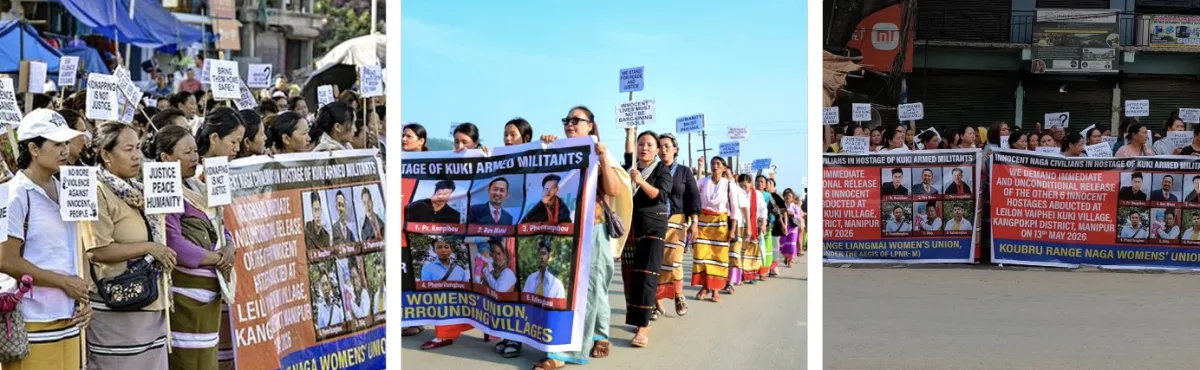
The sun had barely cleared the hills of Kangpokpi when the first shots rang out. It was Tuesday, May 13, 2026. By 10 a.m., three Thadou Baptist pastors lay dead on the Sak - Puilong (SP Road) Road between Kotlen and Kotzim, two Kuki villages strung along the Imphal–Tamenglong highway. By 10:30 a.m., eighteen Naga civilians, travelling in five separate vehicles with their wives, sisters, and an infant daughter, were intercepted at Leilon Vaiphei, a Kuki village barely minutes away. By noon, a Naga man named Wilson Thanga was dead in Noney, and his wife was bleeding on the way to hospital.
Three crimes. One morning. One district. And one government that would spend the next two weeks issuing press releases instead of arrest warrants.
I. The Pastors
Reverend Vumthang Sitlhou, Reverend Kaigoulun Lhouvum, and Pastor Paogoulen Sitlhou were not politicians. They were members of the Thadou Baptist Association, returning from a convention in Churachandpur. Their vehicle was ambushed on the hilly stretch between Kotlen and Kotzim around 10 a.m. Four others were injured. The TBAI president had recently led a peace delegation to Nagaland, trying to build a bridge between Kuki and Tangkhul Naga communities. He never got to finish that bridge.
The Hindu and India Today reported the ambush as the work of suspected armed extremists. What happened next was stranger than the attack itself. Security forces floated a theory of “mistaken identity.” The Kuki Organisation for Human Rights Trust pointed fingers at the NSCN (I-M) and the ZUF. The Naga side quietly suggested that “some Kuki extremist groups” might have staged the killings to sabotage the very peace process the pastors were building.
Then, on May 28, the Thadou Community International dropped a statement that should have stopped everyone in their tracks. It called the circulating narratives “false, baseless and misleading.” It insisted the three men “lived their lives proudly as Thadou until their final breath.” And it warned that the story of their deaths was being manipulated by people who wanted them to mean something else.
Three men of God, killed on a road that cuts through Kuki-dominated villages, in a district that the Kuki National Front has called home for nearly four decades.
II. The Husband
While the state was still counting the pastors’ bodies, Wilson Thanga of Dolang Chiru village was driving near Jouzangtek in Noney district. Allegedly, the kuki militant Gunmen ambushed his vehicle. He died at the scene. His wife survived, seriously injured, rushed to a hospital that could not save him. The Sangai Express recorded the killing. It barely made the front pages. By then, the machinery of the third crime was already in motion.
III. The Abduction
At approximately 10:30 to 11:00 a.m., five vehicles carrying Naga families from Konsakhul village and nearby areas approached Leilon Vaiphei. There were women. There was an infant. There were six men. They were not armed. They were not soldiers. They were civilians going about their morning.
What happened next is not allegation. It is sworn testimony from the fourteen hostages who survived.
The women, among them Kachiaklung Thiumai, Winiliu Thiumai, Sarah Thiumai, and Wibonliu Chawang, later told the Ukhrul Times and human rights monitors that they recognized their captors. They named the Leilon Vaiphei women group and the village chief. They described how the women were herded together, how their mobile phones were snatched, how they were blindfolded and marched to a community hall, then a school. They described the threats. The spades. The sharp iron tools carried by men who were not villagers.
And they described the separation.
The six men were dragged from their vehicles by armed militants. Their hands were tied behind their backs. Their eyes were covered. They were kicked, shoved, and driven away in vehicles that carried tools better suited for digging than for travel. The wives watched. The sisters watched. The infant’s mother watched.
The six men who never returned are:
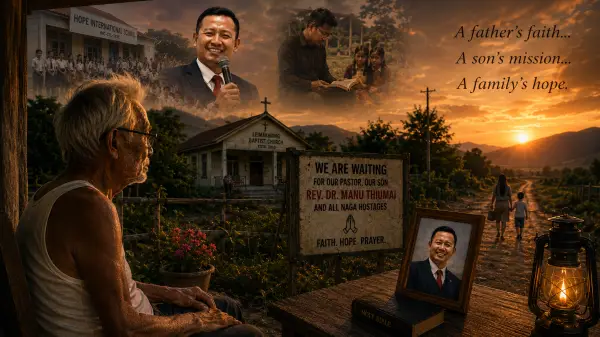
- Reverend Dr. Manu Thiumai.
- Dilip Thiumai.
- Phenrilungbou Chawang.
- Pherongwibou Thiumai.
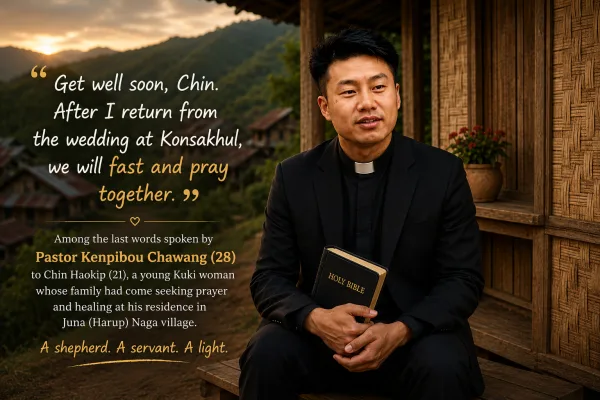
- Pastor Kenpibou Chawang.
- Kliwangbou Abonmai.
Two are pastors. All are husbands, fathers, brothers, sons. Their community has not seen them since. Their wives are still waiting.
IV. The Hostages Who Lived to Speak
Kachiaklung Thiumai is the wife of Dr. Manu. In a video-recorded interview with the Ukhrul Times, she stated clearly, calmly, devastatingly: her husband was abducted and violently taken away right in front of her eyes. She named the village. She named the women. She named the militants.
The other survivors tell the same story. The blindfolds. The community hall. The school. The threats. The Kuki armed militants who carried spades and promised death if anyone disobeyed. They can identify their kidnappers. They have offered to do so. No one has asked them to.
V. The Organizations That Lied
Here is where the official narrative begins to rot.
On May 14, 2026, a full day after the abduction, Kuki Inpi Manipur (KIM), the apex body of the Kuki tribes, issued what it called a “final and non-negotiable ultimatum.” It demanded the release of over 31 Kuki civilians "allegedly" counter detained in Senapati district and Ireng Naga. It described their captivity as “utterly unacceptable, inhuman, and barbaric.” It copied the Governor, the Director General of Police, and every district authority it could find.
But on the twenty Naga civilians taken from its own backyard, an incident that occurred before the alleged detention of the 31 Kukis, KIM said nothing. Not a word. Not a whisper.
When KIM finally spoke, it claimed to have “no knowledge” of the six missing men. The United Naga Council was blunt: “KIM’s denial, despite overwhelming eyewitness accounts, is not merely suspicious but a deliberate attempt to shield the perpetrators and cover up the truth.”
The Kuki National Organization (KNO), in a press note dated May 14, admitted that “12 Naga civilians are in the custody of Kukis.” The Village Volunteers Eastern Zone (VVEZ) admitted on May 16 that “6 Naga civilians [are] presently held in captivity.” Neither admitted what every released hostage had already stated: that the six men were separated from their families by armed militants, and that their fate was sealed long before these carefully worded press releases were drafted.
If the six men were alive, why did KIM not know? If they were dead, why did KNO admit to holding only twelve? And if the Kuki organizations had no hand in their disappearance, why did it take twelve days for the police to arrest anyone at all?
VI. The Geography of Impunity
Look at the map. Kotlen and Kotzim are not random dots. They are Kuki villages on the Imphal–Tamenglong highway, inside Kangpokpi district, what used to be called Sadar Hills before it was carved out of Senapati in 2016. Ukhrul Times and CHVN Radio both explicitly record Kotlen and Kotzim as Kuki villages.
So which armed group actually owns this turf?
The Kuki National Front, KNF, is not a visitor to Kangpokpi. It is based there. Wikipedia’s entry on the KNF states plainly that “the base of the organisation is nevertheless Kangpokpi in Manipur, India,” and that its professed goal is a separate Kukiland carved out of Sadar Hills, Churachandpur, and adjoining districts.
For decades, the KNF has run its operations inside this exact belt. The South Asia Terrorism Portal records that Assam Rifles once neutralised a KNF camp near K Sajal village in Sadar Hills. It notes that security forces killed a KNF-P cadre at Kalapahar, under Kangpokpi police station limits. It documents a designated KNF camp opened at Natheljang village in Sadar Hills. And it reports that the KNF’s own silver-jubilee address was delivered by its president, S.T. Thangboi Kipgen, from the outfit’s headquarters in Sadar Hills.
The KNF’s camps, its cadres, its headquarters, and its “president” have all been located inside the same Sadar Hills–Kangpokpi belt where Kotlen and Kotzim sit. The KNF now operates under the United People’s Front (UPF) and the Kuki National Organisation (KNO), both signatories to the government’s Suspension of Operations agreement since 2008.
So here is the question the government refuses to answer: when three church leaders are gunned down on a road that runs through Kuki-dominated villages, in a district that serves as the KNF’s own backyard, why does the investigation look everywhere except the militant group that has planted its flag there for thirty-eight years?
Kotlen and Kotzim are not just villages. They are the doorstep of an militant hub the KNF has never left.
VII. The Twelve-Day Delay
On May 25, police arrested four persons. The Hindustan Times, The Hindu, and the Times of India reported that four Kuki suspects, described variously as “village volunteers”, were apprehended for allegedly abducting the six Naga civilians, including church leaders. Chief Minister Yumnam Khemchand Singh, after meeting a UNC delegation, promised that the case would be handed over to the National Investigation Agency (NIA).
But here is what no official has adequately answered: why did it take twelve days to arrest four suspects when the crime scene, the village, and the eyewitnesses were known from hour one? Why did the Chief Minister need to “assure” an NIA probe nearly two weeks after the incident, when the abduction occurred in broad daylight and the survivors could identify their captors? And why have the chief of Leilon Vaiphei and the women of the village not been arrested when the released hostages have openly identified them?
The Naga People’s Front (NPF) put it plainly: “Who abducted the men? Who separated the husbands from their wives? How could such an incident occur in broad daylight without any knowledge of those involved?” The All Naga Students’ Association Manipur (ANSAM) has similarly slammed attempts to shield the village chief, questioning claims that he is innocent.
The government has eyewitnesses. It has names. It has locations. It has four suspects in custody. It has press statements from Kuki organizations that admitted to holding Naga civilians while denying knowledge of the six men, admissions that any investigator would recognize as red flags.
What it does not have is a credible explanation for the delay.
VIII. The Alleged Bedroom and the Battlefield
There is one more thread in this web, and it runs straight into the Chief Minister’s office.
Manipur’s Deputy Chief Minister is Nemcha Kipgen. She is a Kuki-Zo leader from Kangpokpi, and by all official accounts, she is the first woman from her community to hold the post. What official biographies rarely highlight is who she goes home to.
Her alleged husband is S.T. Thangboi Kipgen, also known as Semtinthang Kipgen. According to the South Asia Terrorism Portal and Wikipedia’s records on the Kuki National Front, he is the chairman of the KNF (President) faction, abbreviated KNF-P, and heads the United Peoples’ Front (UPF), an umbrella body that binds several Kuki armed groups operating under the government’s Suspension of Operations (SoO) agreement since 2008.
This is not a conspiracy theory. This is a matter of public record. The Ukhrul Times has documented Thangboi Kipgen’s role as KNF-P and UPF chairman. Wikipedia confirms that the KNF (President group) is under his leadership and that this faction joined the UPF, which entered the SoO pact with New Delhi and Imphal in August 2008.
So when the released hostages named KNF cadres as the men who blindfolded their husbands and dragged them into vehicles, they were naming an organization whose top leader shares a household with the Deputy Chief Minister of the state.
The response from Naga civil society was swift and volcanic. The Naga People’s Union Imphal took to the streets and submitted a seven-point memorandum demanding, among other things, the “immediate drop” of Nemcha Kipgen from the Council of Ministers. The Tangkhul Shanao Long (TSL), the apex Naga women’s body, launched what local media called a “fierce attack,” demanding she resign immediately. The All Naga Students’ Association Manipur (ANSAM) publicly questioned her appointment. Mass sit-in protests erupted in Ukhrul. Memorandums landed on the Governor’s desk. The Deccan Herald, the New Indian Express, and E-Pao all reported the same central demand: remove Nemcha Kipgen because her husband heads an armed group that stands accused of abducting and possibly murdering six Naga civilians.
How does a government claim to investigate an armed group when the second-most powerful person in that government is married to the man who leads it? How does the SoO agreement, meant to bring militants into a political process, not become a shield when the militant leader’s spouse controls the state’s Tribal Affairs and Hills portfolio? How does the NIA conduct a free and fearless probe when the chain of command it reports to includes a household linked to the prime suspects?
The government has not answered these questions. It has offered silence, or worse, the same tired assurances. But assurances do not untangle conflict of interest. Assurances do not explain why the KNF operates with impunity in Kangpokpi while its chairman’s wife sits in the cabinet. And assurances certainly do not bring back six men who were last seen with their eyes covered and their hands tied, driven away by cadres of an organization that, on paper, is supposed to be under suspension of operations.
IX. The Names They Want You to Forget
Manipur is no stranger to ethnic violence. But there is a difference between communal tension and the systematic abduction of civilians in broad daylight, followed by organizational denials that insult the intelligence of survivors. There is a difference between militant violence and a state that appears to need weeks to act on information provided by its own citizens.
The six missing Naga men are not statistics. They are husbands, fathers, pastors, and farmers. Their wives have spoken. Their community has marched. Their absence is a wound that will not heal with press releases and promises of NIA probes.
If the state is serious, it must do three things immediately: first, arrest every individual named by the released hostages, regardless of their community standing; second, subject KIM and KNO leaders to rigorous interrogation given their contradictory statements; and third, present the six men alive, or charge those responsible for their murder.
Until then, May 13, 2026, remains a day when twenty Nagas were taken, six were erased, three pastors were martyred, and a government watched from the sidelines, issuing assurances while justice remained hostage.
References
“3 Thadou Church Leaders Killed in Manipur Ambush.” India Today, 13 May 2026.
“4 Arrested for Abducting 6 Naga Civilians in Manipur.” The Hindu, 25 May 2026.
“4 Held for Abducting Six Naga Civilians in Manipur.” Hindustan Times, 25 May 2026.
“4 Suspected Village Volunteers Held for Abducting 6 Naga Civilians in Manipur.” The Times of India, 25 May 2026.
ANSAM. “ANSAM Questions Appointment of Nemcha Kipgen.” Ukhrul Times, 2026.
“Eyewitness Accounts from 14 Released Hostages Recount Leilon Vaiphei Abduction.” Ukhrul Times, 2026.
“KIM Issues Final Ultimatum Over Detained Kuki Civilians.” E-Pao.net, 14 May 2026.
“Kotlen and Kotzim Are Kuki Villages in Kangpokpi District.” Ukhrul Times, 2026.
“Kuki National Front.” Wikipedia, Wikimedia Foundation, 2026, en.wikipedia.org/wiki/Kuki_National_Front.
“Kuki National Front (KNF).” South Asia Terrorism Portal, Institute for Conflict Management, 2026, www.satp.org.
“Manipur: Naga Groups Demand Removal of Deputy CM Nemcha Kipgen.” Deccan Herald, 2026.
“Naga Groups Demand Sacking of Manipur Deputy CM Nemcha Kipgen.” The New Indian Express, 2026.
“Naga People’s Union Imphal Submits Memorandum Demanding Removal of Nemcha Kipgen.” E-Pao.net, 2026.
“NPF Questions Abductors of Six Naga Men.” Ukhrul Times, 2026.
“S.T. Thangboi Kipgen Is Chairman of KNF-P and UPF.” Ukhrul Times, 2026.
Thadou Community International. “Thadou Community International Refutes False Narratives Surrounding the Killing of Thadou Church Leaders.” Thadou Community International, 28 May 2026. Media release.
“Three Thadou Church Leaders Killed in Manipur Ambush.” CHVN Radio, 13 May 2026.
“Three Thadou Church Leaders Killed in Manipur Ambush.” The Hindu, 13 May 2026.
“TSL Demands Resignation of Nemcha Kipgen.” Ukhrul Times, 2026.
“UNC Accuses KIM of Shielding Perpetrators in Naga Hostage Crisis.” Ukhrul Times, 2026.
VVEZ. “VVEZ Statement on Hostage Crisis and Inter Community Relations.” Ukhrul Times, 16 May 2026.
“Wilson Thanga Killed, Wife Injured in Noney Ambush.” The Sangai Express, 13 May 2026.
Zimik, K. Timothy. The Abduction and Murder of 6 Naga Civilians. 29 May 2026. Unpublished memorandum.
---
-- By A. Newmai | The author is an independent researcher focusing on governance and ethnic conflict in Northeast India.

Comments