 Photo Courtesy: India Today Group
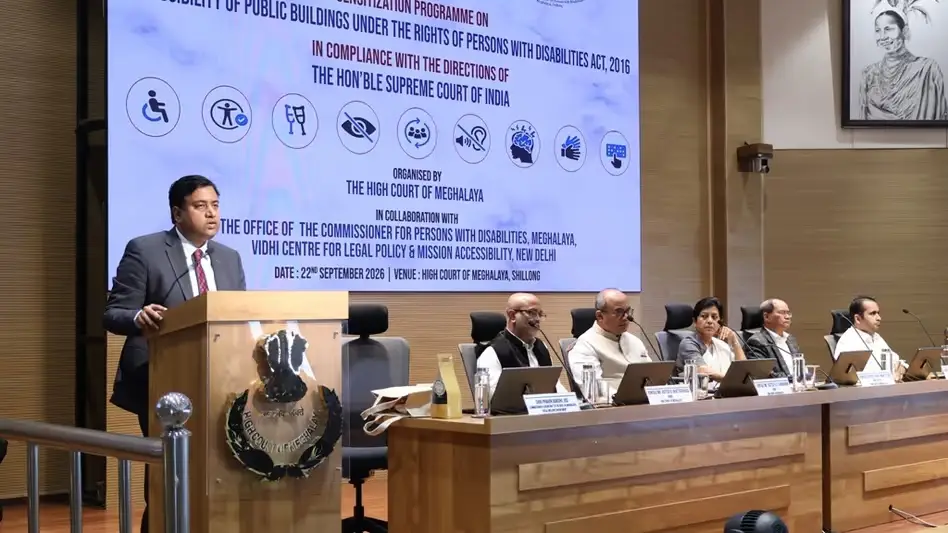
Shillong: Chief Justice Revati Mohite Dere of the Meghalaya High Court has demanded strict compliance with accessibility norms for all public buildings. She ruled that authorities must withhold construction permits unless a building plan includes a formal accessibility certificate. The High Court hosted a sensitisation programme in Shillong this week to address the persistent failures in implementing the Rights of Persons with Disabilities (RPwD) Act, 2016.
The event was organized alongside the Office of the Commissioner for Persons with Disabilities, the Vidhi Centre for Legal Policy, and Mission Accessibility, New Delhi, following specific Supreme Court mandates. Justice Dere dismissed the notion that accessibility is a charitable act. It is a constitutional right. She warned that failures in enforcement leave thousands of citizens behind, noting that the 2011 Census identified over 44,000 persons with disabilities in Meghalaya alone.
Engineers and architects must integrate universal design principles from the blueprint stage. Retrofitting remains a secondary, failing strategy. Justice Dere pointed to common failures, including steep ramps and toilets repurposed as storage rooms. "A door is not accessible if it needs another person to open it," she stated. The Chief Justice also noted that "Guidelines cannot be voluntary when dignity is mandatory."
Pravin Bakshi, Commissioner and Secretary of the Social Welfare Department, confirmed that accessibility is a legal requirement. Authorities have already completed access audits across 15 district courts and six district prisons and correctional homes. The state must now embed these standards into all future planning permissions, construction, and maintenance. Officials must also expand these efforts beyond physical structures to include digital services, transportation, and public communication.
Justices H.S. Thangkhiew, B. Bhattacharjee, and W. Diengdoh joined the session. Representatives from the police and social welfare departments also attended. Experts provided training on the Harmonised Guidelines and Standards for Universal Accessibility in India, 2021, to ensure officials understand how to remove physical barriers that block fundamental access to justice, employment, and education.


Comments