 Photo Courtesy: Representative Image
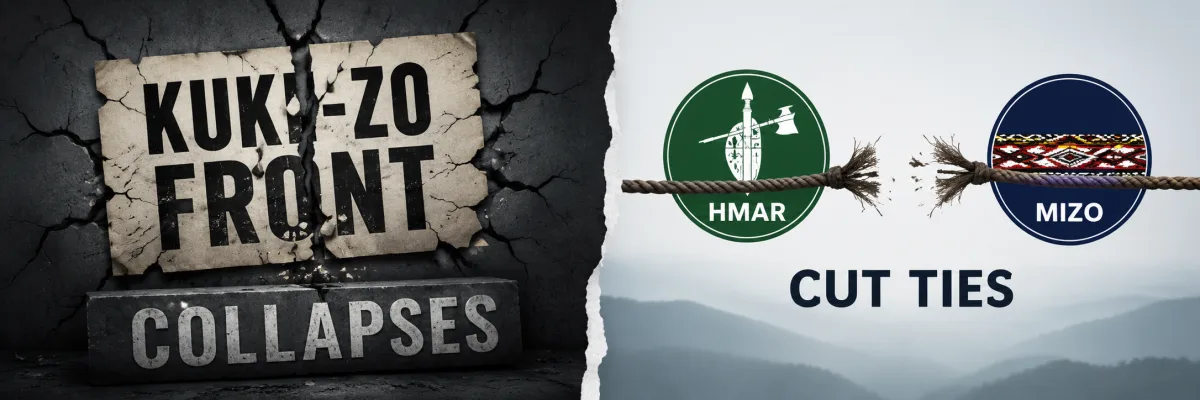
The Kuki-Zo Council, formed in October 2024 as a political successor to the Indigenous Tribal Leaders' Forum (ITLF), has unravelled within eighteen months. On June 24, 2026, the Mizo People Convention (MPC) formally withdrew from the ITLF, citing constitutional provisions and pulling its president K. Lalbiaksanga from the ITLF chairmanship he had been elected to occupy for the 2026-2027 term. Five days later, on July 1, 2026, the Hmar Inpui followed suit, issuing a notice that the Council had "not evolved into the common political platform originally envisaged." These exits are not administrative reshuffles. They expose a structural fracture that has plagued Kuki-Zo unity for decades: the unresolved tension between Thadou-Kuki political dominance and Zomi tribal assertions of distinct identity.
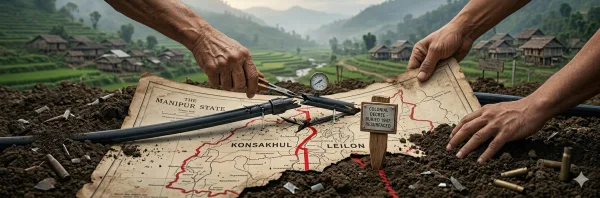
The roots of this fracture run deep. The term "Kuki" is a colonial imposition, applied by British administrators to a broad swathe of Chin-Kuki-Mizo language speakers. After independence, many tribes rejected the label. The Old Kukis separated out during the 1940s, and by the 1990s most non-Thadou tribes had gravitated toward a "Zomi" umbrella, leaving Thadou Kukis as the primary bearers of the "Kuki" identity. This nomenclature dispute was never merely semantic. It carried territorial and political weight, particularly in Churachandpur district, where competing claims to land, representation, and militant taxation authority turned identity into a zero-sum contest.
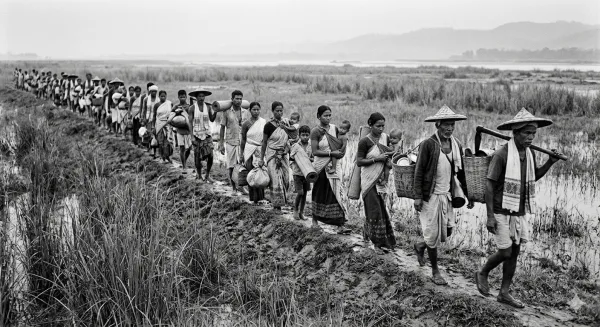
The Kuki-Paite conflict of 1997-1998 stands as the bloodiest manifestation of this divide. On June 24, 1997, militants of the Kuki National Front (KNF) lined up and shot ten to thirteen Paite villagers in Saikul, an act that the Paite community read as an assertion of Kuki dominance over Zomi-inhabited territory. The ensuing seventeen months of violence killed 352 people, destroyed over fifty villages, and displaced approximately fifteen thousand individuals across Churachandpur. The Paite response was the formation of the Zomi Revolutionary Army (ZRA), explicitly created to defend Zomi tribes from what it termed the "onslaught" of Thadou-Kuki encroachment. A peace accord in October 1998 formally recognised "Kuki" and "Zomi" as separate identifiers, but the underlying power imbalance remained unresolved. Gangte and Hmar tribes subsequently left the Zomi umbrella, and factional splinters proliferated on both sides, indicating that the truce had papered over rather than healed the structural rift.
The current rupture replays these older patterns in a new key. The Zomi Council, at its General Assembly in May 2024, passed Resolution No. 1 formally rejecting "Kuki-Zo" as a legitimate collective identity. In August 2025, it issued a strongly worded statement declaring the Kuki-Zo Council "unwelcome" in Zomi-inhabited areas, particularly in Churachandpur (Lamka). It accused Assam Rifles of escorting KZC delegations through Zomi territory and warned against the deployment of armed guards in residential areas, which it said posed "a direct threat to the security and well-being of innocent bystanders." The Zomi Council's position is categorical: NH-2 and NH-102B pass through Zomi land, and any discussion of their use without Zomi participation is "obsolete and untenable."
This territorial assertion is inseparable from the question of who speaks for whom. The ITLF, formed in June 2022, brought together eight tribal bodies. In theory, this was an inclusive federal structure. In practice, leadership has tended to concentrate in hands acceptable to the Kuki Inpi and its political allies. The Kuki-Zo Council's own leadership roster, announced in October 2024, placed Henlianthang Thanglet (Vaiphei) as chairman and Ch. Ajang Khongsai as chief of the governing council. While these are non-Thadou names, the Council's political alignment with the Kuki Inpi Manipur, which endorsed its demand for separate administration in January 2026, suggests that the Kuki-Zo label functions as a Thadou-Kuki political vehicle repackaged for broader tribal consumption.
The Thadou dimension complicates the picture further. The Thadou Inpi Manipur (TIM), in an August 2025 press release, accused "Kuki supremacists and militants" of issuing death threats to Thadou leaders and disbanding Thadou organisations during the 2023 crisis. TIM insists that the Thadou people, numbering approximately 216,000 in Manipur, are distinct from the "Any Kuki Tribes" category that accounts for only 28,000 people. The Thadou Convention of 2024 formally rejected the Kuki label as a colonial misidentification and condemned what it called "escalating Kuki supremacy and Kuki supremacist agenda" perpetrated against Thadou people since the 1970s by Kuki armed militant groups, politicians, and civil society organisations. Yet the Thadou Inpi General Headquarters, in a November 2024 statement, dismissed this move as an "emotional outburst" driven by "supremacist mentality," revealing that even within the Thadou community, the question of Kuki affiliation remains contested. What is clear, however, is that a significant Thadou faction now explicitly frames Kuki identity not as an ethnic category but as a "political ideology" and a "separatist and extremist" project from which Thadous must distance themselves.
What unites the Zomi Council, the Hmar Inpui, and the Mizo People Convention in their recent withdrawals is a shared suspicion that the Kuki-Zo framework subordinates their identities to a Kuki political project. The Hmar Inpui's July 1, 2026 notice explicitly states that the Council failed to become the "common political platform originally envisaged." The MPC's June 24, 2026 circular declared continued membership "no longer feasible" and withdrew Lalbiaksanga from the ITLF chairmanship. These are fundamental rejections of the premise that a Kuki-led umbrella can equitably represent tribes who have spent decades asserting their separateness from the Kuki identity.
The implications for the Naga question add another layer. During the 2023-2025 ethnic violence, the Kuki-Zo coalition positioned itself against the Meitei community and, by extension, in opposition to Naga territorial claims in the hill districts. The Zomi Council's August 2025 statement accused the KZC of pursuing a "divisive agenda" and warned against allowing Kuki-Zo armed personnel into Zomi areas. Analysts at the Observer Research Foundation have noted that while Kuki organisations demand a separate state or Union Territory, Zomi Council and Suspension of Operation groups have historically pressed for autonomy within Manipur, not secession from it. This divergence suggests that Zomi tribes may be reluctant to sign on to a Kuki-Zo political project that targets Nagas as adversaries, particularly when Zomi communities have their own complex histories of coexistence and conflict with Naga groups in the border regions.
The Kuki-Zo Council now faces a credibility crisis that no leadership reshuffle can fix. The ITLF, its predecessor, had already seen the Zomi Revolutionary Front defect to the Kuki National Organisation fold in the early 2000s, and the United Socialist Revolutionary Army break away in 2005 over Vaiphei grievances against Zomi dominance. The current exodus of the MPC and Hmar Inpui indicates that these centrifugal forces operate not only at the militant level but within the overt political sphere as well. The Council's January 2025 meeting with Union Home Affairs officials, where it submitted demands for separate administration, now looks like a delegation representing a shrinking constituency rather than a unified tribal front.
The official position, as articulated by the Kuki Inpi Manipur in January 2026, holds that the Kuki-Zo Council's demand for a Union Territory reflects the "collective will, democratic aspirations, and lived realities of the Kuki-Zo people." Against the documented evidence of serial withdrawals by Zomi-affiliated tribes, this claim of collective will appears increasingly aspirational. The "unified position" KIM asserts exists in theory, but the practice of Hmar, Mizo, and Zomi bodies walking out suggests that the Kuki-Zo framework is experienced by many as a mechanism of Kuki political consolidation rather than genuine federalism.
The structural pattern is clear. Every attempt to build a Kuki-Zo or Kuki-Zomi political umbrella has eventually foundered on the same reef: the unwillingness of alleged Thadou-Kuki elites to cede meaningful leadership share, and the corresponding unwillingness of Zomi tribes to accept subordination under a Kuki identity they regard as externally imposed and politically domineering. The 1997-1998 conflict proved that this tension could turn lethal. The 2026 withdrawals prove that it remains politically potent even under the pressure of a shared external threat from the Meitei community. The Kuki-Zo Council is not merely facing a leadership crisis. It is confronting the historical reality that the "Kuki-Zo" identity, however inclusively framed, cannot paper over a power imbalance that Zomi tribes have resisted for three generations.
-- By A. Newmai | Independent Researcher
SOURCES CONSULTED
"Kuki-Paite Conflict in Manipur: Various Perspectives." Economic and Political Weekly, vol. 34, no. 10/11, 1999, pp. 599-606. JSTOR, www.jstor.org/stable/4407720.
"Kuki National Front." South Asian Terrorism Portal, Institute for Conflict Management, www.satp.org/satporgtp/countries/india/states/manipur/terrorist_outfits/kuki_national_front.htm.
"Thadou Inpi Manipur Clarifies Kuki Is Not an Ethnic Identity but a Political Ideology." India Today NE, 6 Aug. 2025, www.indiatodayne.in/manipur/story/thadou-inpi-manipur-clarifies-kuki-is-not-an-ethnic-identity-but-a-political-ideology-1257002-2025-08-06.
"Thadou Inpi Manipur Rejects Kuki Inpi Provocative Allegations." E-Pao, 12 Aug. 2025, e-pao.net/epSubPageExtractor.asp?src=news_section.Press_Release.Press_Release_2025.Rejects_Kuki_Inpi_Provocative_Allegations_20250812.
"Thadou Convention 2024: Historic Resolutions." Scribd, 2024, www.scribd.com/document/787134131/Thadou-Convention-2024.
"Thadou Tribe Rejects Kuki Label in 2024 Convention." GK Today, 4 Nov. 2024, www.gktoday.in/thadou-tribe-rejects-kuki-label-in-2024-convention/.
"'We Are Not Kukis': Manipur Community Rejects British-Era Tag." Times of India, 3 Nov. 2024, timesofindia.indiatimes.com/india/we-are-not-kukis-manipur-community-rejects-british-era-tag/articleshow/114896774.cms.
"Thadou Inpi Slams TCI as 'Unmandated' Group." The Hills Journal, 6 Nov. 2024, www.thehillsjournal.com/thadou-inpi-slams-tci-as-unmandated-group-labels-thadou-is-not-kuki-slogan-as-an-emotional-outburst/.
"Kuki Inpi Manipur Rejects Thadou Inpi Delegation to Imphal Peace Talks." Ukhrul Times, 8 Aug. 2025, ukhrultimes.com/kuki-inpi-manipur-rejects-thadou-inpi-delegation-to-imphal-peace-talks/.
"Thadou Inpi Manipur Opposes SoO Extension." Virthli, 4 Sept. 2025, www.virthli.in/2025/09/thadou-inpi-manipur-opposes-soo.html.
"Zomi Council Rejects Kuki-Zo Identity, Warns Council Against Operating in Zomi Areas." The Sangai Express, 28 Aug. 2025, www.thesangaiexpress.com.
"Hmar Inpui Exits Kuki-Zo Council Over Lack of Inclusivity." NEWire.in, 1 July 2026, newire.in/articles/hmar-inpui-exits-kuki-zo-council-over-lack-of-inclusivity.
"Mizo People Convention Pulls Out of ITLF, Cuts Every Tie with Kukis." NEWire.in, 24 June 2026, newire.in/articles/mizo-people-convention-pulls-out-of-itlf-cuts-every-tie-with-kukis.
Kuki Inpi Manipur. "Press Statement on Kuki-Zo Council's Demand for Separate Administration." Kuki Inpi Manipur, 15 Jan. 2026.
Thadou Inpi General Headquarters. "Press Statement on Thadou Convention 2024." Thadou Inpi, 18 Nov. 2024.
Zomi Council. "Resolution No. 1: Rejection of Kuki-Zo Identity." Zomi Council General Assembly, May 2024.
Zomi Council. "Statement on Kuki-Zo Council Operations in Zomi Areas." Zomi Council, 28 Aug. 2025.

Comments