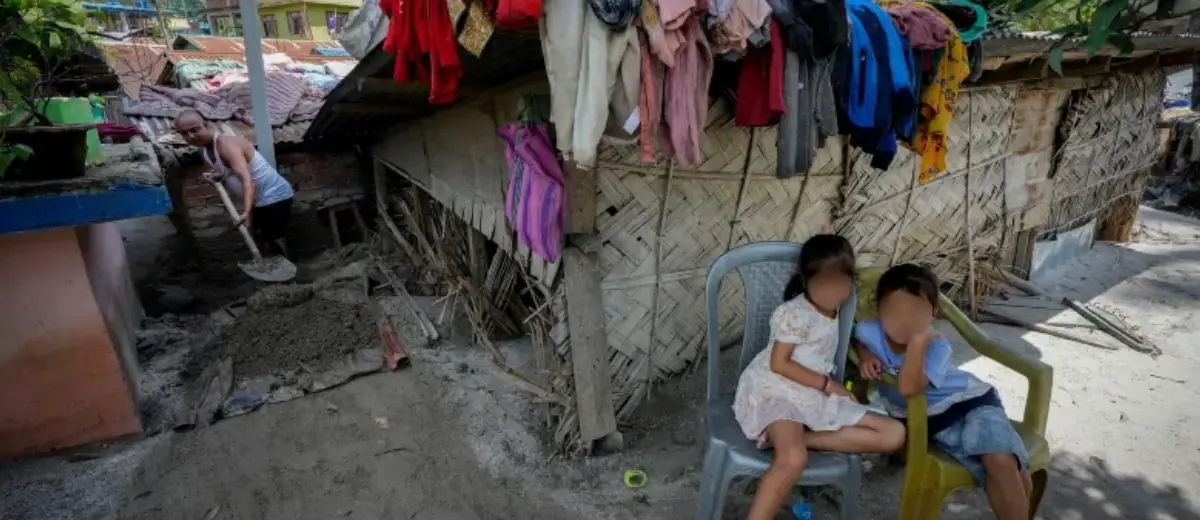
 Photo Courtesy: nenow
Gangtok: Three years after a catastrophic Glacial Lake Outburst Flood ravaged the Teesta river region, hundreds of survivors remain trapped in temporary shelters. The disaster, triggered by the October 2023 breach of South Lhonak Lake in Sikkim, impacted 80,000 people. A Science journal study reported that 270 million cubic metres of sediment surged downstream. Riverbeds in Kalimpong rose by up to 14 metres.
Displaced families continue to live in squalor. In Teesta Bazaar, ten families occupy the unfinished Haat Ghar building, while 32 others from Melli endure life in dilapidated forest-land shacks at Labar Bhotay. Rats, snakes, and rain are daily threats. Residents fear eviction as no permanent land has been allocated. Bijay Pradhan, 36, now a daily-wage labourer, reflected on his displacement: “When the flood took everything from me, it took more than my home and livelihood, it took away the place I once had in society. People look at us differently now. The relationships and respect we once had are no longer the same. I am not a beggar, and I was never born into a life like this.”
Early warning systems failed the victims. Although sensors were planned for the South Lhonak and Shako Cho lakes, they were not installed when the flood hit. The region has since faced consecutive floods in 2024 and 2025. Praful Rao, founder of the group Save The Hills, warns that the time for mitigation is vanishing. “The winter dry season is when flood mitigation work must happen. Once the monsoon arrives, working in flood-prone areas becomes almost impossible,” Rao said.
Recovery remains fragmented by political infighting. While Sikkim provided rental assistance and housing schemes, West Bengal never declared the 2023 event a disaster. Compensation remains a point of contention. Initial assessments counted 550 damaged houses, but subsequent surveys produced conflicting figures. Madan Chettri, head of the Teesta Sangrakshan Mancha, confirmed that a re-survey identifying 116 homes for reconstruction is still awaiting state finance department approval.
The Teesta river itself is increasingly unstable. Decades of road construction and deforestation have worsened erosion. Despite the ongoing uncertainty, survivors persist. Some residents in Teesta Bazaar refuse to repair homes the river claims every monsoon. Others, like Pradhan, maintain a fragile optimism. He is still waiting for a permanent solution to give his children a secure future.




Comments